Tampilkan postingan dengan label love interest. Tampilkan semua postingan

Rabu, 19 Februari 2014

The Hero and The Dream Girl

“Any delusions I once had about me being the protagonist of some predestined epic quest have gone the way of boy bands.” So says the last man on Earth, halfway through an epic quest of which he is certainly the protagonist. What Yorick is doing, however, is confusing the protagonist for the hero, which is what he really wants to be. In his head, he’s a dashing space captain, a barbarian warrior, and a slick noir detective: a hyper-masculine ideal who drives the plot and gets the girl. In reality, he’s surrounded by women who arguably have far better claim to the title of “hero.”


There’s Dr. Allison Mann, who solves the main problem of the series by restoring men to the planet. In fact, the climax of the gendercide plot revolves entirely around her and her relationships, while Yorick remains strapped to a hospital bed, unable even to understand most of what’s going on, let alone do anything to stop it. In the pivotal moment, he’s little more than a damsel in distress, rescued one more time by one of two women who have been saving his life for five years. There’s Agent 355, the bodyguard responsible for protecting Yorick, who is again figured in a role usually occupied by a woman. While he struggles with the possibility that he may not be the hero of the story, she busies herself with the actual heroics, all while trying to resist the corrupting influence of the violence that comes with survival in a dystopian world.


And then, of course, there’s the real reason why Yorick can never be the hero in his own story: the position was filled before he was born.


Hero Brown
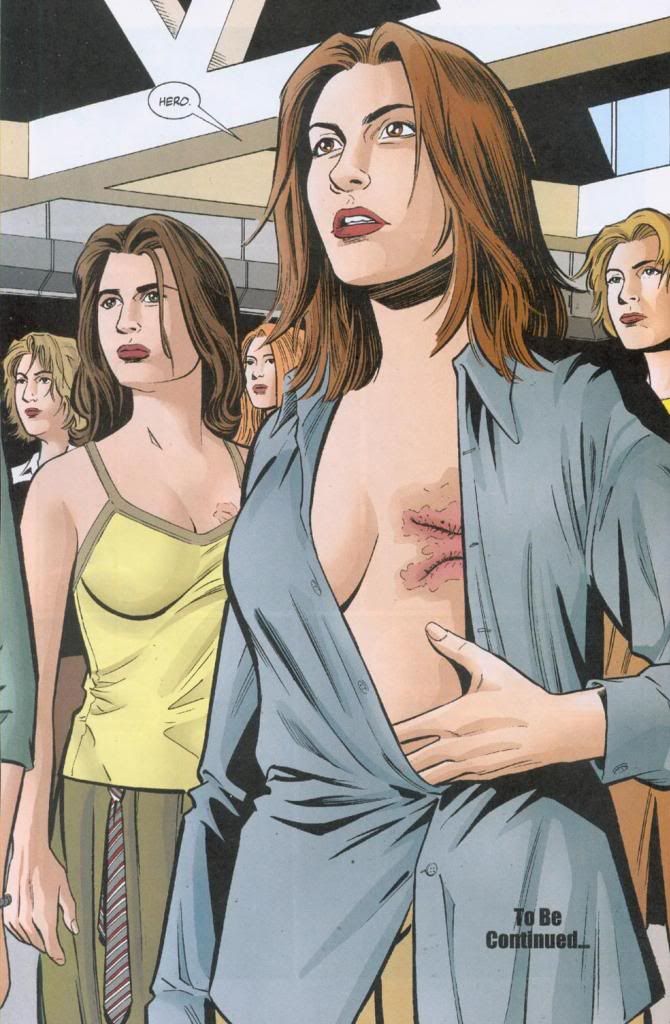

Like Yorick, his older sister, Hero, is named after an obscure Shakespearean character: Beatrice’s sweet, spineless cousin from Much Ado About Nothing. The irony of her brother’s name, which comes from a man who dies before everyone else, instead of after, is echoed in her own. While her namesake swoons in the face of accusations of premarital sex, Hero Brown is introduced having sex in an ambulance while on duty. Still, as Yorick observes, “In a weird way, Hero and I sort of grew into our names. She got a gig as an EMT… I became a worthless joker.” For Hero, the Shakespearean connection, while amusingly ironic, is less relevant than the modern connotation.


Hero is Yorick’s most obvious foil. They look incredibly similar, and they both entertain, at one point or another, aspirations of becoming a writer. Most importantly, however, they both embark on a quest; while the brother has the designation of protagonist, it is the sister who goes on the hero’s journey.


According to The Hero with a Thousand Faces by Joseph Campbell, the hero’s journey -- also known as the monomyth -- is the journey taken by the archetypal hero in mythology. This hero is usually male, and Campbell later argued that this was because “all of the great mythologies and much of the mythic story-telling of the world are from the male point of view. When I was writing The Hero with a Thousand Faces and wanted to bring female heroes in, I had to go to the fairy tales. These were told by women to children, you know, and you get a different perspective. It was the men who got involved in spinning most of the great myths. The women were too busy; they had too damn much to do to sit around thinking about stories.” There is… a lot to dissect in that comment, but what is most relevant to this analysis is Campbell’s identification of the limited narrative space that exists for heroic women. You don’t have to look much further than the Valentine’s card displays to see the difference between boys, who learn that they can be monsters and pirates and cars and superheroes, and girls, who are told that they can only be fairies and princesses. With her arc, Hero pretty much punches that gender division in the face.


The hero’s journey is split into three parts: Departure, Initiation, and Return, and it begins with the call to adventure. For Hero, that comes just after the plague strikes. She has just watched the man she loves die in her arms when a fellow EMT tells her that they have to help the living. Hero refuses, saying, “No. They can help themselves.” She then spends several months journeying from Boston to Washington, D.C., battling starvation as she treks across a post-apocalyptic landscape in order to find the last of her family.
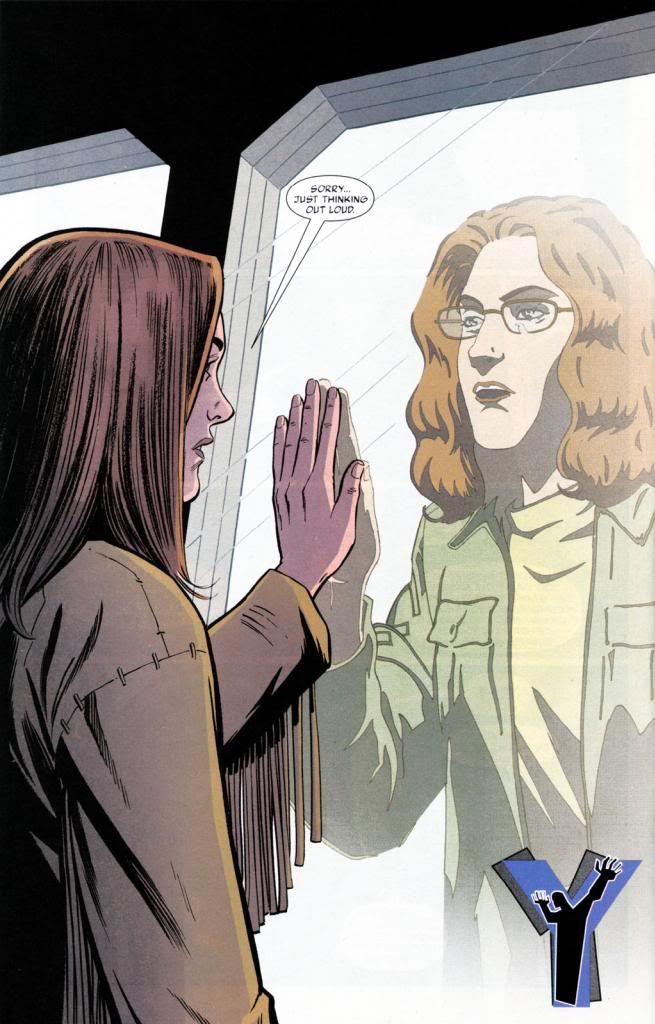

Along the way, she runs into what Campbell terms “supernatural aid,” in this case the leader of the Amazons. The Amazons are a group of women who said good riddance to the end of mankind and ushered in the new matriarchy by blowing up all the sperm banks. They’re ultra-violent, man-hating straw women the likes of which only Fox News could dream up, though the narrative humanizes them by showing us Hero’s rise through the ranks. She is recruited by the leader, Victoria, when she sees a starving, almost feral Hero slice an Amazon’s face open with a tin can. Victoria rewards her with food for this desperate act and, when Hero tells her she’s looking for her mother, Victoria replies, “And found her you have.”


In the aptly named flashback issue, “Hero’s Journey,” we learn that Hero is particularly susceptible to the controlling influence of others. Before the plague, she was involved with “this constant parade of losers and… quasi-abusive scumbags” as she searched for the love and validation that she felt was missing from her father. Just when she thought she had found someone who truly appreciated her, a global extinction event took him away. Many fictional women share Hero’s tendency to trade agency for validation; the difference here is that the narrative overtly condemns this trait, instead of glorifying it as is the case in many a YA romance.


Accordingly, while Victoria serves as Hero’s mentor, protecting her and teaching her how to survive in the new world, she does so as a corrupting influence. She forces Hero to kill an innocent woman to prove her loyalty, and this murder has a profound psychological effect, triggering Hero’s long battle with psychosis. This could be read as a rather unpleasant version of Campbell’s “crossing of the first threshold” into the world of adventure. The next time we see her, Hero muses aloud that “it is so easy to kill someone. Easier than doing laundry. It… It even smells like laundry. I’ve done it. Have you done it? Killing, I mean, not laundry. Heh.” The effects of her psychosis only worsen after she witnesses Victoria’s death and kills the person responsible. By this point she is also suicidal, asking Yorick to kill her: “All you have to do is make a fist. The bullet does the hitting for you.”


After this bloody showdown, Hero goes into the “belly of the whale,” otherwise known as the prison at Marrisville. According to Campbell, “this popular motif gives emphasis to the lesson that the passage of the threshold is a form of self-annihilation… Instead of passing outward, beyond the confines of the visible world, the hero goes inward, to be born again.” This is precisely what happens to Hero, who spends her time in prison being deprogrammed. When she emerges, she is ready to continue her journey down the “road of trials.”


This is the point where Hero’s story becomes even more subversive, as she dons the trappings of Hollywood’s masculine heroism. When we see her next, she’s wearing a sort of modern cowboy outfit, complete with hat and six-shooter. Having left the prison some time earlier, she’s on a mission to save Yorick from Agent 355, whom their mother now believes to be a shady character. On her way through Kansas, she questions the owner of a brothel, who assures her that they operate inside the law. “I don’t,” Hero replies, every inch the cool Western lead. When she finally catches up to Yorick, she shoots and shatters a sword, only slightly undermining this feat of sharp shooting by pointing out that she was aiming for the attacker’s face. When he asks her if she plans to kill herself, she states, “I’d rather try to make up for some of the horrors I inflicted on the world before I off myself,” framing her journey as a road to redemption.


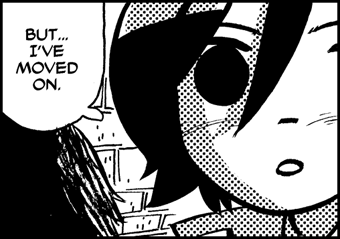
This stage of her arc is integral to Hero’s development, representing both her reconciliation with Yorick and her final rejection of Victoria. The former is important for mostly technical reasons; while she’s still perceived as an antagonist, it’s basically impossible to make Hero a hero. The latter is the most difficult trial on a road full of them. Even after her deprogramming, Hero hears Victoria’s voice in her head and sees her in delusions. On these occasions, Victoria urges her to kill Yorick and destroy every chance of restoring men to the planet. However, when she has the perfect opportunity to do just that, she chooses instead to resist. We see her in her own mind, still agonizing over one of the women she killed. Victoria urges her to kill both Yorick and Allison, and when she recites the reasons why the men deserved to die, Hero calmly tells her that she’s heard all of that before. Victoria then resorts to reminding Hero of the sexual abuse she suffered at her grandfather’s hands. Hero assures her that she remembers, but that she has moved on… then she stabs Victoria through the eye with the arrow Hero used to kill Victoria’s murderer. She turns the violence that Victoria instilled in her back on Victoria in order to rid herself of these same violent urges. In this moment, she also vanquishes the last controlling influence in her life, earning the freedom to live on her own terms.


The next stage of her journey along the road of trials begins with a letter that Yorick asks her to deliver to Other Beth, a woman he met on his own journey. When Hero finds her, Beth is heavily pregnant with Yorick’s child; by the end of the issue, Hero offers to take her along with her, telling Beth that she can provide medical help. Although Beth doesn’t let Hero know, it turns out that the letter Yorick sent asked her to be a friend to Hero. As they travel back across the United States, Hero and Other Beth pick up three more companions: Russian secret agent Natalya Zamyatin, astronaut Ciba Weber, and Ciba’s infant son, Vladimir Jr., the first boy born post-gendercide. Despite Natalya’s superior training, it is Hero who leads the group as they make their way across the Atlantic Ocean to return Vlad to his father’s homeland. Her task is incredibly difficult and its success equally impressive; while Yorick can disguise himself as a woman, there’s not much anyone can do to hide two babies whose existence should be impossible.
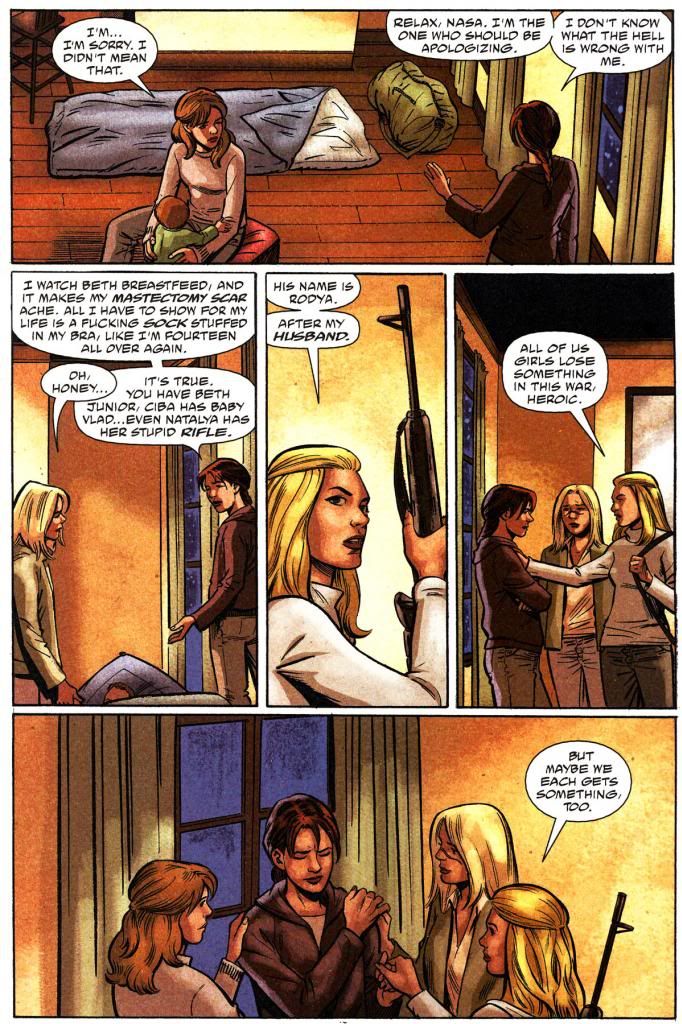

A hero usually completes his journey with a prize to keep and new knowledge to share when he arrives home, and Hero is no exception. Near the end of the journey, Hero and her friends are holed up in Paris, trying to find Yorick. Frustrated, Hero laments her solitary status: “I watch Beth breastfeed, and it makes my mastectomy scar ache. All I have to show for my life is a fucking sock stuffed in my bra, like I’m fourteen all over again.” She sees their treasures as symbols of accomplishment: motherhood and romantic love, represented respectively by the two children and Natalya’s rifle, named for her late husband. From her perspective, her quest is over and she has nothing to show for it. Natalya rejects this conclusion, telling Hero that she’s gained three friends.


This is a powerful idea. While a hero usually has to return with a princess, a golden fleece, a magical elixir, or, in this case, a lost brother, Hero’s reward is female friendship. Admittedly, due to Hero being a supporting character in the larger story, we don’t get to see her nurture these friendships. Still, the narrative’s explicit acknowledgement of the importance of friendship between women -- both in Hero’s relationships and the central bond between Allison and 355 -- is heartening. It’s also interesting, when you consider it as the endpoint of Hero’s arc. She begins as a woman dependent on the approval of men, and she transfers this dependency to Victoria following the gendercide. After her stint in prison, she comes to rely on herself, remaking herself into the very model of the lone cowboy. Finally, she becomes someone on whom other people can rely, who will cross the globe in aid of a friend. As the world begins to rebuild itself, she becomes what she was always meant to be: a Hero in word and deed as well as name.


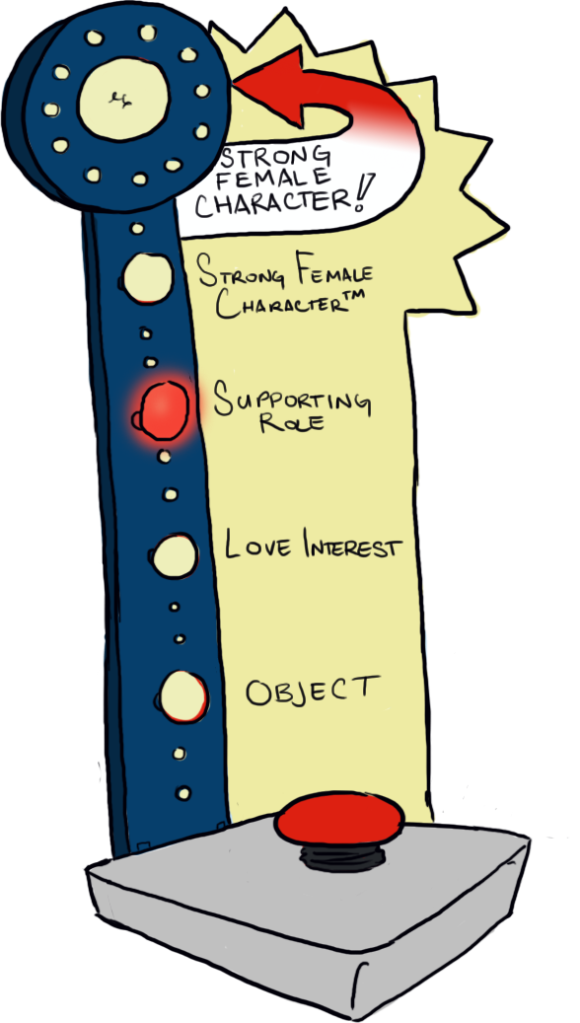
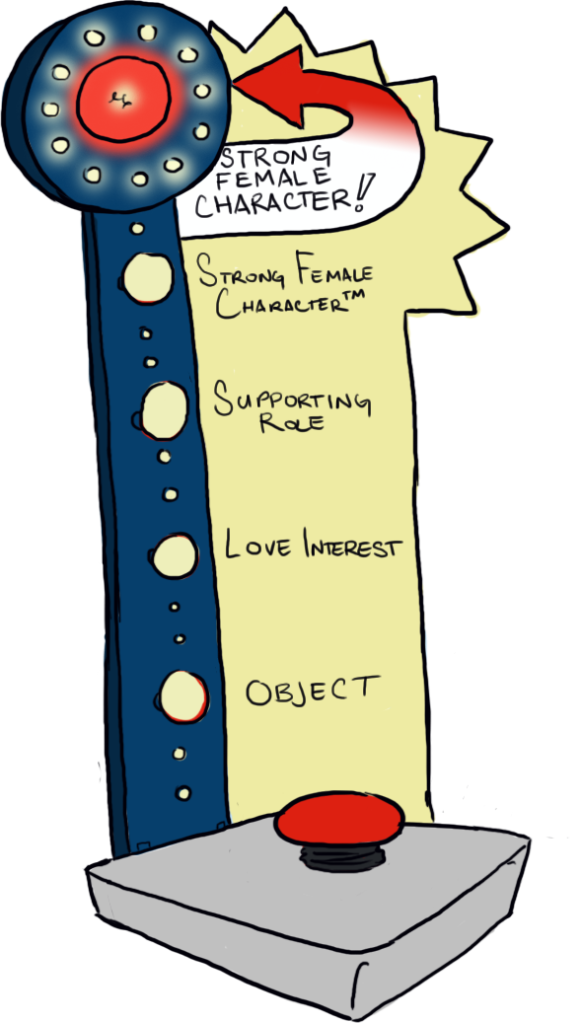
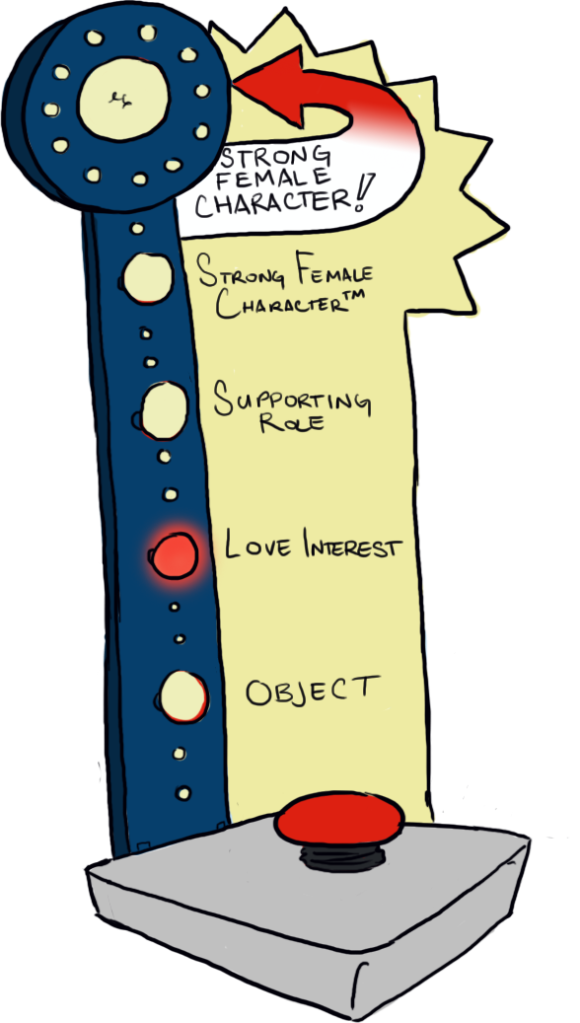
Verdict: Between Strong Female Character™ and actual strong female character, due to the fact that she spends most of her time as the hero of the C-plot


Beth Deville


Beth Deville is simultaneously the most important and least personally influential woman in Y: The Last Man. Finding her is Yorick’s primary goal; unfortunately, this means that she spends a large part of the series literally floating on an island far away from the main plot. Her existence drives the action, but her absence is required to make that happen.


Beth’s story is about what happens when a person is turned into a MacGuffin against their will. We are introduced to her through a conversation with Yorick, during which he laments the state of his life and she acts as the perfect supportive girlfriend, albeit one who is halfway around the world. Just as he’s gearing up to propose to her, she interrupts him to say something important; unfortunately, their conversation is cut off, her comment left unspoken and his proposal unanswered. This is how we see their relationship for most of the series: Yorick projecting his feelings and hopes into the silence with Beth unable to respond.

When Yorick decides to go from New York to Australia, he frames his search for Beth as a quest, making her the quest object. He also assumes that she was going to say yes to his proposal, further denying her subjectivity and agency. Later in the series, we learn that many of the things that Yorick appreciated about Beth were reflections of his own interests; they hate the same things and enjoy the same pop culture, and Beth is willing to wear a Hallowe’en costume that caters to Yorick’s fantasies. One of the lessons that he has to learn over the course of the series is that a woman is not his soulmate simply because they like the same media. To my mind, this speaks volumes about the depth of his relationship with Beth.


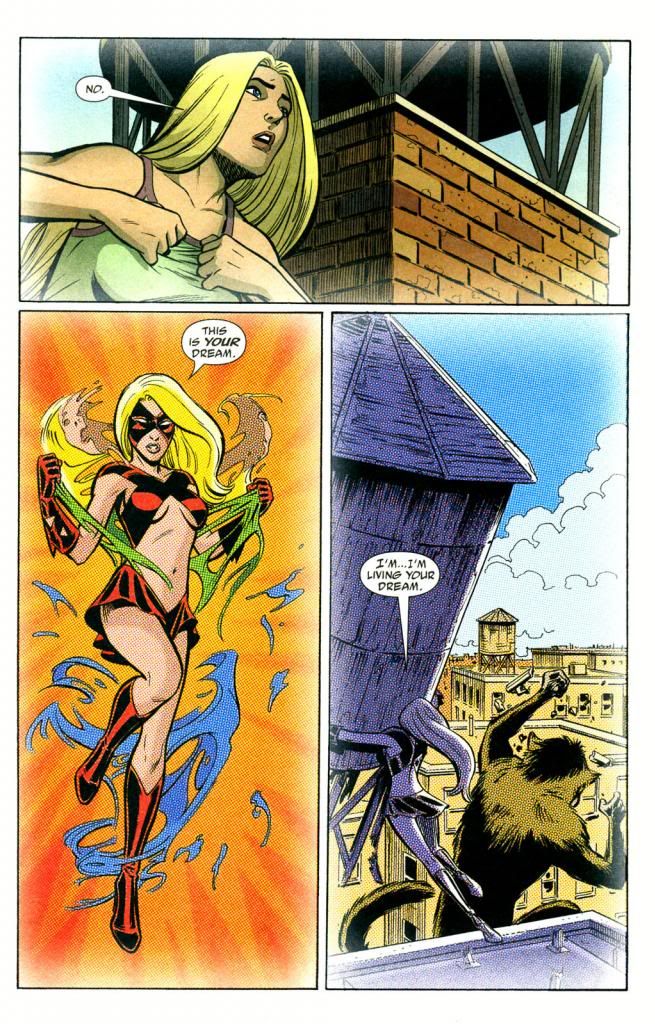
In light of this, it’s especially troubling that Beth spends most of her panel time as a figment of Yorick’s imagination; she is, quite literally, the girl of his dreams. In these dreams he is invariably the hero, casting himself in a number of Hollywood action roles and forcing his imaginary Beth to portray a host of generic love interests, all of whom are sexy and passive. In these dreams, Beth usually comes to some kind of physical harm and warns Yorick not to look for her. The crucial shift in this pattern occurs when we are given access to Beth’s dreamscape. Her memories and thoughts revolve around Yorick, and the vision culminates in a scene in which Beth turns into a superhero and saves Yorick from a giant capuchin monkey. Despite her central role, she realizes that this is not her dream but Yorick’s, and this connection allows her to realize that he is still alive.


This issue complicates Beth’s role as an object. Taking this new information, she travels to France in her own quest, for which Yorick is the prize. What makes her treatment subversive is the fact that Beth (and the narrative itself) calls attention to it. When she saves dream Yorick, she says, “No. This is your dream. I’m… I’m living your dream.” She shows us that Yorick has been projecting his own thoughts and desires onto her, and his dreams now replace her own. In this moment, we understand that what we have seen up to this point is Beth as Yorick sees her, not as she truly is. While he imagines her as a damsel in distress that he has to save, she makes herself the questing knight. The narrative builds on this with its follow-up to that first conversation and the interrupted proposal. After they are reunited, we learn that Beth was going to break up with Yorick during this conversation. Her life was going somewhere while his had hit a wall, and no matter how much she loved him, she wasn’t willing to let him hold her back. As she puts it, “I had a whole world to explore and you… you didn’t.” Seeing that he has undergone some serious personal growth, she is now able to see a future for them.

Unfortunately, while Beth does get some opportunity to contest her objectification, the narrative still isn’t terribly interested in her as a person. As soon as she decides to go to Paris, she promptly disappears from the story, not to be seen or heard from for upwards of a year (in both comic and real time). She gets to stick around a little longer after her confession, but most of her panel time is spent as bait intended to lure Yorick into a trap. After this, the last time we see her is in a flashback from the flashforward that comprises the final issue (it makes sense in context).


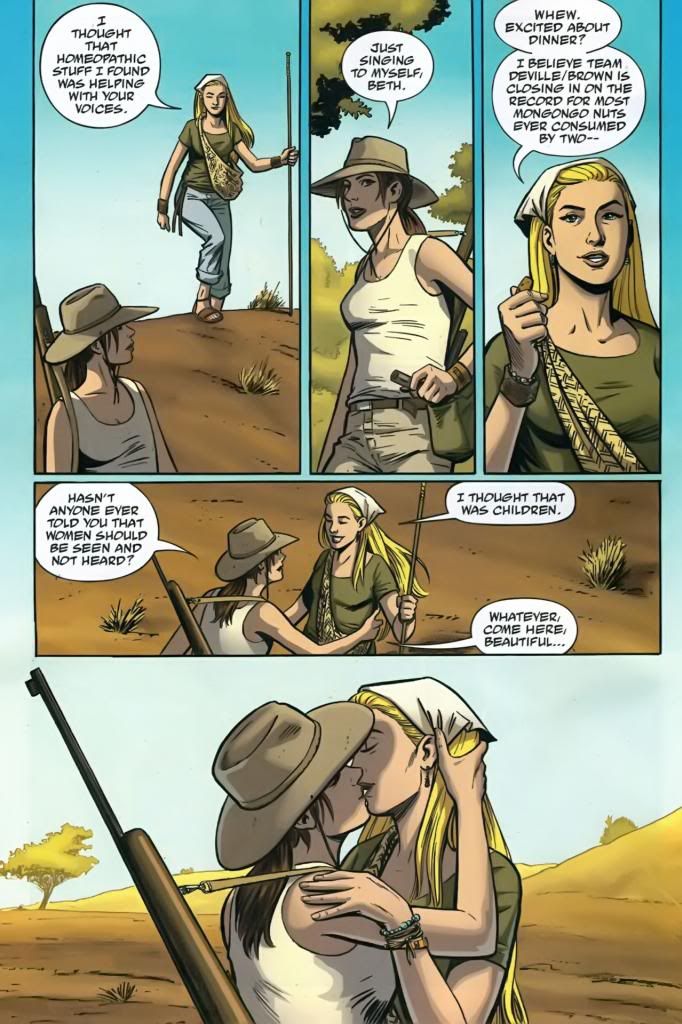
Around six years after the ending of the penultimate issue, Yorick journeys to the Kalahari to give Hero the late Agent 355’s collapsible baton. He jokes that she’ll “be less likely to shoot [her] eye out with it while [she’s] out here doing [her] whole ‘white woman’s burden’ thing.” Hero protests, saying that it’s the lionesses, and not the native population, who need their help. She waxes poetic about the women’s ability to adapt following the gendercide, and Yorick remarks that she “even sounds like her.” It turns out that the “her” in question is Beth Deville, who ended up as the love interest for the other Brown sibling. The evolution of their romantic relationship occurs entirely off-panel, so it reads as a bizarre twist instead of an organic development. The only explanation is that the hero has to get the girl, even when there’s no build-up whatsoever. It’s an amusing play on a tired trope, but it still posits Beth as a prize to be gifted by the narrative to whomever it sees fit.


Ultimately, my problem with Beth is that her story doesn’t go far enough. We are told that she’s more than a MacGuffin, but the moment she gains agency and subjectivity, she is removed from the narrative. We get to see her thoughts, but all of these thoughts revolve around Yorick; it’s so bad that the only conversation she recalls having with Hero -- the person she ends up with -- is actually about the other woman’s brother. It’s understandable for reasons of streamlining the narrative, but it leaves Beth woefully underdeveloped. She may not be an object, but she’s also in no way a fully realized character.

Verdict: Love Interest

artikel terkait
ciri ciri garah tinggi
ciri ciri kucing hamil muda
ciri ciri amandel pada anak
ciri ciri mata minus pada anak
gejala usus buntu pada anak

Jumat, 09 November 2012

The Evil Exes


In a series that unfolds like a video game, we would be remiss if we didn’t discuss the boss battles. By this, of course, we mean the evil exes.

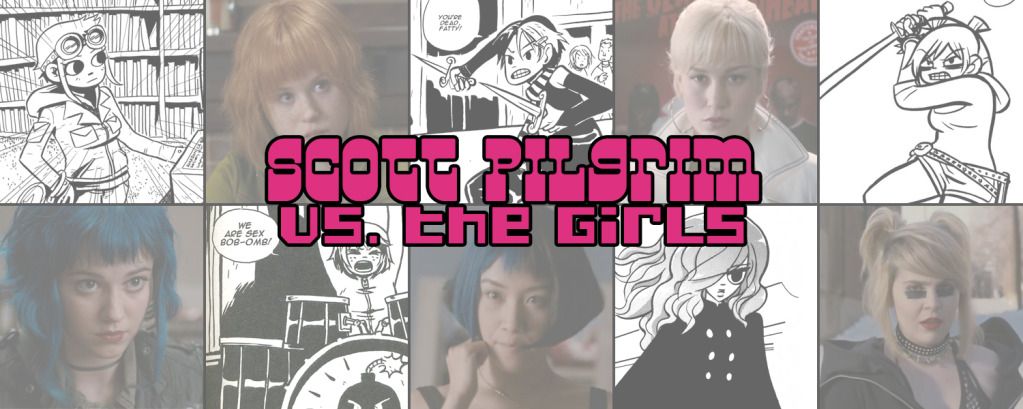
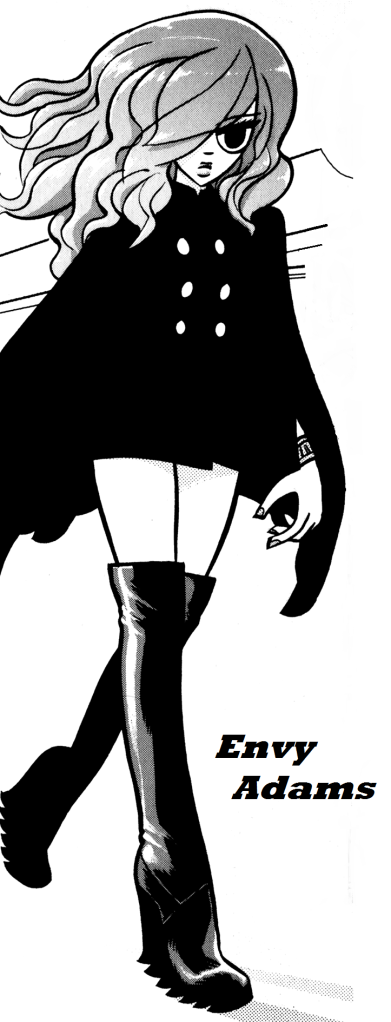
Envy Adams

If you ask Wallace Wells, Envy Adams is pure evil. If you ask Scott Pilgrim, she is a heartbreaker. No one really asks her who she is.

In Natalie V. “Envy” Adams, Bryan Lee O’Malley traces the rise of a superstar and the fall of a fairly decent human being. When we meet Natalie in a flashback, she is an anime fangirl who wears baggy hoodies and dislikes parties. Over the course of her relationship with Scott, she gives up her fannish obsessions, selling her prized possessions for clothing and accessories; changes her name; stops remembering relationship milestones; doesn’t bother hiding her probable cheating; and makes all the decisions for the band they started with Stephen Stills, even forcing Scott to switch instruments. Hers is a classic transformation for the sake of money, fame, and power.

Well, money, fame, power, and a guy. Envy appears to be yet another example of what can go wrong when a woman builds her life around a man. She is completely devoted to Todd, and this makes her blind to his flaws and his transparent lies. She believes that his gesture of love -- punching a hole in the moon -- demonstrates an equal devotion. She believes that gelato is vegan, because Todd says so. Even after she has discovered his infidelity, she believes on some level that Todd didn’t deserve to be defeated. Finally, in the scene in which she departs from Toronto, we catch a glimpse of Natalie, once again clad in a hoodie, taking this opportunity to remake herself without a male influence.

Except, of course, that she doesn’t. The next time we see her, she is preparing to debut her solo album under the watchful eye of Gideon Gordon Graves, Ramona’s seventh and most evil ex. She is intensely fetishized, as he mentions his tendency to dress her up like a Barbie in order to achieve sexual fulfillment. She has been reduced from a woman in control, determining the conditions for Todd and Scott’s battles, to a sparkling bauble for Gideon to play with.

It’s difficult to resist the symbolism that emerges in these last few moments with Envy. Gideon has dressed her in a butterfly outfit, as if to represent metamorphosis and flight. However, he literally removes her wings in order to get to the sword he concealed in her outfit, leaving her in a “sexier dress.” She is clearly reduced to a mere object. Bizarrely, though, by the end of the final battle, she is once again left on her own, and she retains some form of power; using her song, she releases the six potential girlfriends Gideon had locked away. It’s a strange moment, because it seems like Envy’s selfish need to perform nevertheless has positive consequences.

This is one of the problems with Envy: she is difficult to figure out. She has a shifting identity, being both Natalie and Envy to varying degrees throughout the series. The one thing that is clear about Envy is that our view of her is clouded by Scott’s perception. She has the power to literally make him fall to pieces. For the duration of her first phone call with Scott since their break-up, the visual style of the comic changes. Suddenly, the page assumes a fragmented appearance, with smaller panels in a 3x3 format depicting Scott’s memories of Envy interspersed with the scattered pieces of his body, separated by the gutters between panels. His self is actually torn apart.


So it’s hard to consider his point of view to be objective when it comes to Envy. In the sixth volume, Envy says as much: “You make me out to be some kind of villainess. We were practically kids when we dated, Scott, and it’s not like you were some paragon of virtue.” She claims that Scott broke her heart, just as she broke his, and reminds him that he was the one who started that final argument. Scott needed not to be the bad guy in their relationship, so he made Envy suit the role.

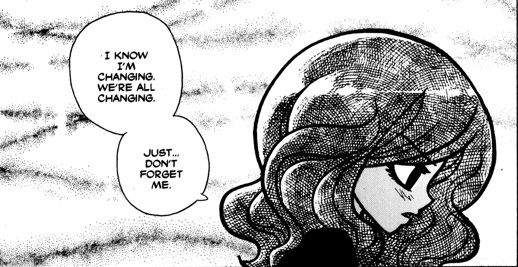
The concept of perception is further complicated by a statement Envy makes at the end of this conversation: “I know I’m changing. We’re all changing. Just... don’t forget me. This is the only me he knows...” This is an issue that goes beyond the problematic aspects of Scott’s suffocating perception that we brought up in our discussion of Kim. Guilty of papering over real events with his more convenient memories, Scott is being entrusted with the preservation of Natalie V. Adams. He must keep an entire person alive.
 
What troubles us -- and what we’re pretty sure is supposed to trouble us -- about this line is the way it frames and genders memory. Scott’s story involves him having to look beyond his own straight, white, male narrative in order to acknowledge the truth of other viewpoints. What are the implications, then, of Envy entrusting him with her self before he has seen the error of his ways? Indeed, what are the implications of allowing a woman’s identity to be maintained or determined by a man? In addition, it’s problematic not only that Scott is made responsible for Natalie, but that Gideon is seemingly creating Envy. Scott is therefore protecting her past self from Gideon’s controlling influence. Unlike Ramona, who finds a way to save herself using an army of Ramonas, Envy is defined by men.

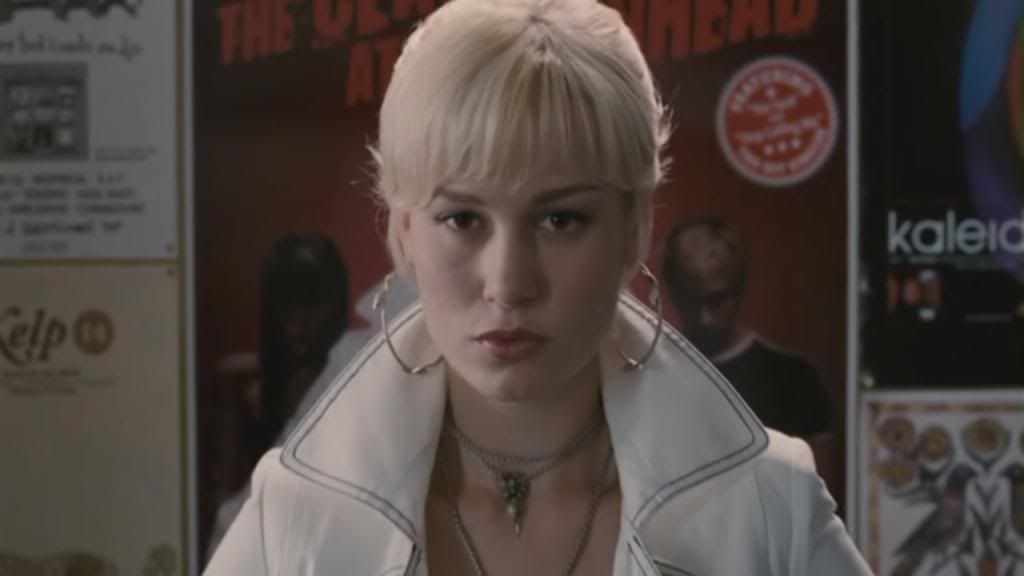
It almost seems disingenuous to mention the film version here, because she’s nothing more than a caricature. She doesn’t even get to fight. She does, however, get to rock a Metric song.

Verdict: Love Interest


Roxie Richter

If we’re discussing the ex who most influenced Scott, we have to talk about the ex who, aside from Gideon, had the greatest influence on Ramona.
 
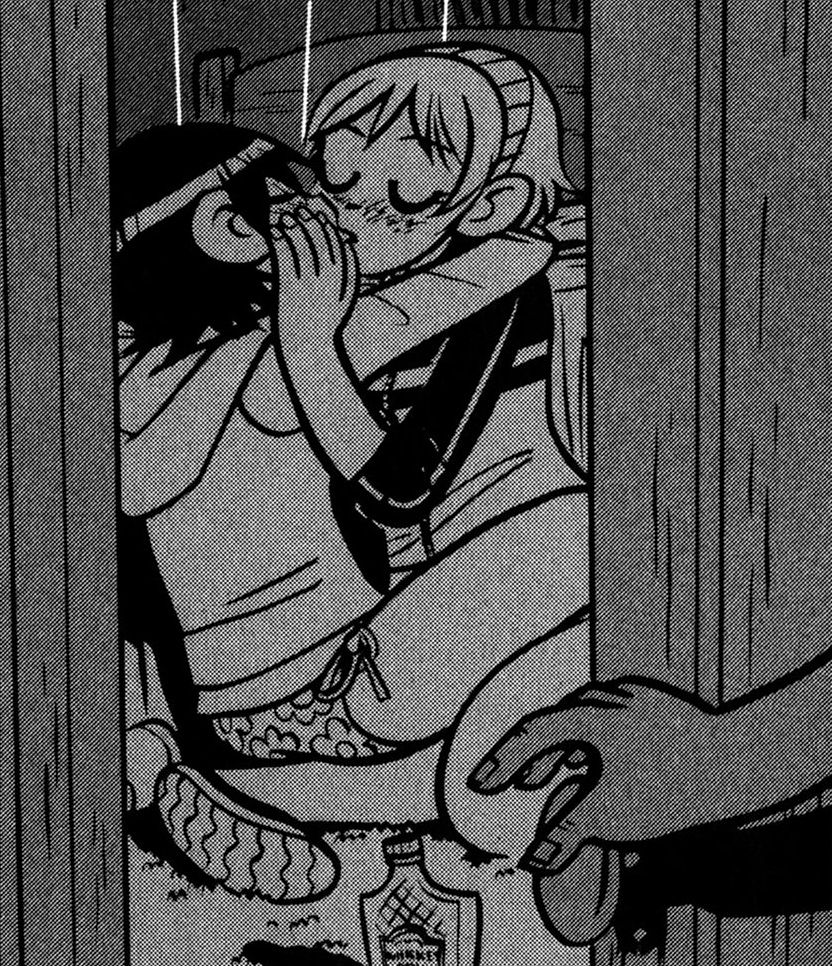
Roxie Richter affects the story even before she is introduced. In the world of Scott Pilgrim, male homosexuality has always existed, in the form of Wallace Wells, his boyfriend, Mobile, the Other Scott, Kim’s roommate, Joseph, and, at the last possible second, Stephen Stills. Queer female sexuality, however, doesn’t warrant a mention until the fourth volume, when it is suddenly EVERYWHERE. Kim and Knives have a drunken make-out session, and Ramona starts to make comments about marrying Kim. Wallace tells Scott to break out the “L” word, to which Scott responds, “Lesbian?” It seems almost as if O’Malley thought he needed to remind his readers that women can be interested in other women so we wouldn’t be shocked when an actual queer woman showed up.

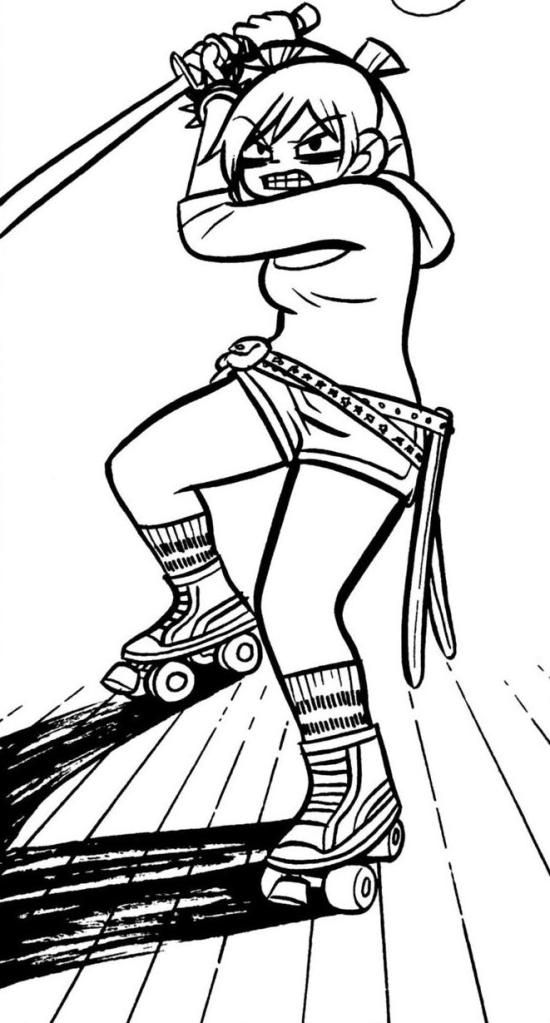
Roxie is introduced as an almost invisible force, which seems somehow appropriate when she represents a group of people heretofore invisible in the series’ universe. We learn that the canonical reason for this is that she is a half-ninja and therefore has a sword, as well as the ability to move with “almost ninja-like stealth and speed.” We also learn that Roxie and Ramona were roommates at the University of Carolina in the Sky, a floating school tethered to a mountain by a giant chain. Unlike any ex before her, Roxie seems to have Ramona’s number, calling her out on her habitual cheating. At the same time, Roxie is clearly the ex Ramona knows best, evidenced by the familiarity of their highly personal insults.

There is a strange and unpleasant subtext in the treatment and characterization of Roxie. She is intensely insecure, interpreting Ramona’s comment that she’s a lousy excuse for a ninja as a slight against her half-ninja status: “Half ain’t good enough, huh?!” When Knives’ father shows up to fight Scott, Roxie immediately assumes that Gideon sent him to help her. She has an emotional outburst, shouting, “I don’t need help! Why doesn’t anyone ever believe in me?!” Even the expository text doesn’t respect her, identifying her as the “4th evil ex-boyfriend.” Further supporting the idea that no one takes her seriously is the fact that, after Scott avoids every opportunity to fight her, one time even going so far as to hide in Ramona’s subspace suitcase, he defeats her with a single blow.

It seems to be no coincidence that she is the ex that represents a homosexual blip in Ramona’s largely heterosexual dating history. Her relationship with Ramona was, for Ramona, apparently just a phase. Even when Roxie promises to kill him, Scott doesn’t consider the possibility that she might be one of the evil exes or, indeed, the reason why Ramona no longer refers to them as her seven evil ex-boyfriends. Instead, he assumes that Roxie is merely dating one of the exes. The realization of her true identity is so momentous that it requires an entire page for Scott’s brain to literally crack open. He points a finger, almost in accusation, and then, when Ramona says that it was only a phase, he replies, “You had a sexy phase?!” Every other ex at this level is a serious threat, and Roxie is part of a sexy phase.

Indeed, the book even puts forward the idea that a woman cheating on a man with another woman isn’t actually cheating. When Ramona tries to apologize to Scott for Roxie staying at her place, she assures him that they “didn’t even make out that much.” This is apparently not infidelity enough to get in the way of an exchange of love confessions.

To add insult to injury, Roxie shows up in the volume where Scott finally gets up the nerve to tell Ramona that he loves her, thereby earning a sword representing the Power of Love. So the heterosexual man defeats the queer woman who dated his girlfriend with the power of heterosexual love. This may be the absolute worst statement made in the entirety of the series.

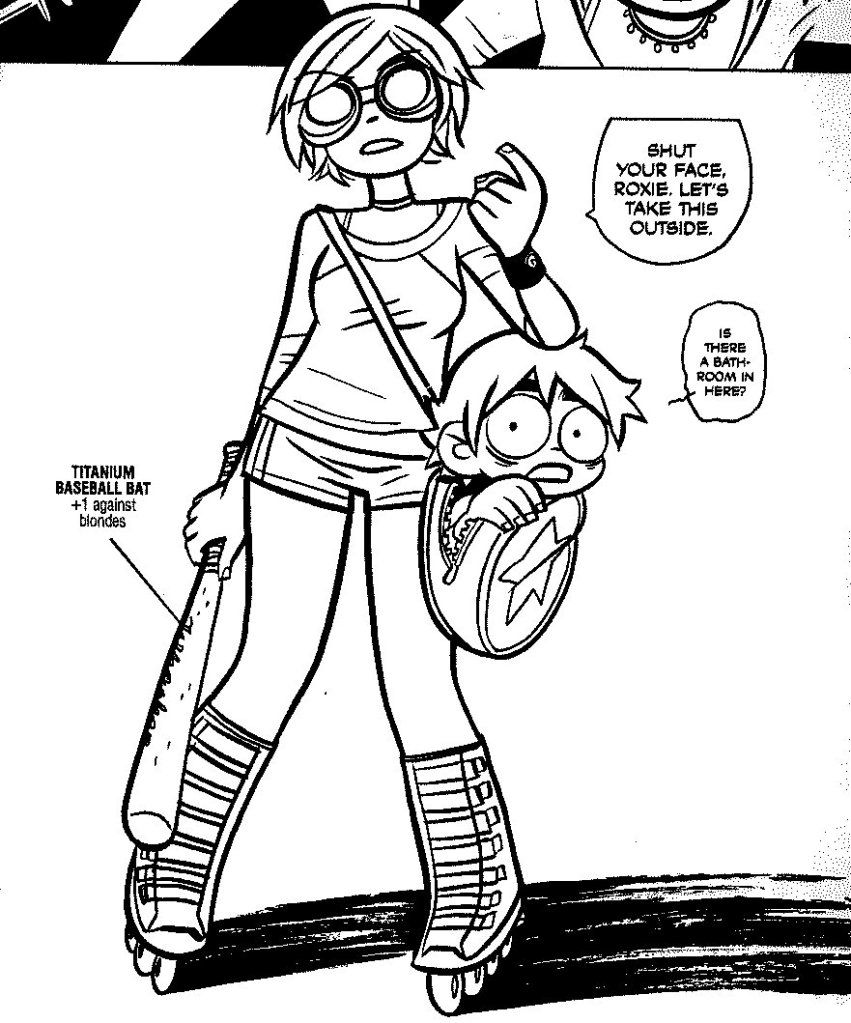
It’s especially obvious that Roxie and Ramona’s relationship is invalidated due to Roxie’s gender, as she is actually quite clearly second only to Gideon in the extent of her effect on Ramona. Ramona’s trademark rollerblades seem to be a riff on Roxie’s rollerskates. Roxie claims on two occasions to have taught Ramona everything she knows about subspace. She seems to be the only person Ramona didn’t just play with for a few days or weeks before she got tired of them, as demonstrated by their familiarity with each other and Ramona’s decisions to have lunch with Roxie and visit her gallery opening.

What complicates the portrayal of Roxie in the comic is, as always, the fact that we are still by the fourth volume quite firmly entrenched in Scott’s point of view. His heteronormative viewpoint may be affecting the storytelling itself. This seems unlikely, however, because most of the instances where Scott’s perspective has a profound effect are interrogated in some way. This is played pretty straight. (Pun intended.)

What is also played pretty straight is the film’s rendition of the Scott vs. Roxie battle. We’ve talked in every post in this series about the injustices done to the female characters in their translation from page to screen. In a lot of ways, it may have been more apt to call this series “Scott Pilgrim Vs. the World Vs. the Girls.” Still, no female character’s arc becomes more thoroughly offensive than Roxie’s.

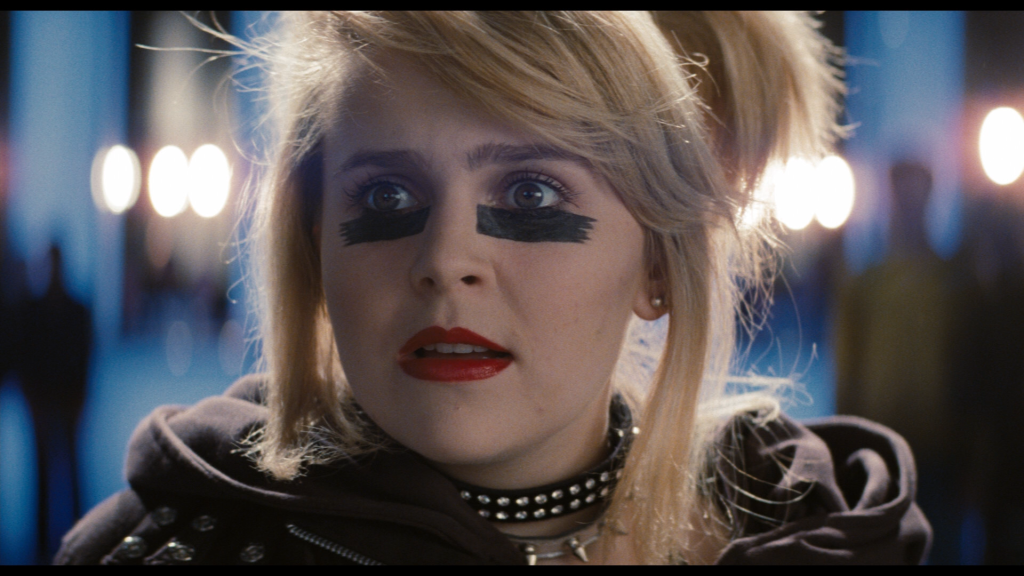
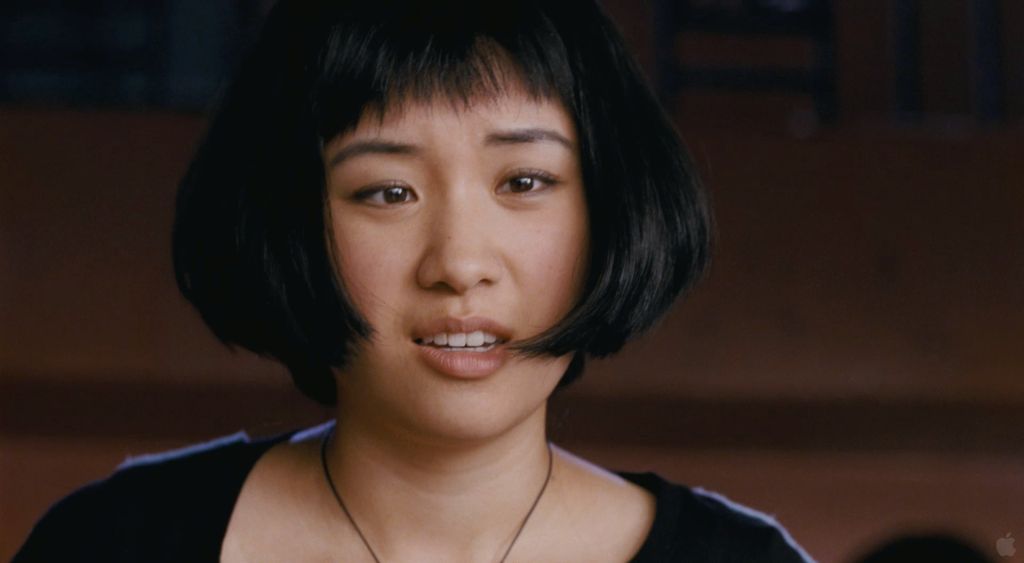
Roxie, or Roxy, as she’s apparently called in the film, is introduced almost exactly as she is in the comic. Her defeat, however, could not be more different. This is partially because in the original, it’s not actually her battle, but rather one that takes place between Ramona and Envy. The battle begins when an invisible Roxy punches Scott in the back of the head and knocks him to the ground. As he sits up, we’re given a delightful view of him framed by Roxy’s legs, just to demolish any hope you may have had that Roxy was going to be treated as seriously as the other exes.

This becomes even clearer when Ramona tells Scott not only that her relationship with Roxy was a phase, but that “it meant nothing. I didn’t think it would count! … I was just a little bicurious.” As if this weren’t bad enough, the soundtrack for the reveal that Roxy is one of the evil exes is punctuated with breathy feminine sighs.

When Roxy then tries to attack Scott, Ramona intervenes; in this version, she doesn’t fight Roxy because Scott is hiding behind the rules of chivalry and his own terror, but because she just... does? It’s not explained. Roxy also suddenly fights with a whip-sword-belt-thing because, I don’t know, it’s sexier than a sword or something. (The change is likely a matter of increasing visual interest and avoiding repetition in a film where the final battle involves swords, but still...) When Roxy reveals that Scott will have to defeat her by his own hand, he protests, saying that he can’t hit a girl. Instead of denying Scott the moral high ground he thinks he deserves for taking this position, as Ramona and Roxie both do in the book, Ramona just tells him that he has no choice... and then proceeds to control his limbs as he enters into fisticuffs with Roxy.

Then something happens that makes us a little bi-furious. As Roxy lifts her leg in the air to deliver the final blow, Ramona tells Scott that Roxy’s weakness is an erogenous zone at the back of her knee. This will be familiar to readers of the comic as Envy’s weakness, discovered by Scott during a serious two-year relationship, and used to take her down in a non-lethal manner. In the movie, however, it is a weakness discovered during just-for-fun make-out sessions, used by a straight man to orgasm a queer woman to death. Roxy’s last words: “You’ll never be able to do this to her,” followed by a blissful moan. Our reaction: not suitable for print.

What really irks us about this scene is that it is so intentional. Roxy suffers a perfectly adequate, if still dubious, defeat in the comic, so the appropriation of Envy’s fight and weakness represents a deliberate change. A character that is already treated as a joke is humiliated in an incredibly offensive way, and we’re supposed to find it funny. We are, perhaps, even supposed to think it better than the original. We’re actually not sure what could have been worse.

Verdict: Love Interest (Comic) and NO NO NO OH GOD WHY (Film)


Jumat, 02 November 2012

That Poor Misguided Angel


KNIVES CHAU
17 YEARS OLD
STATUS: TOTALLY CRAZY

 
“Scott Pilgrim is dating a high schooler!” So begins the tale of Scott Pilgrim, introducing at the same moment its titular character and his seventeen-year-old counterpart, Knives Chau.

Knives enters the story as a stereotypical Asian teenager, complete with overbearing parents and advanced textbooks. She initially treats Scott as another friend, regaling him with stories of high school drama. Their relationship is almost preternaturally innocent, and it is only after she hears Sex Bob-omb play for the first time that her obsession with Scott truly takes hold. Hearing those poorly played chords pitches her face first onto the Yellow Brick Road to adulthood; though her world as we see it remains a land of black and white, she has clearly had her first glimpse of Technicolor.

For Kim, music is a constant, structuring her life; for Knives, it is a gateway to emotions and situations she has never before had a chance to experience. When Scott starts dating Ramona, Knives bemoans her relative lack of life experience: “She’s had time, you know?? She’s got a head start! What am I supposed to do?? How do I fight that? I didn’t even know there was good music until like two months ago!!” Knives frames what she seems to think of as a kind of life seniority in terms of music knowledge, as if everyone had an equally melodic moment of maturation.

Her discovery of music also coincides with the beginning of her search for a model of femininity to emulate. After that first rehearsal, she cuts her hair and starts to dress like Kim. Once Scott has dumped her for Ramona, she gets highlights, mimicking Ramona’s dye job as if that will restore her to Scott’s favour. Although she doesn’t imitate any particular aspect of Envy’s style, she does become obsessed with her, not only explicitly calling her her role model, but also freaking out over the idea that she’s kissed the lips that have kissed Envy. She even tells Scott that he’ll “always be [her] Clash at Demonhead,” compounding in one sentence her love of Scott, her obsession with Envy, and her devotion to music.

This is not to say that Knives’ attitude toward other women is at all positive or healthy. For the majority of the series, she views Ramona as the harlot who stole her man while refusing to see Scott for the cad he demonstrably is. She is constantly using gender-based insults like “slut” and often stoops to calling other women “ugly” or “fat,” regardless of evidence for either claim.

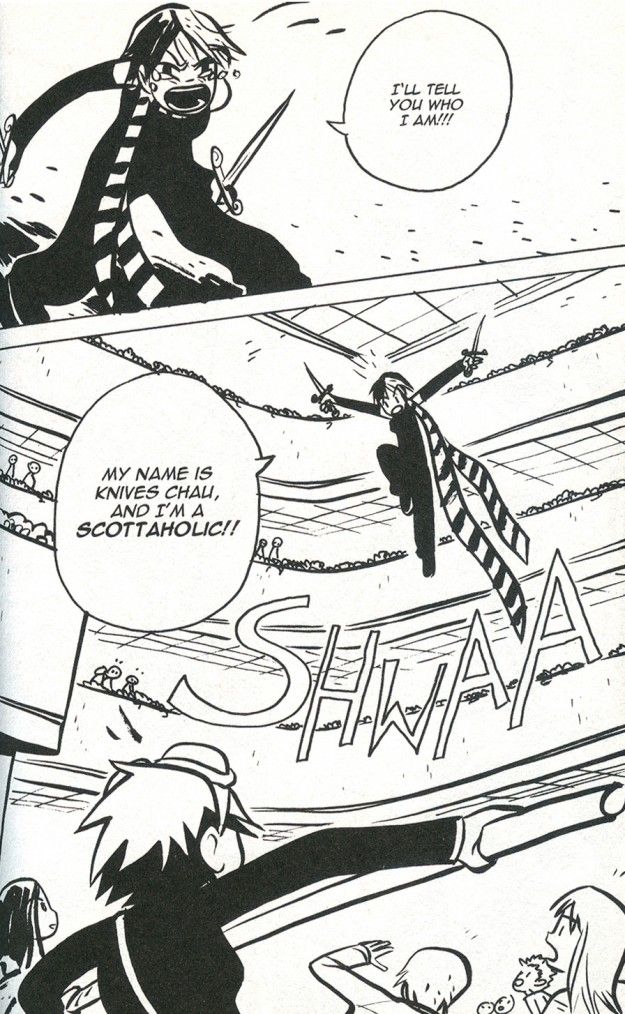
Accordingly, most of Knives’ characterization revolves around her being herself a kind of two-dimensionally awful woman. She is the Crazy Ex-Girlfriend who becomes a stalker and picks fights with her ex’s current love interest, asserting throughout that she’s a “Scottaholic.” She dates Young Neil because he looks like Scott. She even has a shrine. In a narrative that revolves around Scott, she becomes proof of the damage a Scott-centred existence can do.

She is also, in many ways, a reflection of Scott. His dating her represents a regression, as he turns to the easy world of teenage dating to avoid the realities of adulthood. Over the course of the series, he must grow up and learn to take responsibility for his own actions, learning that life isn’t a video game, even if he appears to be living in one. Knives undergoes a more straightforward, if less thoroughly explored, coming-of-age story. She is introduced as a shy, naive child who begins a musically triggered metaphorical puberty. By the third volume, she is beginning to understand the double-edged sword that is adulthood: “I mean, I’m not totally happy, but there’s no way I’d go back to my old oblivious self! I like it here. I like all the... confusion and heart-break. … I feel like I’ve learned some stuff along the way. I know things now.” Eventually, by the final book, Knives’ development has surpassed Scott’s. She is eighteen, an adult in the eyes of the law and a soon-to-be graduate of high school, and she has left the stalled Scott behind. This becomes obvious when she rejects Scott’s offer of casual sex, telling him that they should try to be grown-ups.

Her maturity is finally demonstrated by her decision to let Scott go. He retains the importance of being her first boyfriend as well as the person who helped open her eyes to the world beyond her Catholic school, but that’s all. As she asserts, “I’m happy being alone right now, Scott. I’m trying to learn to like me. Alone.” Best ending for a character that seemed to be nothing more than a caricature of a crazy ex? We think so.

The film’s version of Knives doesn’t fare much better than Ramona or Kim. While she does get to replace Ramona in the final battle against Gideon, she was only there because she wanted to fight Ramona and punish her for stealing Scott. Whereas the comic leaves us with an image of Knives as an independent person striking out on her own, the film ends with Knives telling Scott to go get the girl, assuring him with a wry “I’m too cool for you anyway.” It’s an important and disappointing difference. Comic!Knives completes her character arc by growing up, and leaving Scott behind is merely part of the process. Movie!Knives completes her own arc by letting Scott go, making the romantic relationship the whole point of her story. As you may imagine, we don’t like this ending very much at all.

Verdict: Supporting Role (Comic) and Love Interest (Film)


Jumat, 19 Oktober 2012

This One Girl With Hair Like This


RAMONA FLOWERS
AMERICAN NINJA DELIVERY GIRL
AGE UNKNOWN
EVERYTHING UNKNOWN
FUN FACT: UNKNOWN


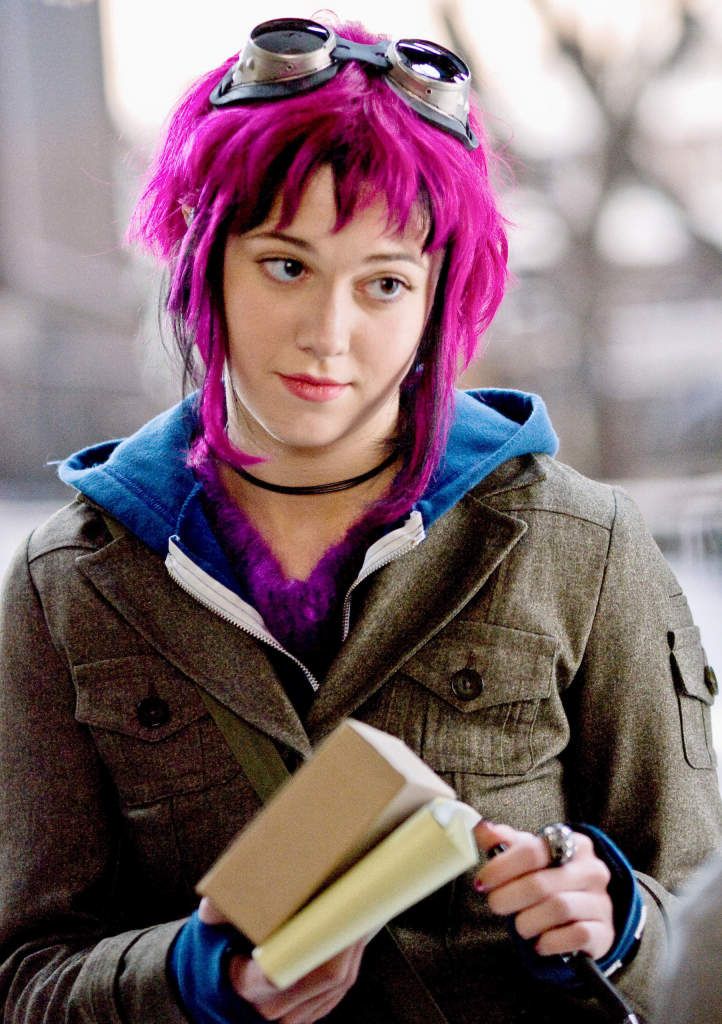
Ramona Flowers is American. Ramona Flowers is the girl of Scott Pilgrim’s dreams, literally. Ramona Flowers is a mystery, wrapped in an enigma, wrapped in a conundrum, all surrounding a squishy, straightforward centre: a Tootsie Roll Pop of characterization. And if Scott Pilgrim is the lens through which the story is told, Ramona Flowers is its focal point.

When she first enters the story, rollerblading across an arid desert of loneliness, Ramona seems like she will be no more than one more in a long line of Manic Pixie Dream Girl characters. The MPDG is a term coined in 2005 to describe a young, spirited woman who is so high on life that she must drag the male protagonist along for the ride, turning his boring life upside down and giving him the motivation he previously lacked.

Like many a Manic Pixie Dream Girl, Ramona is introduced as the solution to the male protagonist’s dull, static existence. She is quirky, intelligent, and ever-changing. Unlike the typical MPDG, however, Ramona clearly has an existence outside the protagonist’s limited world. Her mysterious allure is less the result of a personality tailored to the needs of the hero than a simple matter of the hero not taking an interest in learning about her. The MPDG trope is brutally taken to account when Scott and Ramona have a discussion about what attracts each of them to the other. Scott claims to like Ramona because she is mysterious, and Ramona quite understandably thinks that that’s not enough and that he should know more about her like, say, her age. When he replies that it’s unknown, as if that’s a valid excuse, she responds by saying that he could just ask. In this moment, Ramona introduces the idea that she is not a mystery forever resisting a solution, but an actual person with whom Scott could interact on a human level.

Because the series is so thoroughly based in Scott’s subjective viewpoint, it makes sense that the reader comes to know Ramona just as Scott does. In the first volume, Ramona is introduced as a prize, and objects have no need of a personality. In order to win her, Scott must defeat her seven evil exes in a series of increasingly difficult boss battles. What is particularly interesting is that Matthew Patel, the first evil ex, emails Scott before Ramona has expressed any interest in him; he begins the path toward winning Ramona even before she has consented to being won.

One of the great accomplishments of the series lies, then, in the paradigm shift from viewing a woman as an object to be won to accepting her as a whole person with agency and subjectivity; this is the development from apparent Manic Pixie Dream Girl to Actual Strong Female Character. Ramona is not perky, upbeat, or fun-loving; rather, she is sarcastic and brutally honest, encouraging Scott to grow up and take responsibility for himself instead of luring him out into the world through the sheer force of her frenetic energy. Despite her use of subspace travel, she is not some sort of otherworldly being. In fact, the text goes to great lengths to point out similarities between Scott and Ramona, from their propensity for cheating to their selfishness to their decision to take wilderness sabbaticals following their break-up. Just as Scott turned to video games to escape from his problems, Ramona, who had intended to work through her own issues, “just ended up sleeping all day, dicking around on the Internet and watching every episode of The X-Files.” In that moment, she may have become the most relatable character in the series.

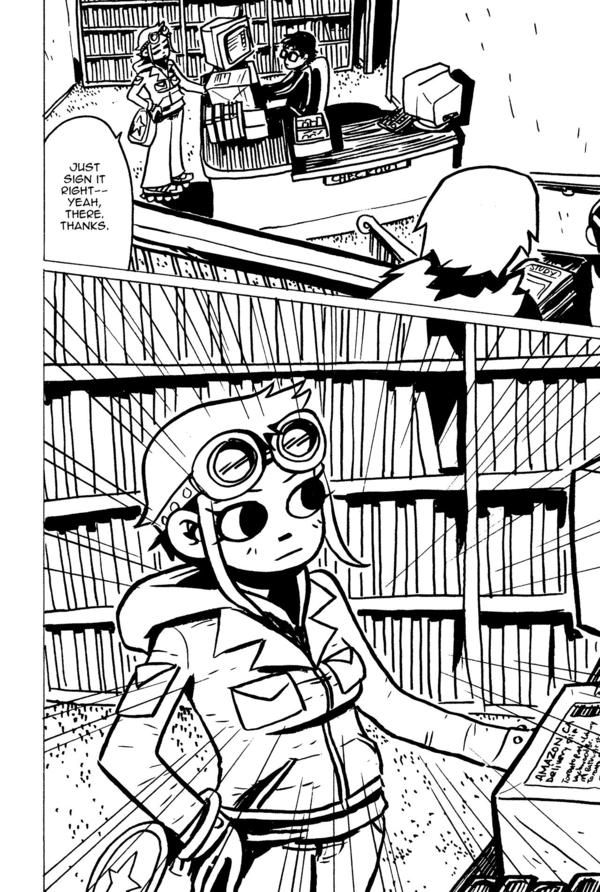
Although she resembles Scott in certain ways, she exists outside of him. Like Princess Kida, it seems like we meet Ramona part way through her own story: a comic already in progress that just happens to crossover with the one that we’re reading. She has an extensive backstory involving her seven evil exes (and at least one non-evil one) delivered in intriguing, if sometimes frustratingly brief, snippets. She also has her own friendship with Kim, based on their mutual hatred of idiocy. By the third volume, Ramona turns the quest narrative on its head by taking her own shot at defeating an evil ex: Scott’s former girlfriend Envy Adams. At this point, Scott temporarily becomes a prize. Ramona further subverts the narrative by fighting Roxie, her fourth ex, in a sense fighting the battle for her self (and shooting for her own hand).

In the fifth volume, Ramona gains some autonomy from Scott’s point of view, achieving a kind of temporary subjectivity. She has a series of introspective moments, the most revealing of which occurs, conveniently, as she tries on clothing while shopping. In the two-page scene, she is clearly dissatisfied with herself; no outfit seems to work, so she tries to adjust her hair, and finally takes refuge in her hood. Throughout the scene, we see both her and her reflection but, while at first we mainly see her, as the scene goes on, we see more and more of the reflection and less and less of the person. The fact that Ramona ultimately decides to hide her hair -- her most distinctive feature -- is telling. Bryan Lee O’Malley has stated on his blog that Ramona changes her hair to try on different identities, depending on the emotional state that she is in. Covering it, then, suggests that she cannot face any version of herself.

This finally changes in the final book. The sixth volume marks the moment when Scott comes into his own as a person aware of other people; accordingly, it also contains Ramona’s crowning moments of character development. After a long absence, Ramona re-enters the story at the end of all things... or, at least, the end of Scott. This entrance directly echoes her first one, but this is definitely not the same Ramona. She observes in a candid moment, “Yes, I’m selfish. I’ve dabbled in being a bitch. But listen... I came back because... because I’m always the one who leaves. I could never say goodbye. I don’t want to be that person anymore. So... I’m sorry, Scott. I came back to say I’m really really sorry.” She does come back for herself, but explicitly in order to make a better version of herself.

In a series that revolves around the battle for Ramona, the best moments occur when she takes an active role in the fight. In this final showdown, we learn that Ramona has made a habit of beating Gideon at his own game. The bizarre glow that allowed her to disappear was originally invented as a form of imprisonment; Gideon states that it “seals you inside your head. Just you and your issues. And once you’re hit, that’s it. No cure. It’s chronic. … But this brilliant self-hater, she found a way to turn it to her advantage...” Ramona transforms these mental shackles into a form of liberation, using the glow as a way to access subspace.

When she is imprisoned in the all too literal -- if technically figurative -- shackles Gideon forces her to wear in her head, Ramona frees herself, telling Gideon, “You know, you’re right. Part of me does still belong to you. But the other parts of me... are finished with you!” A league entirely comprised of versions of Ramona that we have seen throughout the series appears to back her up as she banishes Gideon from her head, forever answering the question, “You and what army?” As if that weren’t enough, she then blocks the blow that would kill Scott using her subspace suitcase, literally and figuratively shedding her baggage. Finally, she gains the Power of Love, just as Scott did in Volume 4, and teams up with him to take down Gideon with simultaneous slices. Ramona is just as much a hero as Scott.


Unfortunately, the same cannot be said of the film version. Changes must be made when adapting six books into one movie, but it’s still unfortunate that Ramona’s characterization loses so much in the translation. Movie Ramona is a far more straightforward Manic Pixie Dream Girl. She goes back to Gideon because she “can’t help [her]self around him.” He has a way of getting into her head, and that way is a microchip, apparently. (Neither its presence nor its shutdown is really explained.) She steals Envy’s shining moment, kicks Gideon in the groin, takes a beating for her troubles, and then spends the final battle looking on as Knives teams up with Scott to beat Gideon. Knives encapsulates all the problems with this version in one line: “You’ve been fighting for her all along.”

The Ramona of the comic fights for herself. There’s a big difference between being a sprite on a screen and the person playing the game, and we’ll always side with the woman holding the controller.


Verdict: Actual Strong Female Character (comic) and Love Interest (film)