Tampilkan postingan dengan label y: the last man. Tampilkan semua postingan

Rabu, 19 Februari 2014

The Hero and The Dream Girl

“Any delusions I once had about me being the protagonist of some predestined epic quest have gone the way of boy bands.” So says the last man on Earth, halfway through an epic quest of which he is certainly the protagonist. What Yorick is doing, however, is confusing the protagonist for the hero, which is what he really wants to be. In his head, he’s a dashing space captain, a barbarian warrior, and a slick noir detective: a hyper-masculine ideal who drives the plot and gets the girl. In reality, he’s surrounded by women who arguably have far better claim to the title of “hero.”


There’s Dr. Allison Mann, who solves the main problem of the series by restoring men to the planet. In fact, the climax of the gendercide plot revolves entirely around her and her relationships, while Yorick remains strapped to a hospital bed, unable even to understand most of what’s going on, let alone do anything to stop it. In the pivotal moment, he’s little more than a damsel in distress, rescued one more time by one of two women who have been saving his life for five years. There’s Agent 355, the bodyguard responsible for protecting Yorick, who is again figured in a role usually occupied by a woman. While he struggles with the possibility that he may not be the hero of the story, she busies herself with the actual heroics, all while trying to resist the corrupting influence of the violence that comes with survival in a dystopian world.


And then, of course, there’s the real reason why Yorick can never be the hero in his own story: the position was filled before he was born.


Hero Brown
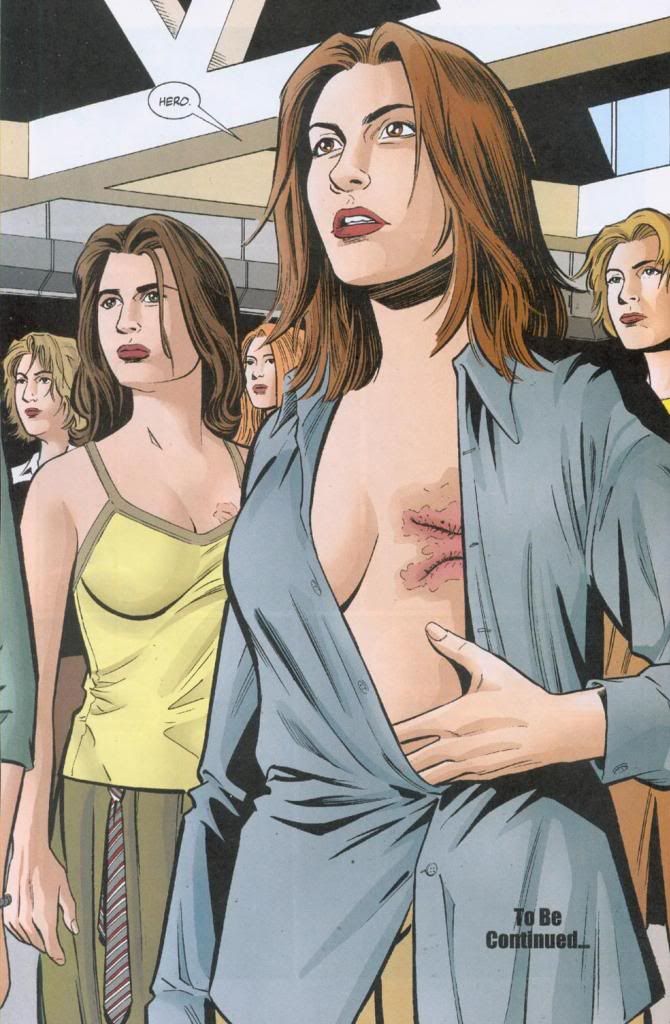

Like Yorick, his older sister, Hero, is named after an obscure Shakespearean character: Beatrice’s sweet, spineless cousin from Much Ado About Nothing. The irony of her brother’s name, which comes from a man who dies before everyone else, instead of after, is echoed in her own. While her namesake swoons in the face of accusations of premarital sex, Hero Brown is introduced having sex in an ambulance while on duty. Still, as Yorick observes, “In a weird way, Hero and I sort of grew into our names. She got a gig as an EMT… I became a worthless joker.” For Hero, the Shakespearean connection, while amusingly ironic, is less relevant than the modern connotation.


Hero is Yorick’s most obvious foil. They look incredibly similar, and they both entertain, at one point or another, aspirations of becoming a writer. Most importantly, however, they both embark on a quest; while the brother has the designation of protagonist, it is the sister who goes on the hero’s journey.


According to The Hero with a Thousand Faces by Joseph Campbell, the hero’s journey -- also known as the monomyth -- is the journey taken by the archetypal hero in mythology. This hero is usually male, and Campbell later argued that this was because “all of the great mythologies and much of the mythic story-telling of the world are from the male point of view. When I was writing The Hero with a Thousand Faces and wanted to bring female heroes in, I had to go to the fairy tales. These were told by women to children, you know, and you get a different perspective. It was the men who got involved in spinning most of the great myths. The women were too busy; they had too damn much to do to sit around thinking about stories.” There is… a lot to dissect in that comment, but what is most relevant to this analysis is Campbell’s identification of the limited narrative space that exists for heroic women. You don’t have to look much further than the Valentine’s card displays to see the difference between boys, who learn that they can be monsters and pirates and cars and superheroes, and girls, who are told that they can only be fairies and princesses. With her arc, Hero pretty much punches that gender division in the face.


The hero’s journey is split into three parts: Departure, Initiation, and Return, and it begins with the call to adventure. For Hero, that comes just after the plague strikes. She has just watched the man she loves die in her arms when a fellow EMT tells her that they have to help the living. Hero refuses, saying, “No. They can help themselves.” She then spends several months journeying from Boston to Washington, D.C., battling starvation as she treks across a post-apocalyptic landscape in order to find the last of her family.
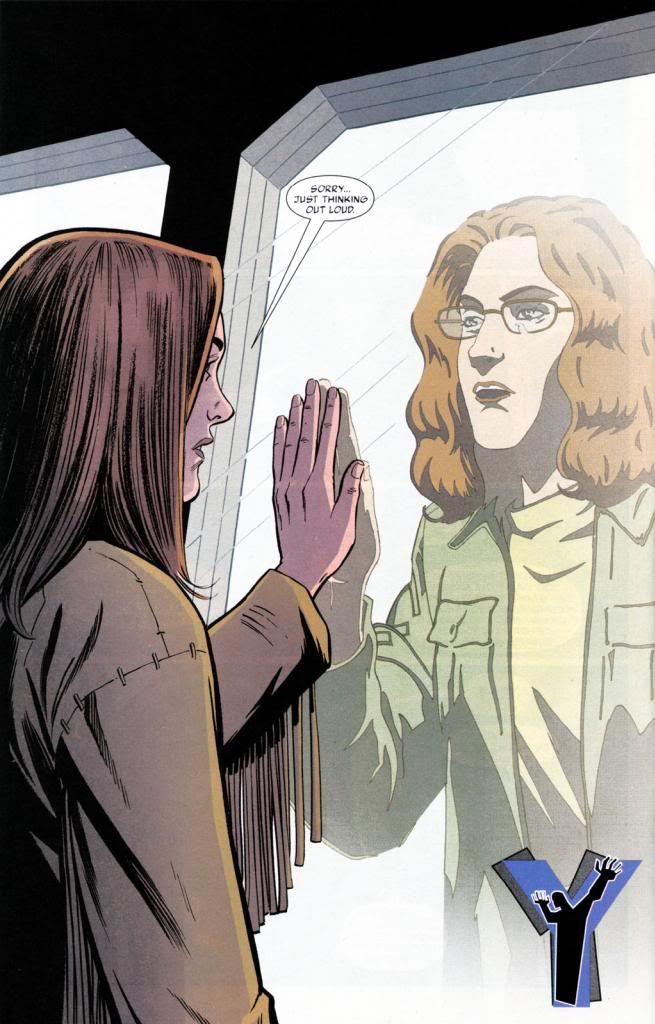

Along the way, she runs into what Campbell terms “supernatural aid,” in this case the leader of the Amazons. The Amazons are a group of women who said good riddance to the end of mankind and ushered in the new matriarchy by blowing up all the sperm banks. They’re ultra-violent, man-hating straw women the likes of which only Fox News could dream up, though the narrative humanizes them by showing us Hero’s rise through the ranks. She is recruited by the leader, Victoria, when she sees a starving, almost feral Hero slice an Amazon’s face open with a tin can. Victoria rewards her with food for this desperate act and, when Hero tells her she’s looking for her mother, Victoria replies, “And found her you have.”


In the aptly named flashback issue, “Hero’s Journey,” we learn that Hero is particularly susceptible to the controlling influence of others. Before the plague, she was involved with “this constant parade of losers and… quasi-abusive scumbags” as she searched for the love and validation that she felt was missing from her father. Just when she thought she had found someone who truly appreciated her, a global extinction event took him away. Many fictional women share Hero’s tendency to trade agency for validation; the difference here is that the narrative overtly condemns this trait, instead of glorifying it as is the case in many a YA romance.


Accordingly, while Victoria serves as Hero’s mentor, protecting her and teaching her how to survive in the new world, she does so as a corrupting influence. She forces Hero to kill an innocent woman to prove her loyalty, and this murder has a profound psychological effect, triggering Hero’s long battle with psychosis. This could be read as a rather unpleasant version of Campbell’s “crossing of the first threshold” into the world of adventure. The next time we see her, Hero muses aloud that “it is so easy to kill someone. Easier than doing laundry. It… It even smells like laundry. I’ve done it. Have you done it? Killing, I mean, not laundry. Heh.” The effects of her psychosis only worsen after she witnesses Victoria’s death and kills the person responsible. By this point she is also suicidal, asking Yorick to kill her: “All you have to do is make a fist. The bullet does the hitting for you.”


After this bloody showdown, Hero goes into the “belly of the whale,” otherwise known as the prison at Marrisville. According to Campbell, “this popular motif gives emphasis to the lesson that the passage of the threshold is a form of self-annihilation… Instead of passing outward, beyond the confines of the visible world, the hero goes inward, to be born again.” This is precisely what happens to Hero, who spends her time in prison being deprogrammed. When she emerges, she is ready to continue her journey down the “road of trials.”


This is the point where Hero’s story becomes even more subversive, as she dons the trappings of Hollywood’s masculine heroism. When we see her next, she’s wearing a sort of modern cowboy outfit, complete with hat and six-shooter. Having left the prison some time earlier, she’s on a mission to save Yorick from Agent 355, whom their mother now believes to be a shady character. On her way through Kansas, she questions the owner of a brothel, who assures her that they operate inside the law. “I don’t,” Hero replies, every inch the cool Western lead. When she finally catches up to Yorick, she shoots and shatters a sword, only slightly undermining this feat of sharp shooting by pointing out that she was aiming for the attacker’s face. When he asks her if she plans to kill herself, she states, “I’d rather try to make up for some of the horrors I inflicted on the world before I off myself,” framing her journey as a road to redemption.


This stage of her arc is integral to Hero’s development, representing both her reconciliation with Yorick and her final rejection of Victoria. The former is important for mostly technical reasons; while she’s still perceived as an antagonist, it’s basically impossible to make Hero a hero. The latter is the most difficult trial on a road full of them. Even after her deprogramming, Hero hears Victoria’s voice in her head and sees her in delusions. On these occasions, Victoria urges her to kill Yorick and destroy every chance of restoring men to the planet. However, when she has the perfect opportunity to do just that, she chooses instead to resist. We see her in her own mind, still agonizing over one of the women she killed. Victoria urges her to kill both Yorick and Allison, and when she recites the reasons why the men deserved to die, Hero calmly tells her that she’s heard all of that before. Victoria then resorts to reminding Hero of the sexual abuse she suffered at her grandfather’s hands. Hero assures her that she remembers, but that she has moved on… then she stabs Victoria through the eye with the arrow Hero used to kill Victoria’s murderer. She turns the violence that Victoria instilled in her back on Victoria in order to rid herself of these same violent urges. In this moment, she also vanquishes the last controlling influence in her life, earning the freedom to live on her own terms.


The next stage of her journey along the road of trials begins with a letter that Yorick asks her to deliver to Other Beth, a woman he met on his own journey. When Hero finds her, Beth is heavily pregnant with Yorick’s child; by the end of the issue, Hero offers to take her along with her, telling Beth that she can provide medical help. Although Beth doesn’t let Hero know, it turns out that the letter Yorick sent asked her to be a friend to Hero. As they travel back across the United States, Hero and Other Beth pick up three more companions: Russian secret agent Natalya Zamyatin, astronaut Ciba Weber, and Ciba’s infant son, Vladimir Jr., the first boy born post-gendercide. Despite Natalya’s superior training, it is Hero who leads the group as they make their way across the Atlantic Ocean to return Vlad to his father’s homeland. Her task is incredibly difficult and its success equally impressive; while Yorick can disguise himself as a woman, there’s not much anyone can do to hide two babies whose existence should be impossible.
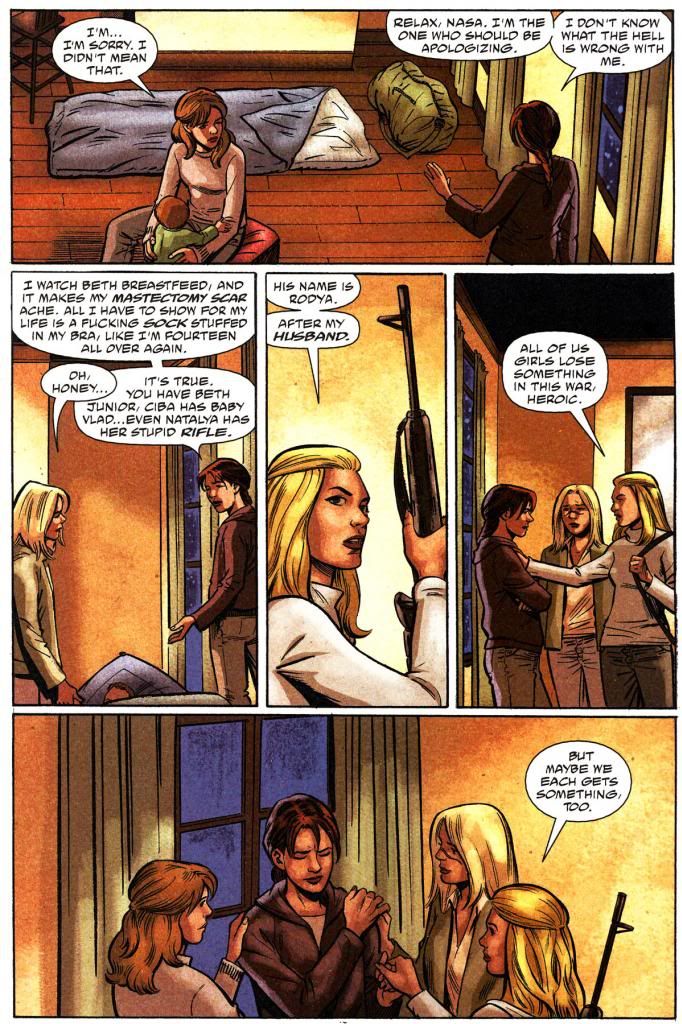

A hero usually completes his journey with a prize to keep and new knowledge to share when he arrives home, and Hero is no exception. Near the end of the journey, Hero and her friends are holed up in Paris, trying to find Yorick. Frustrated, Hero laments her solitary status: “I watch Beth breastfeed, and it makes my mastectomy scar ache. All I have to show for my life is a fucking sock stuffed in my bra, like I’m fourteen all over again.” She sees their treasures as symbols of accomplishment: motherhood and romantic love, represented respectively by the two children and Natalya’s rifle, named for her late husband. From her perspective, her quest is over and she has nothing to show for it. Natalya rejects this conclusion, telling Hero that she’s gained three friends.


This is a powerful idea. While a hero usually has to return with a princess, a golden fleece, a magical elixir, or, in this case, a lost brother, Hero’s reward is female friendship. Admittedly, due to Hero being a supporting character in the larger story, we don’t get to see her nurture these friendships. Still, the narrative’s explicit acknowledgement of the importance of friendship between women -- both in Hero’s relationships and the central bond between Allison and 355 -- is heartening. It’s also interesting, when you consider it as the endpoint of Hero’s arc. She begins as a woman dependent on the approval of men, and she transfers this dependency to Victoria following the gendercide. After her stint in prison, she comes to rely on herself, remaking herself into the very model of the lone cowboy. Finally, she becomes someone on whom other people can rely, who will cross the globe in aid of a friend. As the world begins to rebuild itself, she becomes what she was always meant to be: a Hero in word and deed as well as name.


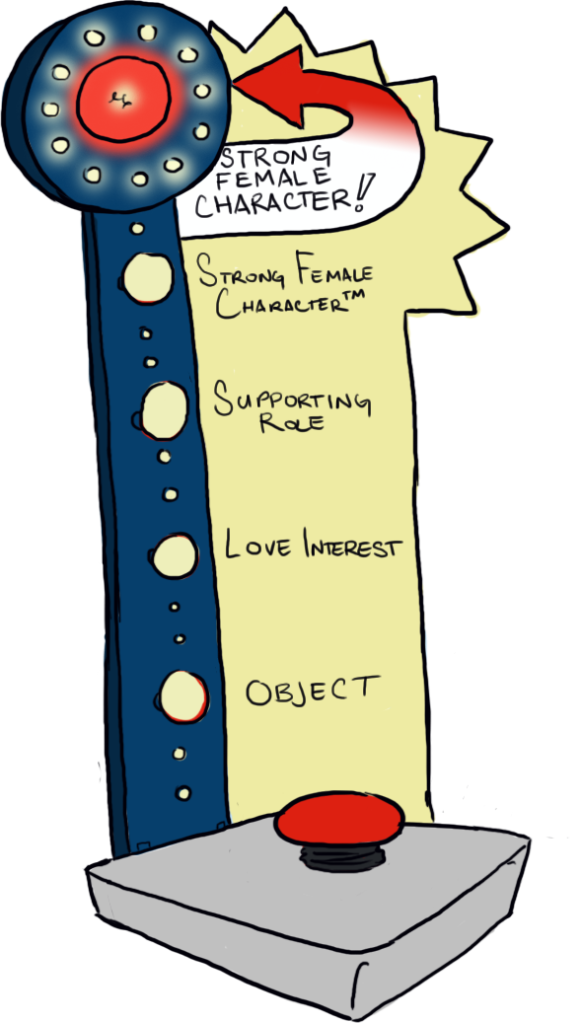
Verdict: Between Strong Female Character™ and actual strong female character, due to the fact that she spends most of her time as the hero of the C-plot


Beth Deville


Beth Deville is simultaneously the most important and least personally influential woman in Y: The Last Man. Finding her is Yorick’s primary goal; unfortunately, this means that she spends a large part of the series literally floating on an island far away from the main plot. Her existence drives the action, but her absence is required to make that happen.


Beth’s story is about what happens when a person is turned into a MacGuffin against their will. We are introduced to her through a conversation with Yorick, during which he laments the state of his life and she acts as the perfect supportive girlfriend, albeit one who is halfway around the world. Just as he’s gearing up to propose to her, she interrupts him to say something important; unfortunately, their conversation is cut off, her comment left unspoken and his proposal unanswered. This is how we see their relationship for most of the series: Yorick projecting his feelings and hopes into the silence with Beth unable to respond.

When Yorick decides to go from New York to Australia, he frames his search for Beth as a quest, making her the quest object. He also assumes that she was going to say yes to his proposal, further denying her subjectivity and agency. Later in the series, we learn that many of the things that Yorick appreciated about Beth were reflections of his own interests; they hate the same things and enjoy the same pop culture, and Beth is willing to wear a Hallowe’en costume that caters to Yorick’s fantasies. One of the lessons that he has to learn over the course of the series is that a woman is not his soulmate simply because they like the same media. To my mind, this speaks volumes about the depth of his relationship with Beth.


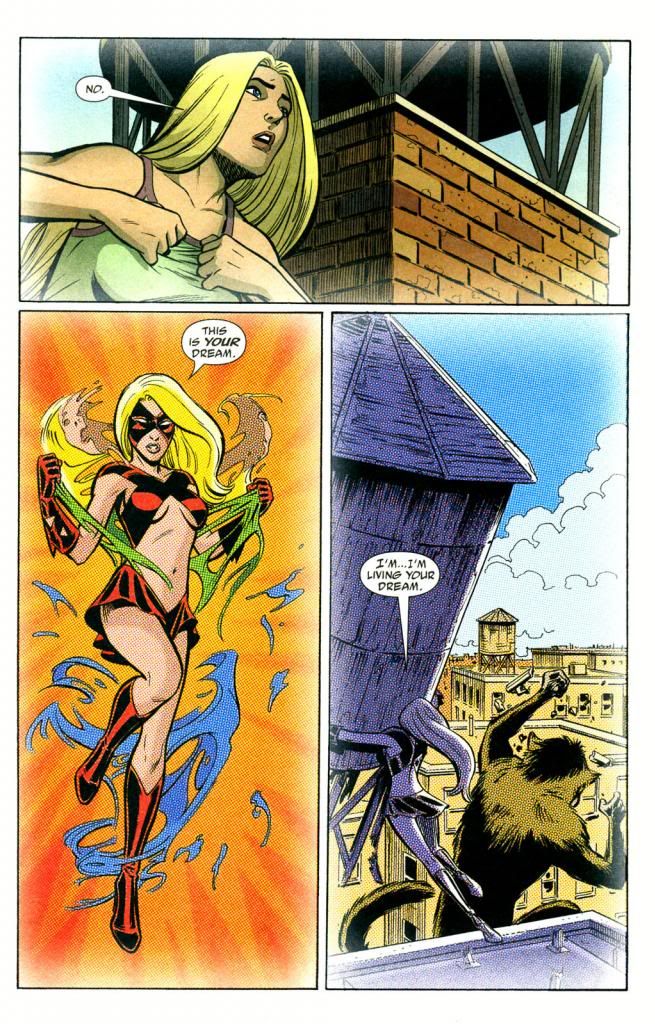
In light of this, it’s especially troubling that Beth spends most of her panel time as a figment of Yorick’s imagination; she is, quite literally, the girl of his dreams. In these dreams he is invariably the hero, casting himself in a number of Hollywood action roles and forcing his imaginary Beth to portray a host of generic love interests, all of whom are sexy and passive. In these dreams, Beth usually comes to some kind of physical harm and warns Yorick not to look for her. The crucial shift in this pattern occurs when we are given access to Beth’s dreamscape. Her memories and thoughts revolve around Yorick, and the vision culminates in a scene in which Beth turns into a superhero and saves Yorick from a giant capuchin monkey. Despite her central role, she realizes that this is not her dream but Yorick’s, and this connection allows her to realize that he is still alive.


This issue complicates Beth’s role as an object. Taking this new information, she travels to France in her own quest, for which Yorick is the prize. What makes her treatment subversive is the fact that Beth (and the narrative itself) calls attention to it. When she saves dream Yorick, she says, “No. This is your dream. I’m… I’m living your dream.” She shows us that Yorick has been projecting his own thoughts and desires onto her, and his dreams now replace her own. In this moment, we understand that what we have seen up to this point is Beth as Yorick sees her, not as she truly is. While he imagines her as a damsel in distress that he has to save, she makes herself the questing knight. The narrative builds on this with its follow-up to that first conversation and the interrupted proposal. After they are reunited, we learn that Beth was going to break up with Yorick during this conversation. Her life was going somewhere while his had hit a wall, and no matter how much she loved him, she wasn’t willing to let him hold her back. As she puts it, “I had a whole world to explore and you… you didn’t.” Seeing that he has undergone some serious personal growth, she is now able to see a future for them.

Unfortunately, while Beth does get some opportunity to contest her objectification, the narrative still isn’t terribly interested in her as a person. As soon as she decides to go to Paris, she promptly disappears from the story, not to be seen or heard from for upwards of a year (in both comic and real time). She gets to stick around a little longer after her confession, but most of her panel time is spent as bait intended to lure Yorick into a trap. After this, the last time we see her is in a flashback from the flashforward that comprises the final issue (it makes sense in context).


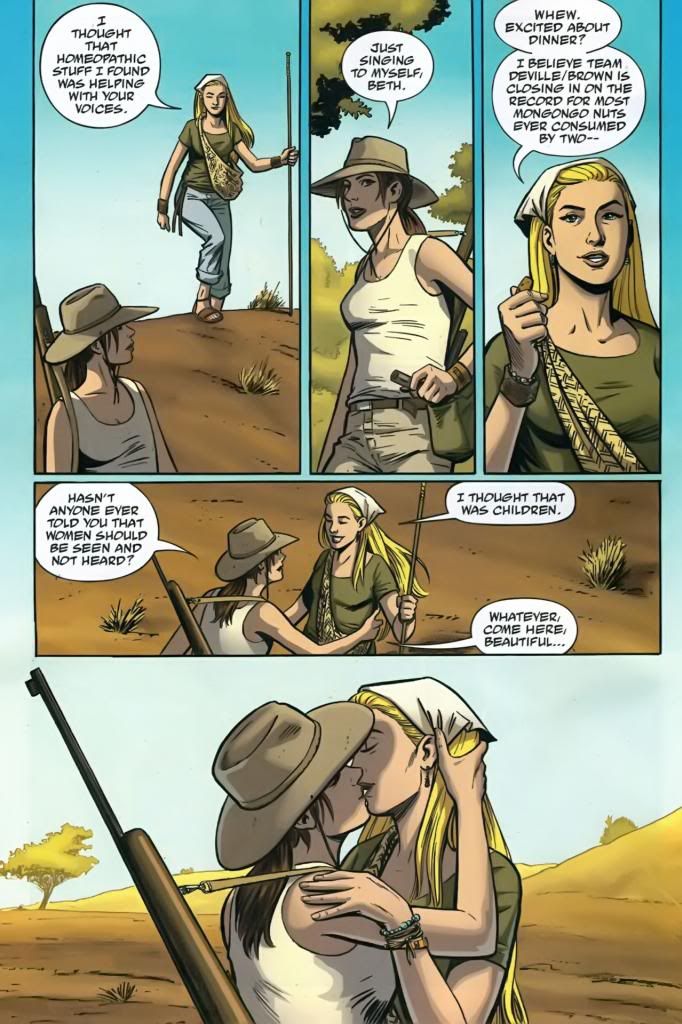
Around six years after the ending of the penultimate issue, Yorick journeys to the Kalahari to give Hero the late Agent 355’s collapsible baton. He jokes that she’ll “be less likely to shoot [her] eye out with it while [she’s] out here doing [her] whole ‘white woman’s burden’ thing.” Hero protests, saying that it’s the lionesses, and not the native population, who need their help. She waxes poetic about the women’s ability to adapt following the gendercide, and Yorick remarks that she “even sounds like her.” It turns out that the “her” in question is Beth Deville, who ended up as the love interest for the other Brown sibling. The evolution of their romantic relationship occurs entirely off-panel, so it reads as a bizarre twist instead of an organic development. The only explanation is that the hero has to get the girl, even when there’s no build-up whatsoever. It’s an amusing play on a tired trope, but it still posits Beth as a prize to be gifted by the narrative to whomever it sees fit.


Ultimately, my problem with Beth is that her story doesn’t go far enough. We are told that she’s more than a MacGuffin, but the moment she gains agency and subjectivity, she is removed from the narrative. We get to see her thoughts, but all of these thoughts revolve around Yorick; it’s so bad that the only conversation she recalls having with Hero -- the person she ends up with -- is actually about the other woman’s brother. It’s understandable for reasons of streamlining the narrative, but it leaves Beth woefully underdeveloped. She may not be an object, but she’s also in no way a fully realized character.

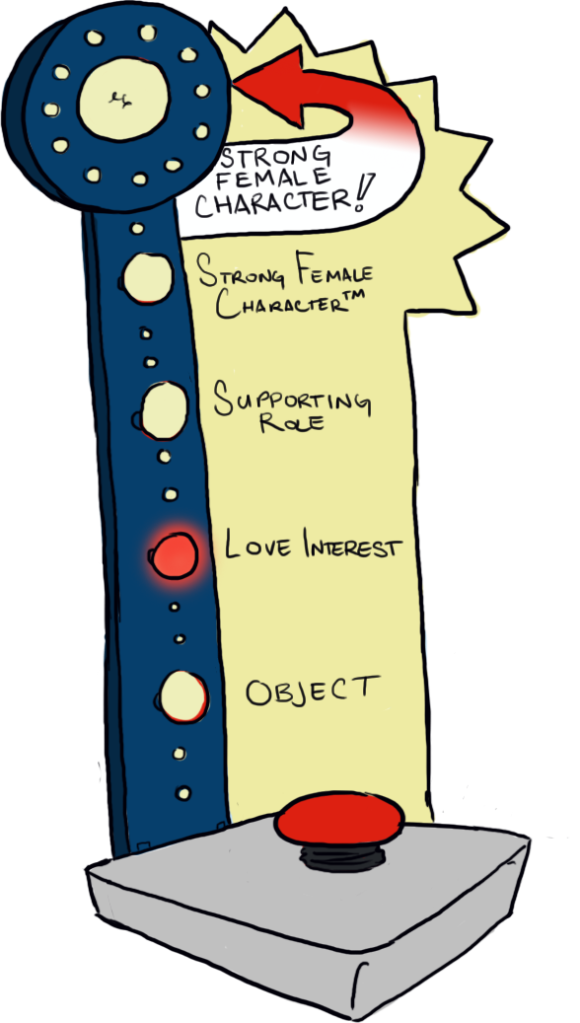
Verdict: Love Interest

artikel terkait
ciri ciri garah tinggi
ciri ciri kucing hamil muda
ciri ciri amandel pada anak
ciri ciri mata minus pada anak
gejala usus buntu pada anak

Minggu, 26 Januari 2014

The Self-Made Mann

One of the problems with what we call the Strong Female Character™ is their simultaneous ubiquity and rarity; just about every comic, film or television show has to have one, but quite often one seems to be the limit. They’re the Love Interest, the Girl, the token, and the representational weight of one half of the population falls on their invariably slim shoulders. Even those characters that manage to achieve realistic complexity can be crushed under the massive form of the Everywoman.


There is no such problem in the series that I will be discussing for the next several posts: Brian K. Vaughan and Pia Guerra’s Y: The Last Man. As suggested by the title, the series tells the story of the last man on Earth. In 2002, a mysterious plague instantaneously wipes out every creature with a Y chromosome, save for one unemployed English major/escape artist and his disobedient capuchin monkey. When the gendercide hits, Yorick is proposing to his girlfriend, Beth, via phone call, and the rest of the series follows his quest to reunite with her.


“It figures,” one character observes halfway through the series, “An entire planet of women, and the one guy gets to be the lead.” To Vaughan’s credit, however, while Yorick struggles to stay afloat in a sea of existential angst, the series uses his journey to depict the all-female population’s efforts to ensure the continuation of the species and the establishment of a matriarchal society. Yorick is the last man, but it’s the last women who drive the story.


Dr. Allison Mann


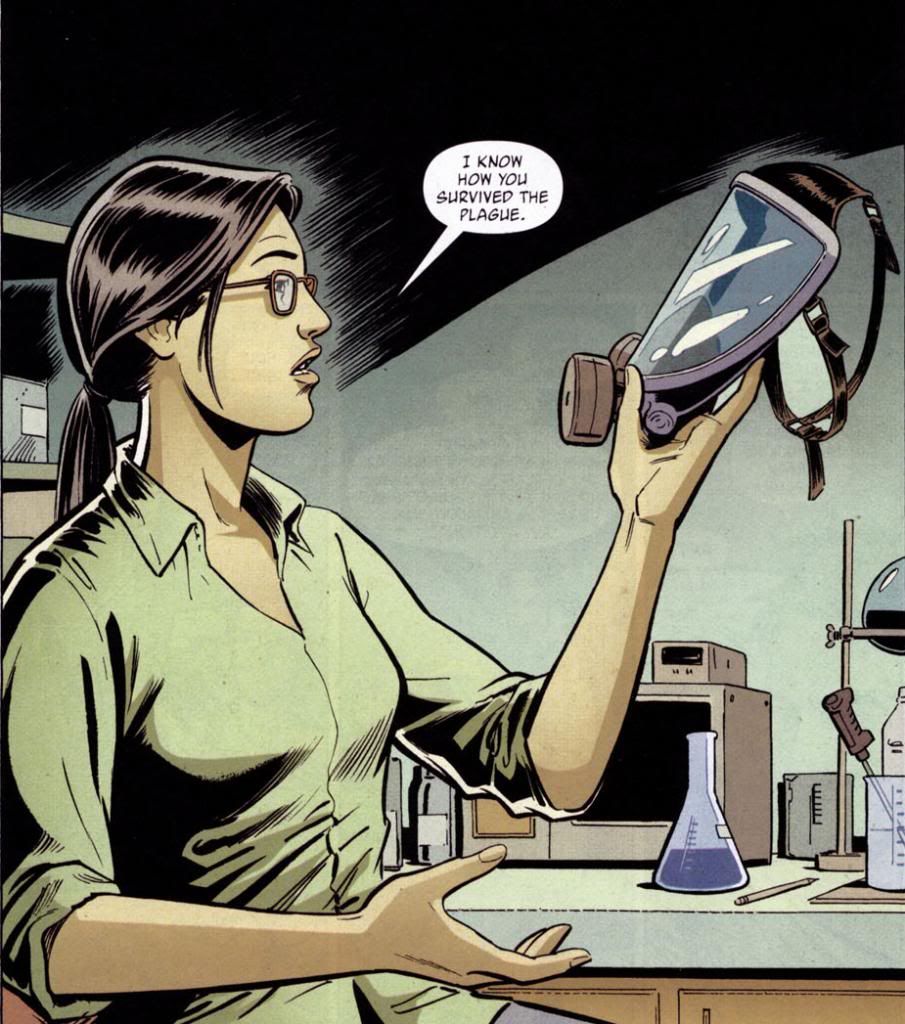
The first thing to know about Dr. Mann is that she’s the best of the best. She tenured at Harvard before the age of thirty, and her papers bring other scientists to tears with their perfection. The finest scientific mind in the United States, who “knows more about asexual reproduction than anyone alive,” Dr. Mann is introduced giving birth to her own clone. When Yorick tells her she’s a god, she replies, “Yes. I know.” She’s the kind of person who didn’t need half the population to die to be considered exceptional. Dr. Mann is formally introduced as humanity’s best hope for survival. Yorick, accompanied by his bodyguard, Agent 355, an ultra-competent member of a secret paramilitary organization dating back to the time of George Washington, is sent to find Dr. Mann. She is tasked with finding out and reproducing whatever protected Yorick and Ampersand from the plague as well as mastering the creation of viable human clones. Without her, Yorick is merely an anomaly.


Unfortunately, when Yorick and 355 find her, she has given up on cloning, saying, “I just want to do whatever I can to make up for my stupid mistake… so I can kill myself in good conscience.” Joining Yorick’s quest is, initially, a matter of seeking absolution. However, a year and a half later, she reveals that the male fetus she claimed to be carrying was actually female. Now relatively certain that she didn’t cause the plague, she still lacks faith in her own abilities. To her, the baby’s sex matters because “it means I’m a fucking failure!” Her self-described “shoddy science” could easily prevent her from successfully cloning anyone. Compounding the difficulty of her already nearly impossible task is her own self-doubt.


Allison Mann has a complicated relationship to her ego, her identity, and her sense of self. Early in their journey, Yorick makes a comment about “someone like you,” and she immediately gets defensive about her mixed Chinese and Japanese background, even though it turns out that Yorick was talking about something completely unrelated. Later, she speaks English to her Chinese mother, who demands that she switch to one of her parents’ languages. On some level, she wants to sever ties to her own history, to any part of herself that she did not create. This extends to her reluctance to reveal her real name, despite the fact that she admits early on that “Allison Mann” is a fabrication derived from Mann’s Chinese Theater: “something kitsch-y and faux-Asian to insult my father.”


The key to understanding Dr. Mann -- AKA Ayuko Matsumori -- lies in her construction of “Allison Mann.” Although she argues that her self-naming was a “dumb teenage rebellion thing,” it’s clearly much more than that. She uses her new identity to separate herself from her father, the man who controlled her life until he disowned her for being a lesbian. It was likely at this time, when they renounced their familial ties, that she became Allison Mann. This is the name that she hopes will go down in history when she gives birth to the first viable human clone, a project that she begins not for the sake of scientific progress, but for bragging rights over her father. She makes a point of detaching herself from her father but, in so doing, strengthens the attachment. Instead of working for herself, she works against him. “Allison Mann” is important because it is the name Ayuko Matsumori gave herself, but it is perhaps more important because it is not the name her father gave her.


This changes when she sees her father for the last time. It turns out that Dr. Matsumori managed to survive the plague because he (probably) caused it. (The series never confirms the veracity of his story, but there is something to be said for the fact that it explains more than any other theory put forward.) Whereas she began her cloning project to beat him, he started his to remake her, viewing the clones as opportunities to fix the mistakes he made while raising her. He was responsible for the death of her fetus, and he plans to finish sabotaging her work by killing Yorick. This drives Allison to fight back, asserting her identity and her agency: “My name is Doctor Allison Mann, and your hostage is my patient.” She claims responsibility for keeping Yorick alive and vows to bring men back to the planet.


Most importantly, however, she finally finds a way to separate herself from her father through the things she has learned on her journey. She accuses him of letting his ego get in the way of his science, and he turns the accusation back on her, asking her how she’s any different. She responds, “Because I learn from my mistakes. I care about people other than myself, and I owe it to them to get this right. I will get it right.” Her accomplishments are no longer driven by hubris and a need to outdo the man who rejected her; instead, she finds confidence in the good she can do for the people who give her love and support. Her self-chosen name no longer reinforces her connection to her father, but severs it. Finally, in a moment loaded with symbolism, one of the Ayuko clones distracts her father and gives Allison the chance to kill him. After he dies, Allison hugs her younger self and tells her that she’s sorry: Dr. Allison Mann embracing Ayuko Matsumori and apologizing for all of the suffering that they have had to endure.


What sets Allison apart from her father also differentiates her from the Dr. Mann who began the journey with Yorick and 355 four years earlier. In the time just before the plague hits, Allison is at her most self-centered, literally growing another version of herself inside of her in order to prove her superiority over the man who disowned her. The gendercide both undermines and strengthens this self-centeredness, at once awakening Allison to the effects her actions have on others and making her believe that her work was powerful enough to kill billions of people. While she originally joins 355 and Yorick as part of a search for redemption, it is the journey itself that helps her to care for others.


Throughout the series, there are a myriad of references to Dr. Mann’s seeming heartlessness. She claims that her father’s death was the only good thing to come out of the gendercide, interrupts Yorick’s romantic musings with mood-killing logic, and destroys a bonding moment between 355 and Yorick with news of the pygmy shrew’s extinction. Yorick considers her to be robotic, thinking of her as the Tin Man, and she hardly dissuades this way of thinking when she says things like, “Love isn’t an ‘emotion,’ it’s an abstract construct mammals assign to a biological imperative they don’t fully understand.” However, the Tin Man is a more apt analogue than even Yorick might realize: the Tin Woodman of the original books gained his metal body due to an enchantment intended to keep him from the girl he loved, and he retained his emotional tenderness despite -- and, bizarrely, because of -- the removal of his heart. Allison suffers betrayal at the hands of the woman she loves and builds herself a metaphorical suit of armour. Having been abandoned by almost everyone she loves, she forsakes interpersonal connections. Despite this, she largely forsakes violence, believes that everyone deserves the chance to be saved, and risks her own life to help people she’ll never meet. Unlike the Tin Man, she doesn’t need a heart made of velvet and sawdust; she simply needs a reminder that hers is still in her chest.


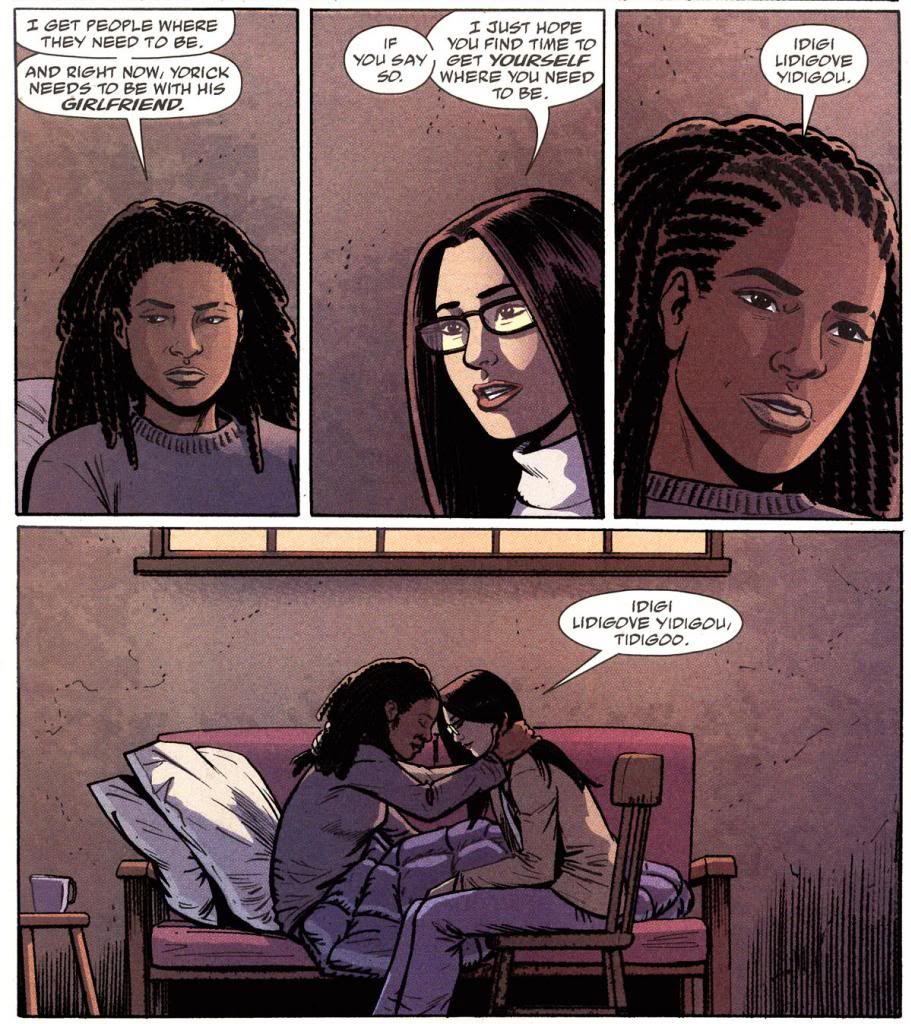
This reminder comes from three sources: Yorick, 355, and Rose. When she clones herself, Allison tells her assistant that they’ll worry about the ethics later. Her friendship with Yorick, born of snarky quips and years spent caring for him both medically and emotionally, helps her to see that there is a person beyond the problem. By the end of their time together, Allison thinks of Yorick not as an experiment but as a friend. In her pivotal moment of self-identification, she includes Yorick: “My name is Doctor Allison Mann, and your hostage is my patient.” In so doing, she makes the care of others part of her identity. Her relationship with Agent 355 is somewhat more complicated. In its early stages, the friendship between Allison and 355 seems to be based mostly on mutual respect and, on Allison’s end, an unrequited crush and a lie intended to get 355 to like her. Still, over time they come to rely on each other as a source of honesty and support. Allison encourages 355 to think of her own needs instead of always tending to the needs of others, while 355 helps Allison to emerge from the critical echo chamber of her own mind. The extent of their devotion to each other is evident in their final goodbye: an exchange of “I love you’s” delivered in gibberish. It’s explained in an earlier issue both that they speak gibberish to keep the content of their conversations secret from Yorick, and that they speak it with incredible ease. This is their shared language, and it is used to discuss important things; its use in this exchange speaks to the value they both place on their relationship.


Allison’s romantic relationship with Rose Copen is the series’ most explicit treatment of her trust issues. Rose is an Australian spy, originally posted to a ship carrying both our heroes and a cargo hold full of heroin. She is ordered to cultivate a relationship with Allison in order to keep tabs on Yorick’s movements, but she soon finds herself falling in love with Allison. Allison, for her part, finds herself drawn to Rose despite her protestations about the inherent falseness of love. When Rose inadvertently reveals her orders to Allison, the doctor feels that her distrust of love has been validated, and she plans to dump Rose before Rose can betray her any further. Rose surprises her, however, and goes AWOL in order to pursue her relationship with Allison. By the end of the series, Rose is pregnant with the first clone of Yorick, having stayed with Allison until her death.


We’ve seen this character arc in its simplest form many times: a self-centered workaholic is reformed through the healing power of love. In many of these stories, this reformation involves the character quitting their soulless corporate job and taking up a career in whatever field the creators consider to be good, honest work. In Allison’s case, however, the narrative suggests that opening yourself up to love, both platonic and romantic, can make your work better. This isn’t the kind of nebulous development that takes place in Frozen; love doesn’t just “thaw a frozen heart.” It causes Allison to take risks, to trust other people, to find value in herself irrespective of her brilliance. It helps her to make scientific advancements for the good of others instead of bragging rights and the attention of a neglectful father. Ultimately, it empowers her to save humanity.


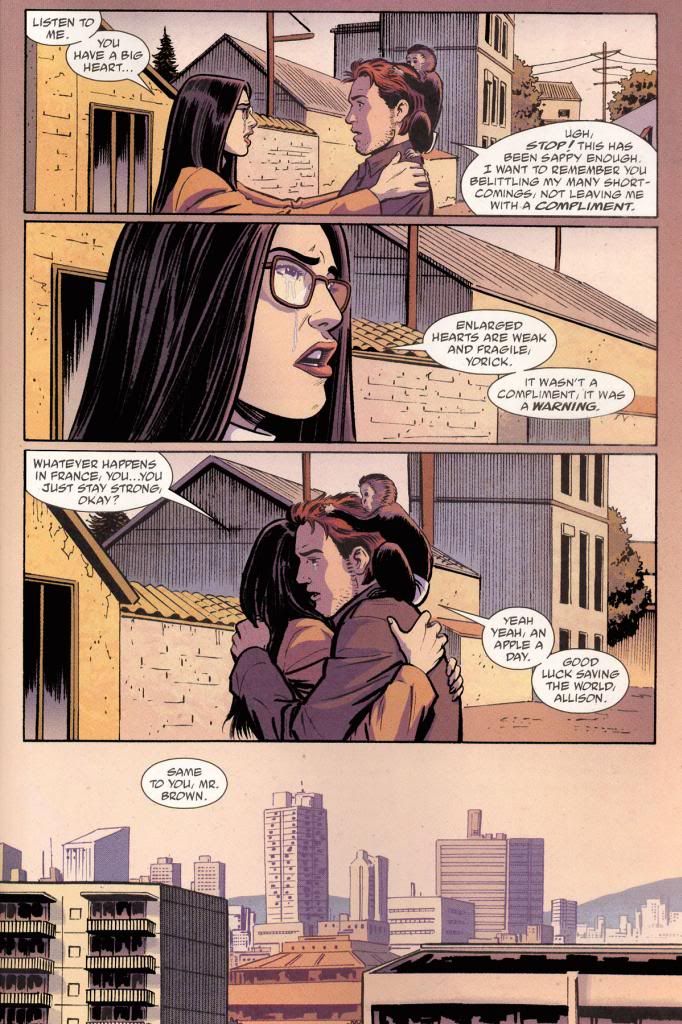
This is a particularly fascinating aspect of Y: The Last Man: Yorick may be the lead, but he’s not the hero. I’ll be discussing this in greater depth in the post about Hero Brown, Yorick’s conspicuously named sister, but it’s also highly relevant to any analysis of Dr. Mann. In Allison’s final scene, the last thing Yorick says to her is, “Good luck saving the world, Allison.” She wishes him the same, but it’s made clear in the final issue that she was vastly more successful. Before she died, Dr. Mann cloned females en masse and impregnated Rose with a viable clone of Yorick. Yorick ends up a relic of another world, trying and failing to find meaning in his survival. Yorick wallows in the existential angst of being the last man, while Allison ensures that there will be another.


Verdict: Actual strong female character

ciri ciri wanita mandul yang tua
ciri ciri gejala penyakit ginjal orang dewasa
cara menurunkan berat badan pada orang gemuk
cara membuat pancake yang lezat
cara membuat pancake durian yang lezat
metode ilmiah biologi yang baik dan benar
nama latin tebu dan manfaat tebu


Senin, 10 Desember 2012

Comic Recommendations


This year saw comic-related movies smash box office records, as The Avengers and The Dark Knight Rises entered the list of the top ten highest grossing films of all time, in third and seventh place respectively. This seems like good news for comic fans, but all of these comic-based films making millions and even billions of dollars are about men.

Unless Black Widow has a ridiculously successful solo screen outing, this isn’t likely to change anytime soon. Although two of our recommended titles have been adapted into films, and the other three have all, at some point or another, had adaptations in some stage of development, they don’t provide much hope. Persepolis, while excellent, was a box office flop and lost the Oscar for Best Animated Feature to Ratatouille. Whiteout replaced one of the principal female characters with a man because obviously no one would want to see a film about two women solving a murder mystery. Fables seems to be the catalyst of the recent fairy tale trend in films and television, but it’s not being adapted itself. The last time I checked, Y: The Last Man was in limbo, partially due to Hollywood executives wanting to make a story that lasts five years into a film that lasts two hours. While Marvel focused its attention on The Avengers, The Runaways, a film that had already put out casting calls, quietly disappeared.

Basically, we’re saying that it’s best to read these stories in their original form, because waiting for the big-budget adaptation means you might be waiting forever.

Whiteout

Writer: Greg Rucka
Penciller: Steve Lieber

The first thing you need to know about this comic is that it is not the movie. Don’t watch the movie. Pretend the movie doesn’t exist. The next thing you need to know is that it is written by Greg Rucka, a man whose work could very easily have constituted an entire recommendation post on its own.

A body has been found on the ice in the Antarctic, and it is up to Deputy U.S. Marshal Carrie Stetko to find out not only who the faceless man is, but who killed him. While trying to figure out the matter of whoisit and whodunit, Stetko must deal with punishing cold, a fast-approaching deadline, and the disrespect of the majority of the male inhabitants of a station where the ratio of men to women ranges from 200-400 to one. Along the way, she meets and teams up with Lily Sharpe, a woman who may or may not be a British spy.

What makes Whiteout brilliant is the same thing that brightens up every one of Greg Rucka’s works: women who are competent, flawed people with agency and personality. Like Wonder Woman, Renee Montoya, Kate Kane, and all the other women Rucka is known for writing, Carrie Stetko and Lily Sharpe are certified badasses who deal with just as much tragedy and hardship in just as interesting a way as the men in other stories do. They’re what Strong Female Characters™ could be if they were people instead of fantasies.

Runaways

Writer: Brian K. Vaughan
Penciller: Adrian Alphona

Let’s be honest: the number one reason why everyone should read this series is that it features a telepathic raptor. That it also features a whole host of fascinating female characters is just the icing on the cake.

The story begins when the the families Wilder, Yorkes, Dean, Stein, Hayes, and Minoru gather for their annual business meeting, the parents leaving their six teenage and preteen children to their own devices while they talk about business. The kids eavesdrop on the meeting from a secret passageway and witness their parents killing a young woman in a ritualistic sacrifice. Faced with the fact that their parents are supervillains, Alex, Gert, Karolina, Chase, Molly, and Nico decide that it is up to them to become superheroes in order to stop the villainous Pride.

Runaways is an exceptional series for a number of reasons. The first is that it features a superhero team with a majority female membership. The second is that the leader is always a person of colour, and, for most of the run, a woman. The third is that it eventually has a really delightful queer couple made up of two aliens, one a lesbian with rainbow energy-shooting powers (which sounds like bad satire but is actually awesome) and the other a bigendered shapeshifter with the powers of the Fantastic Four. We’ll leave you to discover the rest of the reasons for yourselves.

Persepolis

Writer: Marjane Satrapi
Penciller: Marjane Satrapi

I (Megan) was first introduced to this book in a class on the graphic novel. Like Art Spiegelman’s Maus or Alison Bechdel’s Fun Home, Persepolis is a literary, autobiographical comic that quite adamantly disproves any notion that comics are only meant for kids.

Persepolis is the story of one girl’s coming of age during the Islamic Revolution in Iran. According to the blurb printed on the book, it is a tale of “the contradictions between private and public life in a country plagued by political upheaval; of [Marjane’s] high school years in Vienna facing the trials of adolescence far from her family; of her homecoming -- both sweet and terrible; and, finally, of her self-imposed exile from her beloved homeland.” While this is a pretty accurate summation of the story, it doesn’t tell you exactly why you should read it.

In the first few pages, the young Marjane introduces herself as the last prophet, destined not only to end unfair suffering and subvert a masculine tradition of prophecy, but to have jam sessions with God in her PJs. Her rebellious and unconventional personality causes her to chafe against the fabric of a newly restrictive society. Over the course of the book, we get to see the world through her eyes just as she is learning to understand it herself (filtered, admittedly, through the lens of an older, wiser self with an extensive art education). It’s a thoroughly enjoyable look “beyond the veil” that Western society tends to throw over the Middle East in general, and Middle Eastern women in particular.

Y: The Last Man

Writer: Brian K. Vaughan
Pencillers: Pia Guerra and Goran Sudžuka

In the musical Avenue Q, there’s a song called “What Do You Do With a B.A. in English?/It Sucks to Be Me.” That compound title is basically Y:The Last Man in a nutshell.

A recently graduated English major and escape artist, Yorick Brown becomes the last man on Earth following the gendercide, a plague that instantaneously wiped out every animal with a Y chromosome. Unfortunately, the mass death took place just as Yorick was proposing to his girlfriend over the phone, so he must travel to Australia to get her answer. His companions on the journey through a semi-post-apocalyptic landscape are his bodyguard, Agent 355, an increasingly violent and increasingly sympathetic member of a secret organization, and the brilliant, cold, and compelling Dr. Allison Mann, a geneticist who is trying to figure out what saved him.

I (Megan) wrote my Honours thesis on this series, and throughout the process I often joked that I could write a lengthy essay about every single one of the major female characters. (Writing this blog now, I’ll probably get my chance.) In addition to 355 and Dr. Mann, there are Alter, an Israeli general whose search for the last man does not bode well for anyone; the Other Beth, a former flight attendant who’s haunted by the memory of her last moments in the air; Hero, Yorick’s sister who copes with the gendercide by descending into violent madness before discovering her own heroism; and many others. In a series where basically everyone’s a woman, it’s not surprising to find a wealth of strong female characters.

Fables

Writer: Bill Willingham
Pencillers: Mark Buckingham, Lan Medina, Steve Leialoha, and Craig Hamilton

I, Ashley, have a confession to make: currently, Fables is the only comic series that I follow and actively purchase. That’s because it’s awesome.

First published in 2002 and still going strong, Fables follows various characters from fairy tales and folklore (the Fables) who were forced out of their homelands when it was overtaken by “the Adversary.” They now reside in modern-day America (Fables who are or can pass as human live in the community of Fabletown in New York City, while non-human Fables live on “the Farm” in upstate New York), facing modern challenges and fighting some literal battles.

While all the characters are well-known ones, such as Snow White, Prince Charming, and the Big Bad Wolf, Willingham’s writing... reinterprets them, to say the least. Snow White is the intelligent and sarcastic first ex-wife of Prince Charming, introduced as the deputy mayor of Fabletown. Rose Red, her sister, is a reformed party girl and anarchist who finds her calling managing the Farm. Briar Rose and Cinderella were Prince Charming’s second and third wives, and the latter now works as a spy. Amazingly, Willingham has given some pretty bland princesses some pretty awesome backstories and complexities, and given them key roles in Fables’ story arcs to boot.


If you do decide to pick up any of these titles, please choose to support your local comic shop.

If you’re looking for a woman-friendly comic store in the Lower Mainland of B.C., try Central City Comix.

And while we’re on the topic of comics, check out the Hawkeye Initiative (probably NSFW). You won’t regret it.