Tampilkan postingan dengan label lgbt. Tampilkan semua postingan
Jumat, 30 November 2012
Regress the Classics
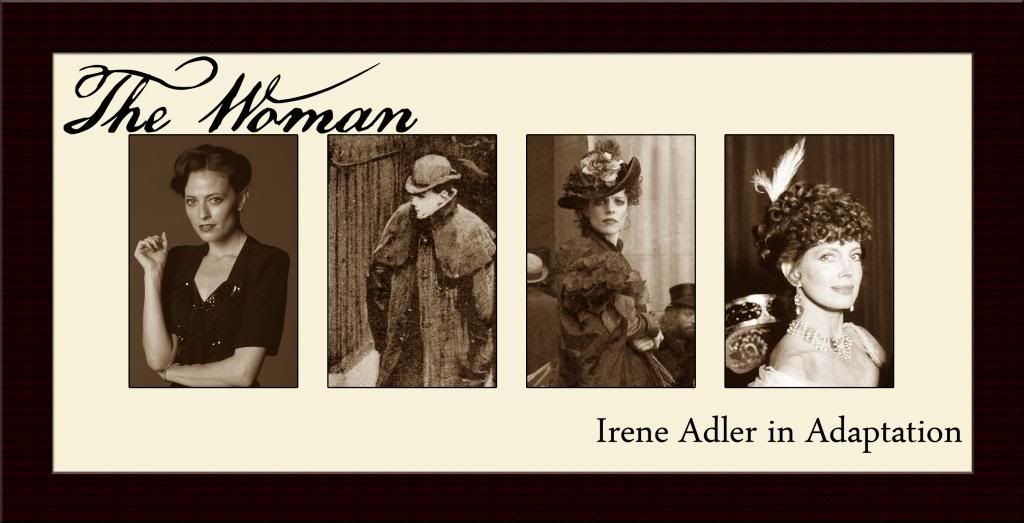
(Disclaimer: If you’re a hardcore Sherlock fan who sees no problem with Irene Adler’s portrayal in the show, this may not be the post for you. Here, there be dragons. Also, NSFW content.)
Imagine, if you will, a modern adaptation of “A Scandal in Bohemia” as an exploration of the spread of digital information set against the backdrop of a status-obsessed high school. Sherlock Holmes is the weird kid, an adolescent Encyclopedia Brown with a drug problem who has recently gained notoriety for acting as a consultant for the local police. John Watson is his straight-laced best friend, recently injured in an Army Cadet exercise. Irene Adler is the former choir star who regularly misses class to visit exotic climes. Last year, she had a fling with a popular student known in the drama department as the King of Bohemia, who has told his new girlfriend’s strict parents that he is saving himself for marriage. When Irene threatens to email incriminating pictures to the king’s potential future in-laws, the king knows it’s time to bring in the big guns, in the form of Sherlock Holmes.
Will Holmes prevail? Will we want him to? No, because this Irene is a woman wronged, whose trust and home are violated, whose quest for revenge ends when she decides to be the bigger person, and whose actions prove her more than equal to the greatest detective in literature. You know, like in the original.
Our point with this exercise is this: it’s not that hard to make a modernized adaptation faithful to the spirit of the original work. Looking at “A Scandal in Belgravia,” however, you’d think it was impossible.
(Full disclosure: Although Ashley has seen every episode of Sherlock, I’ve only watched this one. She’s out of the country right now, so I’ll limit my comments to observations about this specific episode.)
So, to quote the King of Bohemia, the facts are briefly these: Sherlock and Watson are caught in a stand-off with Moriarty when Moriarty gets a phone call that convinces him to let them go. We learn that the mysterious caller was a woman, and we soon find out that this is the woman when Sherlock is hired to find sexually explicit pictures taken by the dominatrix, Irene Adler, of herself and a young, female member of the British royal family. Hijinks (that we will detail a little further on) ensue and Irene keeps the photos from Sherlock’s grasp. So, technically, the “Scandal in Bohemia” section is finished about half an hour in. After this, the episode essentially becomes a piece of particularly misogynistic fanfiction.
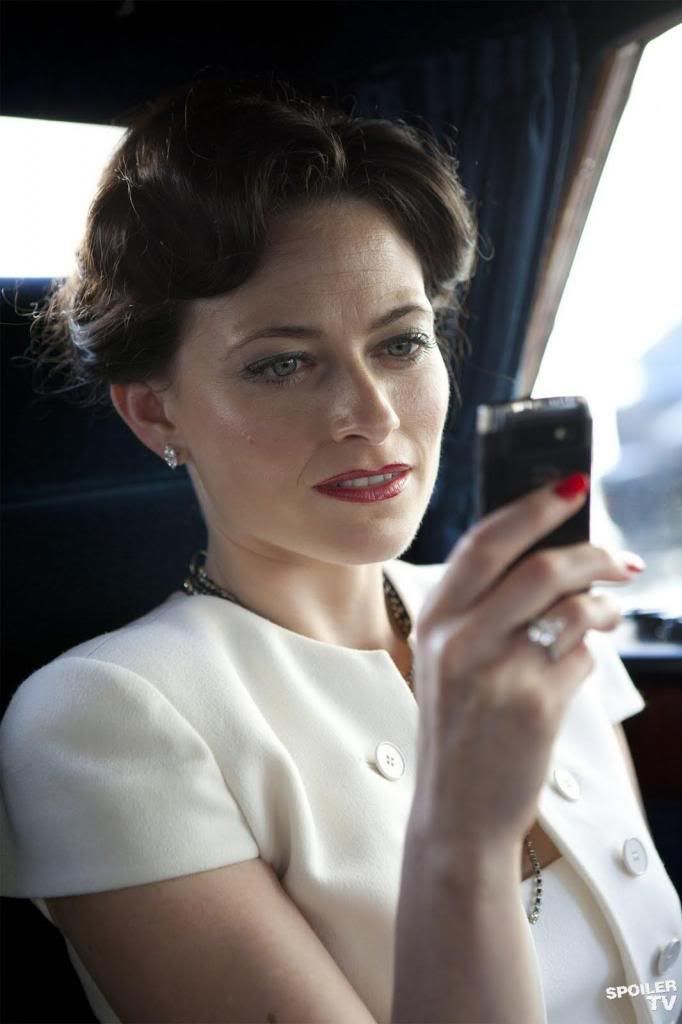
Let’s start again because, as Sherlock Holmes states, “it is a capital mistake to theorize before one has data.” Irene Adler is introduced as a hand with carefully manicured, long, crimson nails clutching a cell phone. When she walks further into the shot, she is wearing black lingerie. Her head is never revealed, showing her to be an anonymous body. She enters a doorway through which we can see the legs of a woman shackled to a bed. Accompanied by the crack of a whip, she says to the woman on the bed, “Well now, have you been wicked, Your Highness?” The shackled woman replies, “Yes, Miss Adler.” And that’s how we meet Sherlock Holmes’ intellectual rival: as a body.

This becomes a recurring problem. Before she meets with Sherlock, there is a scene juxtaposing their separate preparations. Both consider their chosen outfits to be a kind of armour, but while Sherlock remains fully clothed as he puts together his clergyman costume, Irene is again shown in loose, barely there robes and revealing gowns. While she gets ready, the camera lovingly captures (in fragmenting close-up) the sensual movements of her girlfriend/personal assistant/person whose role I’m pretty sure is never really explained applying her eyeshadow and lipstick. Her assistant, Kate, asks what she will be wearing, and Irene answers, “My battle dress.” Which, it turns out, is nothing at all. She throws off Sherlock’s game by arriving naked, relying solely on her body to blast through his defenses. As if all this weren’t enough, the code to Irene’s safe turns out to be her measurements. Because she describes the phone hidden in the safe as her life, her body is literally the key to her life.
Like many of the other people who have commented on this episode, we have no problem with the fact that she’s a sex worker. What we do take issue with is the way in which sex and sexual control form almost the entirety of her character. When she talks about using her connections with specialists or influential people, the connection was invariably forged on the job; when she says she knows someone, the implication is always that it’s in the Biblical sense. She even reframes intellect in these terms, stating that “brainy is the new sexy.” And the thing is, she is brainy, but every time she or Sherlock accomplish some impressive intellectual task, she immediately links it to sex. The best example occurs late in the episode, when Sherlock cracks the code to discover the flight information of a doomed airplane; to show her appreciation for his skill, Irene states, “I would have you right here, on this desk, until you begged for mercy twice.”
There is another problem with this conceptualization of Irene Adler’s power. In the original story, most of the punch of Sherlock’s defeat comes from the fact that she beats him at his own game. He is known for using his powers of deduction; she deduces either that the kerfuffle outside her house was staged or that Holmes was in disguise (or both). He meets her in disguise, so she wears one to follow him and confirm his identity. In Sherlock, however, Irene is constantly manipulating his apparent discomfort and inexperience with sex. It is the difference between besting a master in their area of expertise and striking an easily exploitable weakness. One’s just more impressive than the other.
Comparing these two methods, I find it interesting that the original story complicates Irene’s deduction by portraying her as unwilling to believe that an old clergyman could be working against her. Essentially, she almost doesn’t win because she wants to think the best of people and assumes that an old man who was injured trying to help her is a decent human being, not an agent of her enemy. The Sherlock Irene, by contrast, messes with people’s lives by faking her own death and threatens to incite scandal just for the hell of it.
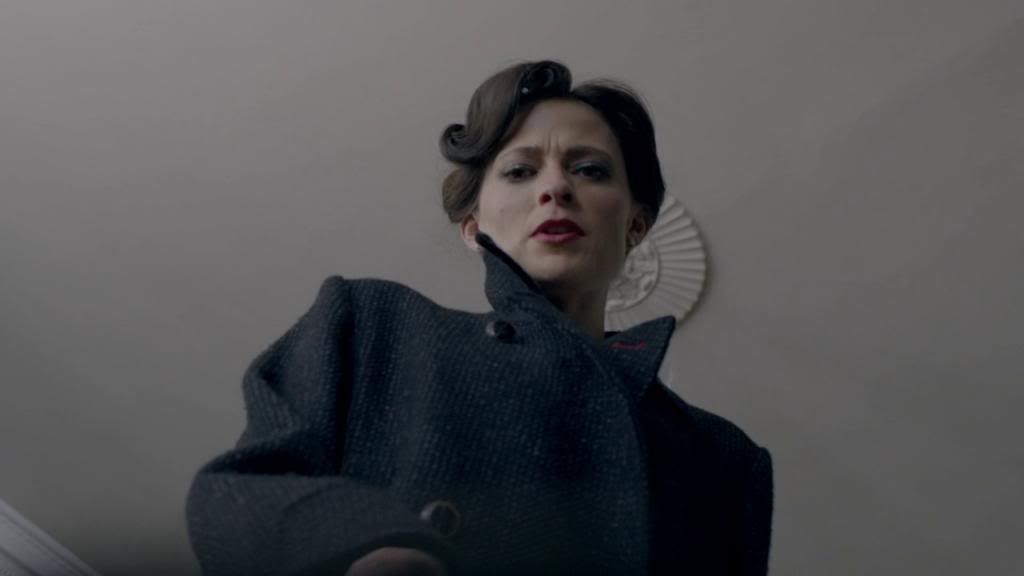
Here’s the deal: I love female characters with dubious moral codes. Give me all the ladies with checkered pasts and compelling, human weaknesses. What I don’t like is the fact that modern (almost always male) writers cannot conceive of a powerful, intellectual woman like Irene Adler being genuinely decent. The scandal in the original story would have been the result of the king doing Irene some cruel wrong, which may or may not be the wrong of carrying on a long-term, sexual and romantic relationship and then pulling the plug because Irene was not of his social status, a fact that he knew going into the relationship. Any payback she exacted could easily be justified as karma.
In addition, the context of the original story has people constantly violating her privacy and invading her home in order to steal her personal belongings. It’s not wrong to be a bit annoyed by that. Still, she doesn’t ruin the king’s life and even makes a point of being the better person. She’s a thoroughly decent human being. In modern adaptations, however, she’s made into a manipulative love interest and antagonist because obviously a powerful woman has to be evil. Or, at the very least, morally inferior to Sherlock Holmes.
What proves that this adaptation misses the point of the original story is not the fact that its Irene is morally inferior to Holmes, but that she is intellectually inferior to him. While most of the episode is offensive, it is in the climax that it proves itself offensively wrong.
First, Irene loses. The whole point of the character in the original depends on her victory, but this Irene does not triumph. She’s not even an independent agent, working instead with Moriarty. Even with the assistance of a man, she cannot beat Sherlock, who bests her in the nick of time and then gloats about it, literally making her beg for protection. Instead of Sherlock learning a lesson in humility, Irene is humiliated.
Beyond the obvious problems with this ending in terms of Irene’s depiction, it has disastrous consequences for Sherlock’s character. Sherlock has to lose to Irene, if for no other reason than that it builds his character. It makes him human and shows him to be fallible. It makes the times when he wins matter more, because we now know that he can lose. It takes him down a peg and makes him acknowledge the value of others. It forces him to reassess his assumptions, ultimately helping him to eliminate his blind spots and become a better detective.
This brings us to this adaptation’s treatment of “the woman.” The title is not originally bestowed by Sherlock on Irene as a mark of respect; instead, it’s Irene’s self-constructed business persona. Sherlock’s brother, Mycroft, suggests that Sherlock’s use of the title could be either a sign of loathing or a salute. The fact that the first is even an option shows that this adaptation went off the rails.
Even the possibility that it is a sign of respect seems unlikely, as Sherlock spends much of the episode being extraordinarily condescending to her, with one brief respite when it becomes apparent that she has played him. In the climactic scene, however, his superiority is restored. He solves the code on her phone and then lectures her about the reason why she lost. As he observes, “this is your heart, and you should never let it rule your head.” Irene Adler is defeated by her love for Sherlock Holmes. She falls victim to her womanly feelings and finds herself beaten by Sherlock’s masculine intellect. It is too awful for words, except perhaps these: if your adaptation of a 120-year-old story has a more antiquated formulation of gender roles than the original, you need to take a long, hard look at your life.
Finally, because a sandwich just isn’t a sandwich without the tangy zip of Miracle Whip, an analysis of “A Scandal in Belgravia” isn’t complete without some mention of its awful treatment of Irene’s sexuality. Not only does Irene fall in love with Sherlock, she does so while seemingly identifying as gay. When she assumes that Watson and Holmes are in a relationship, Watson tells her that he isn’t gay, to which she responds, “Well, I am.” Upto this point, she appears to be portrayed as bisexual, having had relationships with both men and women. With this scene, however, there is a strangely deliberate attempt to turn this into the story of a lesbian who falls in love with a man.
One could make the argument that sexuality is fluid, and that love defies gender. Of course, on television, that’s only ever true of young, attractive women whose queerness is often fetishized before they invariably fall into a heterosexual romance. There is no attempt made here to explore the nuances of sexuality. There is only an incredibly dubious heterosexual romance between an ostensible lesbian and a man often read as asexual, which ends with the man saving the woman as if she were a damsel in distress. It’s the opposite of progressive.
And this is ultimately our problem with this adaptation: for a modern Sherlock Holmes, it seems positively primeval.
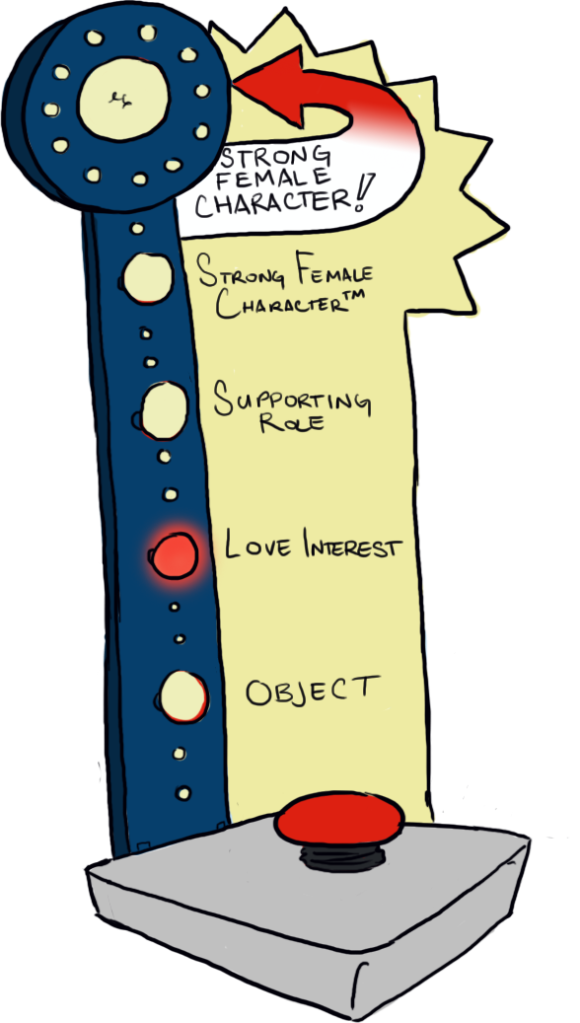
Verdict: Strong Female Character™
And remember, we strongly recommend that you check out our new Monday posts, helping you with gift ideas for your friends, your family, and yourself from now until Christmas.
Jumat, 09 November 2012
The Evil Exes
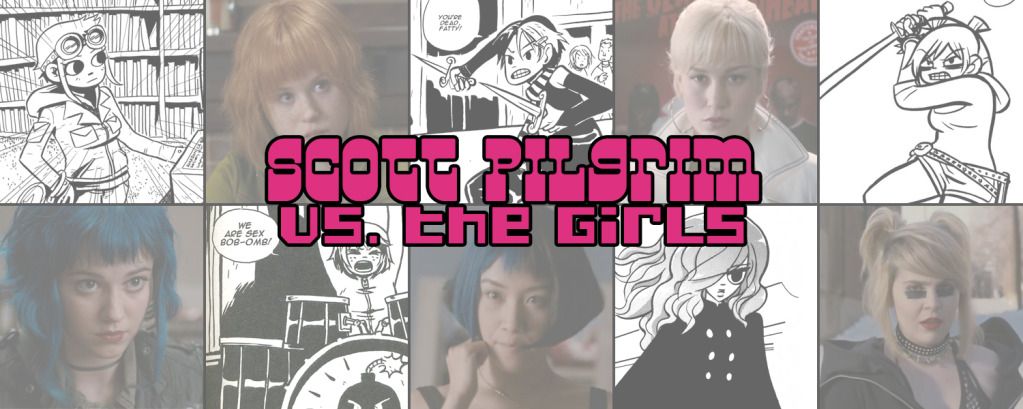
In a series that unfolds like a video game, we would be remiss if we didn’t discuss the boss battles. By this, of course, we mean the evil exes.
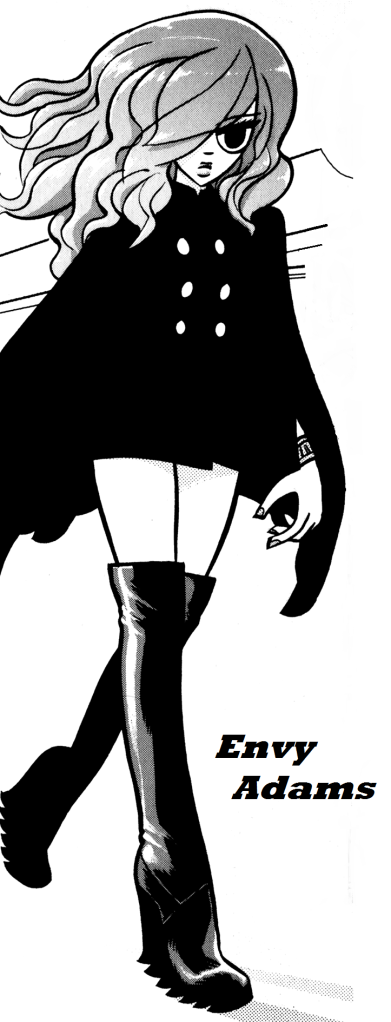
Envy Adams
In Natalie V. “Envy” Adams, Bryan Lee O’Malley traces the rise of a superstar and the fall of a fairly decent human being. When we meet Natalie in a flashback, she is an anime fangirl who wears baggy hoodies and dislikes parties. Over the course of her relationship with Scott, she gives up her fannish obsessions, selling her prized possessions for clothing and accessories; changes her name; stops remembering relationship milestones; doesn’t bother hiding her probable cheating; and makes all the decisions for the band they started with Stephen Stills, even forcing Scott to switch instruments. Hers is a classic transformation for the sake of money, fame, and power.
Well, money, fame, power, and a guy. Envy appears to be yet another example of what can go wrong when a woman builds her life around a man. She is completely devoted to Todd, and this makes her blind to his flaws and his transparent lies. She believes that his gesture of love -- punching a hole in the moon -- demonstrates an equal devotion. She believes that gelato is vegan, because Todd says so. Even after she has discovered his infidelity, she believes on some level that Todd didn’t deserve to be defeated. Finally, in the scene in which she departs from Toronto, we catch a glimpse of Natalie, once again clad in a hoodie, taking this opportunity to remake herself without a male influence.
Except, of course, that she doesn’t. The next time we see her, she is preparing to debut her solo album under the watchful eye of Gideon Gordon Graves, Ramona’s seventh and most evil ex. She is intensely fetishized, as he mentions his tendency to dress her up like a Barbie in order to achieve sexual fulfillment. She has been reduced from a woman in control, determining the conditions for Todd and Scott’s battles, to a sparkling bauble for Gideon to play with.
It’s difficult to resist the symbolism that emerges in these last few moments with Envy. Gideon has dressed her in a butterfly outfit, as if to represent metamorphosis and flight. However, he literally removes her wings in order to get to the sword he concealed in her outfit, leaving her in a “sexier dress.” She is clearly reduced to a mere object. Bizarrely, though, by the end of the final battle, she is once again left on her own, and she retains some form of power; using her song, she releases the six potential girlfriends Gideon had locked away. It’s a strange moment, because it seems like Envy’s selfish need to perform nevertheless has positive consequences.
This is one of the problems with Envy: she is difficult to figure out. She has a shifting identity, being both Natalie and Envy to varying degrees throughout the series. The one thing that is clear about Envy is that our view of her is clouded by Scott’s perception. She has the power to literally make him fall to pieces. For the duration of her first phone call with Scott since their break-up, the visual style of the comic changes. Suddenly, the page assumes a fragmented appearance, with smaller panels in a 3x3 format depicting Scott’s memories of Envy interspersed with the scattered pieces of his body, separated by the gutters between panels. His self is actually torn apart.
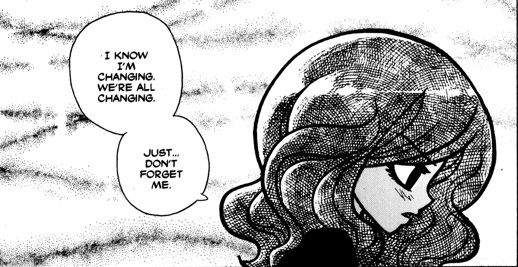
The concept of perception is further complicated by a statement Envy makes at the end of this conversation: “I know I’m changing. We’re all changing. Just... don’t forget me. This is the only me he knows...” This is an issue that goes beyond the problematic aspects of Scott’s suffocating perception that we brought up in our discussion of Kim. Guilty of papering over real events with his more convenient memories, Scott is being entrusted with the preservation of Natalie V. Adams. He must keep an entire person alive.
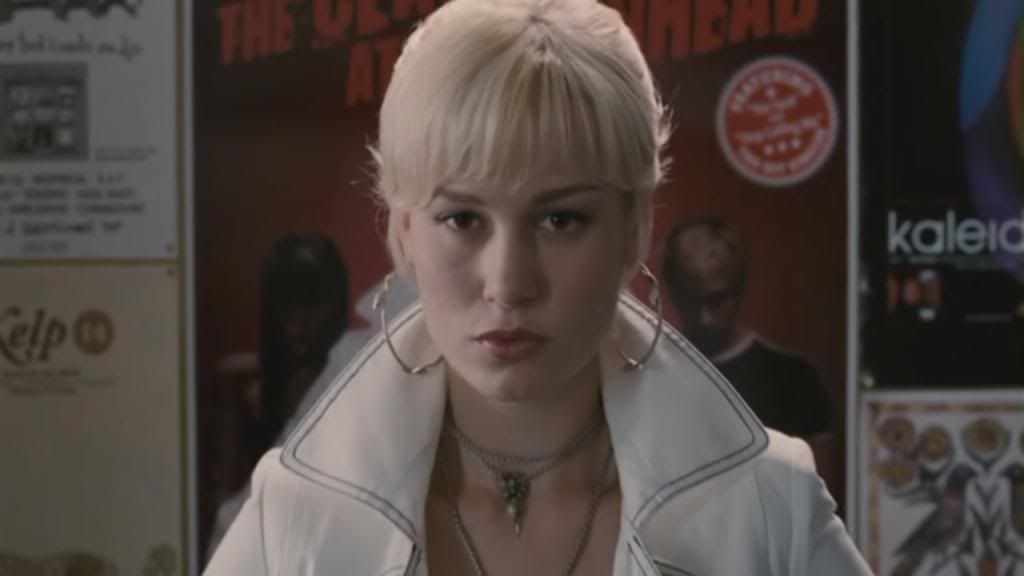
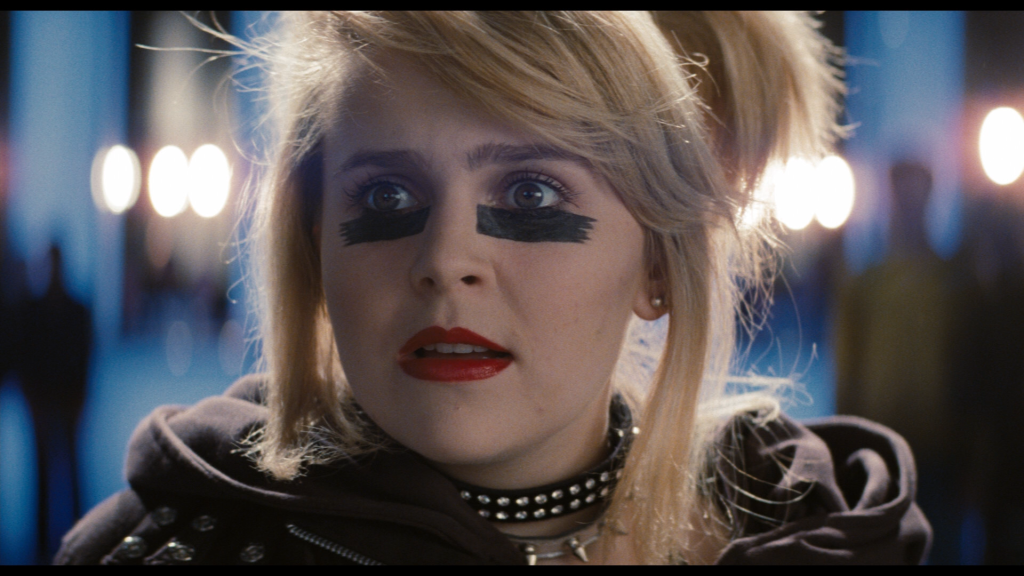
It almost seems disingenuous to mention the film version here, because she’s nothing more than a caricature. She doesn’t even get to fight. She does, however, get to rock a Metric song.
Verdict: Love Interest
Roxie Richter
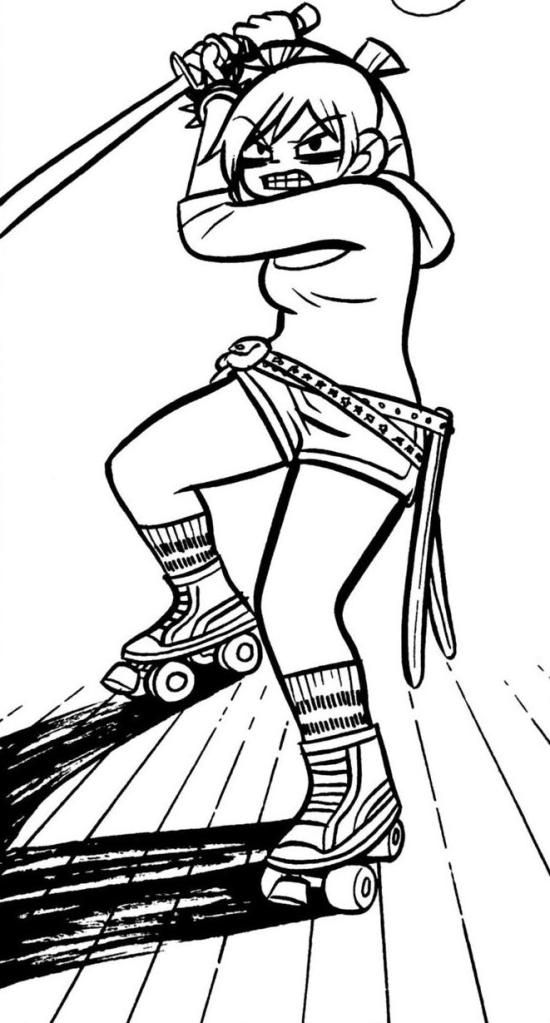
Roxie is introduced as an almost invisible force, which seems somehow appropriate when she represents a group of people heretofore invisible in the series’ universe. We learn that the canonical reason for this is that she is a half-ninja and therefore has a sword, as well as the ability to move with “almost ninja-like stealth and speed.” We also learn that Roxie and Ramona were roommates at the University of Carolina in the Sky, a floating school tethered to a mountain by a giant chain. Unlike any ex before her, Roxie seems to have Ramona’s number, calling her out on her habitual cheating. At the same time, Roxie is clearly the ex Ramona knows best, evidenced by the familiarity of their highly personal insults.
There is a strange and unpleasant subtext in the treatment and characterization of Roxie. She is intensely insecure, interpreting Ramona’s comment that she’s a lousy excuse for a ninja as a slight against her half-ninja status: “Half ain’t good enough, huh?!” When Knives’ father shows up to fight Scott, Roxie immediately assumes that Gideon sent him to help her. She has an emotional outburst, shouting, “I don’t need help! Why doesn’t anyone ever believe in me?!” Even the expository text doesn’t respect her, identifying her as the “4th evil ex-boyfriend.” Further supporting the idea that no one takes her seriously is the fact that, after Scott avoids every opportunity to fight her, one time even going so far as to hide in Ramona’s subspace suitcase, he defeats her with a single blow.
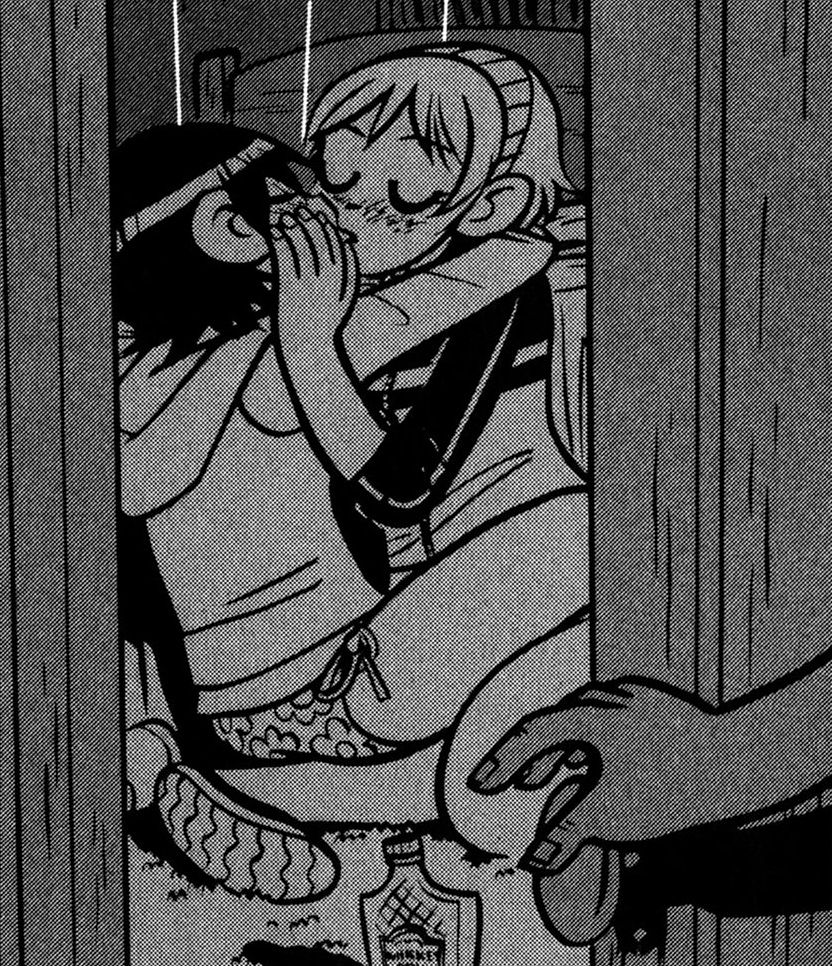
It seems to be no coincidence that she is the ex that represents a homosexual blip in Ramona’s largely heterosexual dating history. Her relationship with Ramona was, for Ramona, apparently just a phase. Even when Roxie promises to kill him, Scott doesn’t consider the possibility that she might be one of the evil exes or, indeed, the reason why Ramona no longer refers to them as her seven evil ex-boyfriends. Instead, he assumes that Roxie is merely dating one of the exes. The realization of her true identity is so momentous that it requires an entire page for Scott’s brain to literally crack open. He points a finger, almost in accusation, and then, when Ramona says that it was only a phase, he replies, “You had a sexy phase?!” Every other ex at this level is a serious threat, and Roxie is part of a sexy phase.
Indeed, the book even puts forward the idea that a woman cheating on a man with another woman isn’t actually cheating. When Ramona tries to apologize to Scott for Roxie staying at her place, she assures him that they “didn’t even make out that much.” This is apparently not infidelity enough to get in the way of an exchange of love confessions.
To add insult to injury, Roxie shows up in the volume where Scott finally gets up the nerve to tell Ramona that he loves her, thereby earning a sword representing the Power of Love. So the heterosexual man defeats the queer woman who dated his girlfriend with the power of heterosexual love. This may be the absolute worst statement made in the entirety of the series.
It’s especially obvious that Roxie and Ramona’s relationship is invalidated due to Roxie’s gender, as she is actually quite clearly second only to Gideon in the extent of her effect on Ramona. Ramona’s trademark rollerblades seem to be a riff on Roxie’s rollerskates. Roxie claims on two occasions to have taught Ramona everything she knows about subspace. She seems to be the only person Ramona didn’t just play with for a few days or weeks before she got tired of them, as demonstrated by their familiarity with each other and Ramona’s decisions to have lunch with Roxie and visit her gallery opening.
What complicates the portrayal of Roxie in the comic is, as always, the fact that we are still by the fourth volume quite firmly entrenched in Scott’s point of view. His heteronormative viewpoint may be affecting the storytelling itself. This seems unlikely, however, because most of the instances where Scott’s perspective has a profound effect are interrogated in some way. This is played pretty straight. (Pun intended.)
What is also played pretty straight is the film’s rendition of the Scott vs. Roxie battle. We’ve talked in every post in this series about the injustices done to the female characters in their translation from page to screen. In a lot of ways, it may have been more apt to call this series “Scott Pilgrim Vs. the World Vs. the Girls.” Still, no female character’s arc becomes more thoroughly offensive than Roxie’s.
Roxie, or Roxy, as she’s apparently called in the film, is introduced almost exactly as she is in the comic. Her defeat, however, could not be more different. This is partially because in the original, it’s not actually her battle, but rather one that takes place between Ramona and Envy. The battle begins when an invisible Roxy punches Scott in the back of the head and knocks him to the ground. As he sits up, we’re given a delightful view of him framed by Roxy’s legs, just to demolish any hope you may have had that Roxy was going to be treated as seriously as the other exes.
This becomes even clearer when Ramona tells Scott not only that her relationship with Roxy was a phase, but that “it meant nothing. I didn’t think it would count! … I was just a little bicurious.” As if this weren’t bad enough, the soundtrack for the reveal that Roxy is one of the evil exes is punctuated with breathy feminine sighs.
When Roxy then tries to attack Scott, Ramona intervenes; in this version, she doesn’t fight Roxy because Scott is hiding behind the rules of chivalry and his own terror, but because she just... does? It’s not explained. Roxy also suddenly fights with a whip-sword-belt-thing because, I don’t know, it’s sexier than a sword or something. (The change is likely a matter of increasing visual interest and avoiding repetition in a film where the final battle involves swords, but still...) When Roxy reveals that Scott will have to defeat her by his own hand, he protests, saying that he can’t hit a girl. Instead of denying Scott the moral high ground he thinks he deserves for taking this position, as Ramona and Roxie both do in the book, Ramona just tells him that he has no choice... and then proceeds to control his limbs as he enters into fisticuffs with Roxy.
Then something happens that makes us a little bi-furious. As Roxy lifts her leg in the air to deliver the final blow, Ramona tells Scott that Roxy’s weakness is an erogenous zone at the back of her knee. This will be familiar to readers of the comic as Envy’s weakness, discovered by Scott during a serious two-year relationship, and used to take her down in a non-lethal manner. In the movie, however, it is a weakness discovered during just-for-fun make-out sessions, used by a straight man to orgasm a queer woman to death. Roxy’s last words: “You’ll never be able to do this to her,” followed by a blissful moan. Our reaction: not suitable for print.
What really irks us about this scene is that it is so intentional. Roxy suffers a perfectly adequate, if still dubious, defeat in the comic, so the appropriation of Envy’s fight and weakness represents a deliberate change. A character that is already treated as a joke is humiliated in an incredibly offensive way, and we’re supposed to find it funny. We are, perhaps, even supposed to think it better than the original. We’re actually not sure what could have been worse.
Verdict: Love Interest (Comic) and NO NO NO OH GOD WHY (Film)
Langganan:
Postingan (Atom)