Senin, 17 Desember 2012

Live-Action Television Recommendations


Once Upon a Time

First things first: this show is probably the best thing to arise from Hollywood’s recent obsession with fairy tales. Seriously.

Once Upon a Time (created by Edward Kitsis and Adam Horowitz, of Lost and Tron: Legacy fame) takes place in the fictional town of Storybrooke, Maine, a town populated entirely by characters from various fairy tales who have been banished from their homeland and can’t remember a thing about their past lives - the result of a curse laid on them by the evil Queen-cum-mayor, Regina. The town’s only hope of having the curse broken lies with Emma Swan, bail bondswoman, daughter of Snow White and Prince Charming, biological mother of Regina’s adopted son Henry, and skeptic. Each episode focuses on a selected character’s actions in present-day Storybrooke, paralleled by that character’s back story, ultimately revealing the characters’ connections both to each other and to the curse.

The awesome thing about this show is that it’s full of, well, awesome female characters. According to Wikipedia, eleven out of twenty-one main and secondary characters are female. Kitsis and Horowitz have done an amazing job with steering the women of the show away from traditional damsel in distress roles and firmly into strong female character territory. Along with Emma and Regina, there’s Snow White, the ex-forest bandit; Mulan, a warrior who guided Prince Philip to the princess he rescued; and Aurora, who (in a refreshing change of trope) is motivated into action by the death of a male. Throw in some realistic and positive portrayals of relationships between women, and I think we have a winner.

Terminator: The Sarah Connor Chronicles

Popular culture tends to remember the Terminator movies in terms of lines spoken by the title character. Although the films have been immortalized in endless repetitions of “Hasta la vista, baby” and “I’ll be back” and even “Come with me if you want to live,” we think that the most important contribution the Terminator franchise has made to society comes in the person of Sarah Connor.

In the original films, Sarah Connor is a modern-day Mary, a woman fated to become the mother of humanity’s saviour in the future war between humans and robots. In order to prepare her son, John, for his destiny, she makes herself into his mentor and example. While the third and fourth films focus on John, the television show expands its own focus to explore the character of Sarah as she struggles to train a reluctant chosen one and, if possible, destroy Skynet before it brings about the robotic apocalypse.

In addition to Sarah and John, the show features Cameron, a Terminator who is sometimes a little too human. The complicated relationship between Cameron and Sarah is one of the show’s major achievements; both of them seek to keep John safe, but Sarah cannot help but be suspicious of a robot programmed to protect a man who will eventually lead the fight against robots. The show is a rather philosophical addition to the franchise, using its episodic structure to address issues of fate and human nature that were less profoundly explored in the films. Unfortunately, it was a victim of the writers’ strike and Fox’s whims, so there are only thirty-one episodes to enjoy.

The Good Wife

I have to begin this recommendation by admitting that all of my knowledge about The Good Wife comes from fannish osmosis and watching the first season. It’s the show I’ve always intended to see, but never (until recently) managed to catch. Fortunately, I recently began watching it, just in time for it to make its way onto my Christmas list.

The show takes as its focus a wife wronged when her politician husband is caught frequenting prostitutes. After her husband, the Cook County State’s Attorney, goes to prison, Alicia Florrick returns to work as a lawyer to make ends meet. Hired at the law firm of Stern, Lockhart, & Gardner while the effects of the 2008 financial crisis were still being keenly felt, Alicia quickly learns that she will be in competition with another junior associate for a single position. In order to win cases and secure this job, she must use her husband’s connections, no matter how reluctant she is to do so.

What makes this show stand out is the care with which each and every female character is crafted. The principal women, Alicia, Kalinda Sharma, and Diane Lockhart, are all compelling characters who take control of their own lives. This depth of characterization extends as far as one-time characters. It is very rare for any woman on the show to come across as anything less than a genuine person. Given, it seems only right that a show that revolves around a figure like the politician’s wife, often silenced or censored for the good of her husband’s career, would make a point of giving every woman it features a voice.

Dead Like Me

This is the opening credits sequence from Dead Like Me. Watch it. If that doesn’t convince you to track it down immediately, you may as well stop reading now.

Created by Bryan Fuller, the man behind the whimsical, gone-too-soon Pushing Daisies, Dead Like Me tells the story of George Lass, an eighteen-year-old girl killed by a toilet seat as it fell from the de-orbiting Mir space station. But, as in all shows where the protagonist is killed in the first episode, death is only the beginning. George learns that she is now a Grim Reaper and must collect an unknown quota of souls before she can move on to the “great beyond.” Of course, moving on -- from this world and from her family -- is a lot harder than it seems. Luckily, there’s a whole new dysfunctional reaper family to take George in and teach her how to go on living now that she’s dead.

Like Bryan Fuller’s other shows, Pushing Daisies and Wonderfalls, Dead Like Me is full of excellent female characters. In fact, based on my calculations, the ratio of women to men among the main cast is something like 7:2. Among George’s fellow reapers are the fearless Betty, the badass Roxy, and the melodramatic Miss Daisy Adair. In addition to her new job, the show focuses on George’s family, particularly her mother and sister, as they try to cope with their grief. Finally, in her other day job at a temp agency, there is Delores Herbig, George’s endlessly entertaining and perpetually surprising boss.

Bomb Girls

While the first four episodes of the show were airing, I had no urge to watch the Canadian World War II drama Bomb Girls. The advertising made it seem like what Lumpy Space Princess might call “a trashy show for ladies.” Then the Internet told me what I’m telling you now: I was wrong. This show is so good.

The show revolves around the women working at the Victory Munitions bomb factory in 1940s Toronto. Gladys, a wealthy young woman with a need to prove herself outside the boundaries of her privileged life, quickly parlays a position in the office into a job making bombs on the factory floor. There she meets Lorna, the shift matron coping with her husband’s emotional neglect and her two sons’ potential deaths overseas; Betty, the model worker who struggles with her inability to live a model (heterosexual) life; Kate, the mysterious new girl whose identity is a lie concocted to help her escape her abusive father; Edith, Lorna’s right-hand woman; and Vera, the group’s social butterfly, particularly social with the men left at home. Together, they must learn to enjoy their new freedoms and challenge the old rules.

This show is the cure for the common costume drama. It doesn’t use the historical setting in order to excuse and perpetuate sexist attitudes. Instead, it uses the situations of yesteryear in order to address the problems of today. I personally fell irrevocably in love the moment it became clear that they were going to address the media’s representation of women (with particular emphasis on the concepts of heteronormativity and the male gaze) in the world of the show. Yes, that is an actual thing that happened and yes, it was glorious. If you like reading this blog, you’ll almost certainly like this show.

Jumat, 14 Desember 2012

My Lovely Lady Lumps


Adventure Time,
C’mon, grab your friends
We’ll go to very distant lands.
With Jake the Dog
And Finn the Human,
The fun will never end,
It’s Adventure Time!

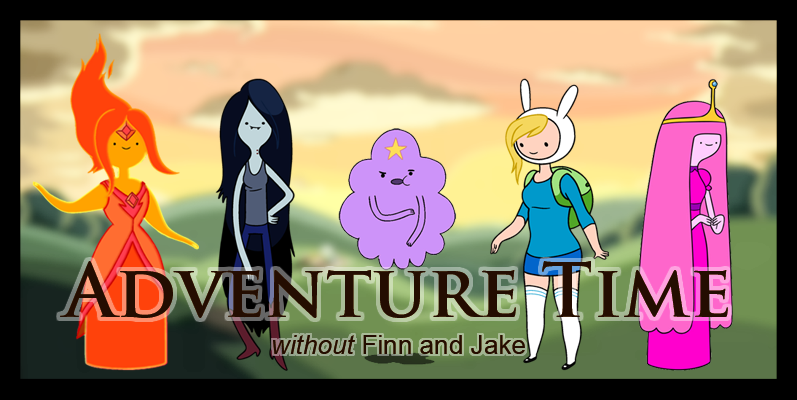
So begins the animated tale of an epic bromance set against the backdrop of a post-apocalyptic fantasy land... And so begins our analysis of basically everyone but Finn and Jake.

It’s not that we don’t appreciate the profound friendship between a boy and his shape-shifting dog; it’s just that we’re more interested in a sucrose-based scientist, a corporeal cloud, a royal red-eater, a pyrotechnic princess, and, well, the gender-swapped versions of the aforementioned bros.

We are also interested in any show that recognizes and interrogates our cultural obsession with princesses, and Adventure Time seems to have made this one of its major causes. Obviously, a show about a capital H Hero having capital A Adventures has to have a plethora of damsels in distress, and tradition dictates that as many damsels as possible should be princesses. This compensates the Hero for his efforts when he marries one of them and becomes a Good and Virtuous King. The thing is, this model generally assumes the presence of one princess, not dozens, per hero and it sort of precludes any situation in which the hero has to save a girl made of slime or compressed pseudo-meat.

Not so on Adventure Time, where the idea that every little girl can be a princess is taken to its logical conclusion. In this world, almost every female character really is a princess, even those who are merely cursed with a particularly royal surname. Though we won’t be covering Dr. Princess in these posts, we will be dealing with four monarchs or heirs to the throne.

As you can probably tell from the title, we’re starting with the inimitable (though oft-cosplayed) Lumpy Space Princess. LSP is the princess of a cloud realm where you have to travel everywhere by car if you don’t want to risk falling into the abyss of space. So, L.A., presumably. Accordingly, she is a bit of a drama queen, blowing things out of proportion and reacting to seemingly minor problems with extreme displays of temper. This tendency to exaggerate and embellish leads her, on a few occasions, to become a pretty self-aware parody of teenage existence. Our favourite example takes place when Finn’s army of friends is about to take on the Cuties and LSP outlines her personal game plan: “First, I’m going to fall in love with one of those little guys, and then I’m going to fall out of love, and then I’m going to totally fake die of a fake heart attack! Oh, my heart! My heart hurts because I fell out of love! And now I have to die! Aaaaaah!”

Her flair for the dramatic also leads her to perform very interesting acts of self-narrativization. In “The Monster,” LSP recounts the story of how she ran away from home and was raised by wolves, before being rejected by her lupine family and forced to become known as a monster in order to survive (all over the course of what seems to be a few days). During this harrowing adventure, LSP proves her resourcefulness, by making a failed shelter out of acorns; her adaptability, by becoming part of a wolf pack; her sense of honour, by exposing a cheating scandal within the pack; and her concern for others, by eating an entire village’s food supply and helping them to lose weight. As she tells it, she even saved the village that she actually terrorized. In a world with an official hero, it’s pretty awesome to see someone else cast themselves in the role, even if they’re perhaps over-selling it a bit.

We also appreciate a very specific way in which LSP’s self-centered world view manifests. LSP resembles every other stereotypical teenage girl character in every respect save, of course, for the actual physical resemblance. There is no way around the fact that she is a lumpy, purple blob living in a world where there is tremendous pressure to be smooth. In an early episode, she seems to succumb to these beauty standards, punching out her lumps in order to make herself more attractive. However, as the show goes on, she clearly comes to embrace her lumpiness and expects everyone to do the same, sometimes literally. This leads to a rather brilliant gag in “Gotcha”: as LSP is attacked by ants, snakes, and vultures, she tells them to stop hitting on her, saying that they “just want her for her lumps.” She also calls each of them by a ridiculous moniker; it’s not wild creatures attacking her, it’s Ricky, Billy, and Chad. She’s like a lumpy Adam, naming the animals in a 1990s Eden.

She also redefines inner beauty according to her new standard of lumpiness. Having initially planned to write a book about how Finn fell for her irresistible looks, LSP instead decides to write about Finn’s inner beauty. While we’re not exactly ecstatic that the whole “beautiful on the inside” validation came from a guy, we are very happy that LSP didn’t have to give up her pride in her physical appearance in order to appreciate inner beauty. She can rest assured with the knowledge that she is fresh to death inside and out.

As the series progresses, LSP’s portrayal becomes more nuanced and genuine. In “The Creeps,” an episode from the third season that gave us the immortal image of Lumpy Space Princess in a ballgown, she has a breakdown as she explains the circumstances of her break-up with her ex-boyfriend. As she recounts: “Brad! He kissed me on the mouth! And I was like, blah blah blah! And then I was like ‘Oh gross, go away Brad!’ and he was like ‘Obvi you’re not ready for me’ but what does that even mean you guys? What does it lumping mean?” She is facing the uncertainty of adolescence and being confronted with the fact that thinking you’re mature doesn’t mean that you actually are. She continues: “What do you want from me, Brad? You said I was the hottest one. Isn’t that enough?” She seems to think that Brad’s approval of her physical appearance should make her ready to take the next step in their romantic relationship, and she hasn’t yet figured out that she’s the only one that can decide when she’s ready. By the end of the episode, she is saying, “I’m ready for you now, Brad. Isn’t it obvi? I’m so ready.” It’s a strangely subtle B-plot: the confrontation of previously unexamined personal issues allowing a teenager to take one more step toward growing up.

Growing up and, we hope, pursuing a lucrative career of writing trashy books for ladies. I’m just saying, I could be seen in public reading Fifty Shades of Lumps.

Verdict: Actual strong female character


Senin, 10 Desember 2012

Comic Recommendations


This year saw comic-related movies smash box office records, as The Avengers and The Dark Knight Rises entered the list of the top ten highest grossing films of all time, in third and seventh place respectively. This seems like good news for comic fans, but all of these comic-based films making millions and even billions of dollars are about men.

Unless Black Widow has a ridiculously successful solo screen outing, this isn’t likely to change anytime soon. Although two of our recommended titles have been adapted into films, and the other three have all, at some point or another, had adaptations in some stage of development, they don’t provide much hope. Persepolis, while excellent, was a box office flop and lost the Oscar for Best Animated Feature to Ratatouille. Whiteout replaced one of the principal female characters with a man because obviously no one would want to see a film about two women solving a murder mystery. Fables seems to be the catalyst of the recent fairy tale trend in films and television, but it’s not being adapted itself. The last time I checked, Y: The Last Man was in limbo, partially due to Hollywood executives wanting to make a story that lasts five years into a film that lasts two hours. While Marvel focused its attention on The Avengers, The Runaways, a film that had already put out casting calls, quietly disappeared.

Basically, we’re saying that it’s best to read these stories in their original form, because waiting for the big-budget adaptation means you might be waiting forever.

Whiteout

Writer: Greg Rucka
Penciller: Steve Lieber

The first thing you need to know about this comic is that it is not the movie. Don’t watch the movie. Pretend the movie doesn’t exist. The next thing you need to know is that it is written by Greg Rucka, a man whose work could very easily have constituted an entire recommendation post on its own.

A body has been found on the ice in the Antarctic, and it is up to Deputy U.S. Marshal Carrie Stetko to find out not only who the faceless man is, but who killed him. While trying to figure out the matter of whoisit and whodunit, Stetko must deal with punishing cold, a fast-approaching deadline, and the disrespect of the majority of the male inhabitants of a station where the ratio of men to women ranges from 200-400 to one. Along the way, she meets and teams up with Lily Sharpe, a woman who may or may not be a British spy.

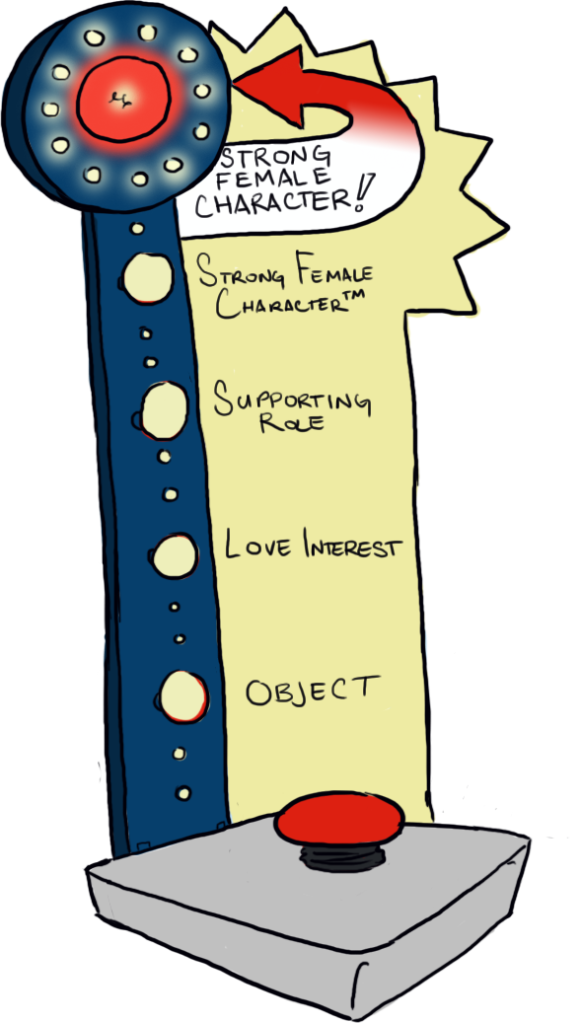
What makes Whiteout brilliant is the same thing that brightens up every one of Greg Rucka’s works: women who are competent, flawed people with agency and personality. Like Wonder Woman, Renee Montoya, Kate Kane, and all the other women Rucka is known for writing, Carrie Stetko and Lily Sharpe are certified badasses who deal with just as much tragedy and hardship in just as interesting a way as the men in other stories do. They’re what Strong Female Characters™ could be if they were people instead of fantasies.

Runaways

Writer: Brian K. Vaughan
Penciller: Adrian Alphona

Let’s be honest: the number one reason why everyone should read this series is that it features a telepathic raptor. That it also features a whole host of fascinating female characters is just the icing on the cake.

The story begins when the the families Wilder, Yorkes, Dean, Stein, Hayes, and Minoru gather for their annual business meeting, the parents leaving their six teenage and preteen children to their own devices while they talk about business. The kids eavesdrop on the meeting from a secret passageway and witness their parents killing a young woman in a ritualistic sacrifice. Faced with the fact that their parents are supervillains, Alex, Gert, Karolina, Chase, Molly, and Nico decide that it is up to them to become superheroes in order to stop the villainous Pride.

Runaways is an exceptional series for a number of reasons. The first is that it features a superhero team with a majority female membership. The second is that the leader is always a person of colour, and, for most of the run, a woman. The third is that it eventually has a really delightful queer couple made up of two aliens, one a lesbian with rainbow energy-shooting powers (which sounds like bad satire but is actually awesome) and the other a bigendered shapeshifter with the powers of the Fantastic Four. We’ll leave you to discover the rest of the reasons for yourselves.

Persepolis

Writer: Marjane Satrapi
Penciller: Marjane Satrapi

I (Megan) was first introduced to this book in a class on the graphic novel. Like Art Spiegelman’s Maus or Alison Bechdel’s Fun Home, Persepolis is a literary, autobiographical comic that quite adamantly disproves any notion that comics are only meant for kids.

Persepolis is the story of one girl’s coming of age during the Islamic Revolution in Iran. According to the blurb printed on the book, it is a tale of “the contradictions between private and public life in a country plagued by political upheaval; of [Marjane’s] high school years in Vienna facing the trials of adolescence far from her family; of her homecoming -- both sweet and terrible; and, finally, of her self-imposed exile from her beloved homeland.” While this is a pretty accurate summation of the story, it doesn’t tell you exactly why you should read it.

In the first few pages, the young Marjane introduces herself as the last prophet, destined not only to end unfair suffering and subvert a masculine tradition of prophecy, but to have jam sessions with God in her PJs. Her rebellious and unconventional personality causes her to chafe against the fabric of a newly restrictive society. Over the course of the book, we get to see the world through her eyes just as she is learning to understand it herself (filtered, admittedly, through the lens of an older, wiser self with an extensive art education). It’s a thoroughly enjoyable look “beyond the veil” that Western society tends to throw over the Middle East in general, and Middle Eastern women in particular.

Y: The Last Man

Writer: Brian K. Vaughan
Pencillers: Pia Guerra and Goran Sudžuka

In the musical Avenue Q, there’s a song called “What Do You Do With a B.A. in English?/It Sucks to Be Me.” That compound title is basically Y:The Last Man in a nutshell.

A recently graduated English major and escape artist, Yorick Brown becomes the last man on Earth following the gendercide, a plague that instantaneously wiped out every animal with a Y chromosome. Unfortunately, the mass death took place just as Yorick was proposing to his girlfriend over the phone, so he must travel to Australia to get her answer. His companions on the journey through a semi-post-apocalyptic landscape are his bodyguard, Agent 355, an increasingly violent and increasingly sympathetic member of a secret organization, and the brilliant, cold, and compelling Dr. Allison Mann, a geneticist who is trying to figure out what saved him.

I (Megan) wrote my Honours thesis on this series, and throughout the process I often joked that I could write a lengthy essay about every single one of the major female characters. (Writing this blog now, I’ll probably get my chance.) In addition to 355 and Dr. Mann, there are Alter, an Israeli general whose search for the last man does not bode well for anyone; the Other Beth, a former flight attendant who’s haunted by the memory of her last moments in the air; Hero, Yorick’s sister who copes with the gendercide by descending into violent madness before discovering her own heroism; and many others. In a series where basically everyone’s a woman, it’s not surprising to find a wealth of strong female characters.

Fables

Writer: Bill Willingham
Pencillers: Mark Buckingham, Lan Medina, Steve Leialoha, and Craig Hamilton

I, Ashley, have a confession to make: currently, Fables is the only comic series that I follow and actively purchase. That’s because it’s awesome.

First published in 2002 and still going strong, Fables follows various characters from fairy tales and folklore (the Fables) who were forced out of their homelands when it was overtaken by “the Adversary.” They now reside in modern-day America (Fables who are or can pass as human live in the community of Fabletown in New York City, while non-human Fables live on “the Farm” in upstate New York), facing modern challenges and fighting some literal battles.

While all the characters are well-known ones, such as Snow White, Prince Charming, and the Big Bad Wolf, Willingham’s writing... reinterprets them, to say the least. Snow White is the intelligent and sarcastic first ex-wife of Prince Charming, introduced as the deputy mayor of Fabletown. Rose Red, her sister, is a reformed party girl and anarchist who finds her calling managing the Farm. Briar Rose and Cinderella were Prince Charming’s second and third wives, and the latter now works as a spy. Amazingly, Willingham has given some pretty bland princesses some pretty awesome backstories and complexities, and given them key roles in Fables’ story arcs to boot.


If you do decide to pick up any of these titles, please choose to support your local comic shop.

If you’re looking for a woman-friendly comic store in the Lower Mainland of B.C., try Central City Comix.

And while we’re on the topic of comics, check out the Hawkeye Initiative (probably NSFW). You won’t regret it.

Jumat, 07 Desember 2012

Buy Humbug

 In honour of the holiday season, this week we’re going to do something a little different. At this time of year more than any other, we face a constant onslaught of advertising, telling us what we should want and who we should want to be. To us, this is yet another opportunity for the media to misrepresent, well, whole swaths of people, but often women and girls in particular. So, in another nod to the commercial Christmas spirit, we’d like to discuss the gender segregation of holiday advertising and why it just might be the most frustrating part of the so-called happiest time of the year.

A couple of weeks ago, my mother and I went shopping for some clothing for my nephew and cousins. As we entered Carter’s-OshKosh, I was taken aback by the difference between the two sides of the store. On the right side, there was a wide variety of clothing styles in a vast array of colours; on the left there was... pink. One side looked like a kids’ clothing store, and the other looked like a Valentine’s Day display.

Now, don't get me wrong. Pink as a colour is lovely; pink as a visual indicator of an object's "girls only" status is not.

We checked out the boys’ side first, its gender affiliation made obvious by the fact that none of the shirts had random ruffles on them. When it came to picking things out for my nephew and cousin, we were spoiled for choice. Then we entered Girl World, where everything was pink and sequined, emblazoned with floral patterns or “cute” sayings (or, in many cases, just the word “cute”). Throwing a glance back into Boy World, I noticed a shirt that read “Boy Genius;” turning to the ultra-feminine landscape before me, I glimpsed the girls’ equivalent: a shirt emblazoned with a heart and the words “Seriously Cute.” Eventually, we completed our expedition, having secured a single specimen of the rare green shirt. I might have thought it had escaped from Boy World, if the ruffles didn’t prove that it was native to the region.

This was such a troubling experience, I think, not because the gender split was new or surprising, but because it was so starkly represented.

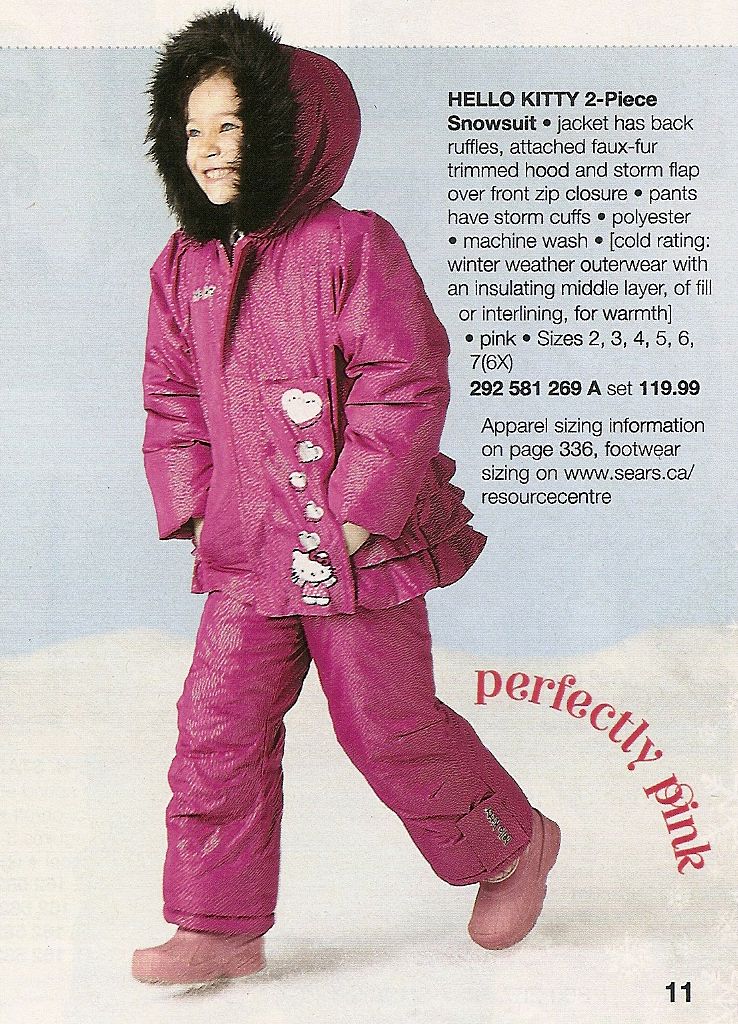
And brick and mortar kids’ clothing stores are hardly the only ones guilty of this rigid categorization. In the Sears Wish Book, a catalogue I’ve browsed every December for as long as I can remember, something like the first few dozen pages are split into gift types like “Cute Gifts” and “Gamer Gifts.” This seems like an admirably gender-neutral approach, until you actually pay attention to the models using the items advertised. “Gamer Gifts” features T-shirts that are only available in men’s sizes, “Totally Cool Gifts” shows a boy using spy gear, and “Galactic Gifts” (or “Star Wars Paraphernalia,” as it could also be known) contains both of these signs of female exclusion. Girls and women do get some items in “Super Gifts” (superhero things) and “Winning Gifts” (hockey stuff), but their only major categories are “Cute Gifts” (so much pink and Hello Kitty, it burns) and Playboy accessories. As if that weren’t enough, the “Galactic Gifts” spread shows a boy wielding a lightsaber with the words “take that, galactic empire” written across the image; by contrast, the “Cute Gifts” model is a girl in a pink Hello Kitty snowsuit just walking with an utterly unnecessary “perfectly pink” written next to her.

This continues throughout the catalogue, to the point that I actually started treating it as a bit of a guessing game. What gender was the model pictured using a punching bag? What about the superhero action figures, the fake guns, the toy cars, or anything from the movie Cars? Who could possibly be pictured playing with fairies, dolls, tea sets, or anything pink and princess-y? The answers are disturbingly obvious.

As for clothing, again, the shirts on offer for girls champion really dubious things. One has the image of Smurfette and the words “Born to be famous,” while another shows an image of Hello Kitty wearing glasses and the text, “Geek is the new cute.” While boys get shirts depicting superheroes and proclaiming their superior intelligence, girls get the message that their value is based on their appearance and their celebrity. And, while the latter would be pretty cool if the girl in question became famous for wielding major political power or making an important scientific discovery, the fact that they used Smurfette somehow suggests otherwise.

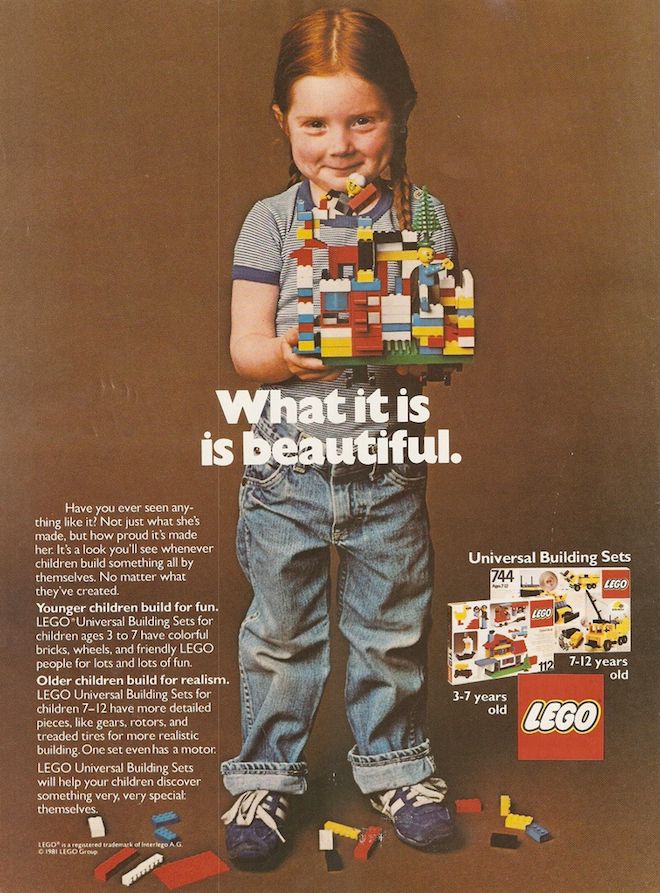
This is not to say that beauty can’t be part of the marketing for girls. Just look at this ad from 1981. First, nothing in this picture is pink. The girl is using real Lego and not the awful new Lego Friends sets; it’s a house that she created, not one that was pictured on the side of the box. More importantly, though, it’s the house that is labelled “beautiful,” not the girl. What is beautiful is the object she made and the imagination that produced it.

I mean, read the accompanying text: “Have you ever seen anything like it? Not just what she’s made, but how proud it’s made her. It’s a look you’ll see whenever children build something all by themselves. No matter what they’ve created.” That description, in and of itself, is a beautiful thing.

Unfortunately, that ad was released more than thirty years ago. Today, Lego produces ads like this one.

But all hope is not lost. In a viral video that has amassed over four million hits, a little girl named Riley Barry manages to isolate the problem of gender-stereotyped marketing while standing in the middle of an aisle of girls’ toys. She bemoans the fact that most of the toys being marketed to her demographic are pink, and argues that both girls and boys would like to play with both dolls and superheroes. Even if she is merely parroting what she’s heard her parents say, as some critics have claimed, there are certainly worse things for parents to teach their children than to question the social roles they are paying to embrace.

Thirteen-year-old Mckenna Pope has started a campaign to get Hasbro, the manufacturers of the Easy Bake Oven, to include boys in their marketing. Her younger brother wants the toy for Christmas, but he has been convinced by the advertisements that the product is only intended for girls. Mckenna’s petition on Change.org has collected over 31,000 signatures. (I signed it, because I had an Easy Bake Oven and I fully support any campaign that would allow all children to feel the pride that comes with eating that first batch of barely edible brownies.)

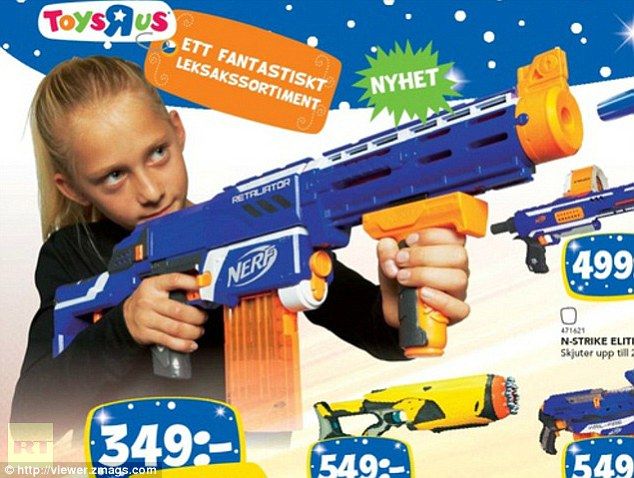
Real change has already occurred in Sweden, where the largest toy chain, Top Toy, has changed its marketing to a gender neutral model following a reprimand for discrimination by the country’s advertising watchdog. Their catalogue now shows boys playing with dolls and girls wielding toy assault weapons. It’s awesome.

Then there’s the response to one of my personal favourite marketing fiascos of the last year: the Bic for Her pen. Both men and women responded to the premiere of the “lady-pen” with often hilarious reviews, many female reviewers’ comments made all the more perfect by the thinly-veiled bitterness caused by a lifetime spent having to buy things that are strong enough for a man, but made for a woman. Even Ellen Degeneres weighed in, a few weeks late but scathing enough to make up for the delay.

We’d like to end this post on a truly positive note, but all we can really say is that, although gender stereotyped marketing is pervasive and pernicious, there is hope. Just, ironically, not around Christmas.

Senin, 03 Desember 2012

Animated Television Recommendations


One Christmas Eve when I was around seven, I couldn’t sleep. No matter what I did, the force of my breathless anticipation kept my eyes from closing. In those days, this was a serious matter; if I wasn’t sleeping, how could Santa come to deliver my gifts?

I can’t remember when I fell asleep or what gifts I received when I woke the next day, but I do remember the excitement of being a child at Christmas. Unfortunately, once you learn that your parents are going to put gifts under the tree whether or not you’re settled in for a long winter’s nap, it’s never quite the same.

Still, there may be one part of childhood that we can reclaim this holiday season: cartoons. Here I’ve recommended a selection of animated television shows that I either grew up with or grew to love as an adult. They may not contain the magic of Christmas, but the fact that you can watch them all year ‘round might make up for it.

(The blog has been a little lonely as of late, what with Ashley being off gallivanting in foreign lands, so feel free to leave a comment about your favourite female-friendly cartoon.)

Avatar: The Last Airbender

In the summer of 2011, I was a diligent student, getting my assignments done and keeping procrastination to a minimum. But that all changed when the Fire Nation attacked. For the next week, I spent all my time mainlining episodes, properly emerging into the land of the living only after I’d finished the series finale.

The show is set in a world in which certain people, called benders, possess the ability to manipulate one of the four elements. Able to control all of the elements, the Avatar must maintain balance between the four nations of Water, Fire, Earth, and Air. However, when twelve-year-old airbender Aang learns that he is the new Avatar, he runs away on his flying bison and gets frozen in a ball of ice for a hundred years. (It makes sense in context.) The show begins when Katara accidentally releases him from the ice, and she and her brother, Sokka, take on the task of keeping him safe while he masters the other three elements in order to fight the megalomaniacal Fire Lord Ozai.

This is one of those shows where there’s only one female character until, at the end of the first season, the writers suddenly seem to realize that there’s only one female character and make up for it by introducing a boatload in the second season.* Still, as the sole important girl throughout Season One, Katara manages to make her mark, teaching herself to waterbend and challenging the patriarchal ideals of her people. The second season starters include Toph, a blind Earthbender with a bad attitude and a brilliant talent, Ty Lee, an acrobat who blithely blocks benders’ abilities, Mai, an expert knife-thrower who seems unimpressed with the world, and Azula, a firebending prodigy and one of the best female villains of all time. Oh, and did I mention that despite the casting of the unspeakably atrocious film version, all of the characters are people of colour?

*Yes, I know Suki and Yue both play important parts in Season One. No, I don’t think their Season One treatment is anything like that of Azula, Mai, Toph, or even Season Three Suki.

Batman: The Animated Series

When I was four, I dressed up as Catwoman for Hallowe’en. When I was seventeen, I started reading Birds of Prey, featuring former Batgirl, Barbara Gordon. Now, at twenty-three, one of my favourite comic book characters is Renee Montoya. All of this is thanks to one show: Batman: The Animated Series.

Created to capitalize on the popularity of the Tim Burton-directed Batman films, this cartoon is a dark take on the Dark Knight. We all know the story: as a child, Bruce Wayne witnesses the murders of his parents in an alley and spends the next couple of decades training his mind and body to take on criminals, that superstitious, cowardly lot. He proceeds to beat up a ridiculous number of mentally ill or psychotic people so that the criminal justice system can place them in a prison from which they will invariably escape.

The difference with this version is that, despite ostensibly being meant for children, it delves into the psychological heart of Batman, his cohorts, and his antagonists. We don’t unquestioningly want Batman to triumph, because we understand why, for example, Mr. Freeze does the horrible things he does (or because we want to watch the Joker continue to be his perfectly bonkers, perfectly terrifying self). We especially love the wealth of female characters the show offers. Here we find what I would argue to be the definitive Catwoman and Poison Ivy, an always amazing Batgirl, and two characters designed for the show that would go on to become fan favourites in the comics: Renee Montoya and Harley Quinn. This is not only Batman as he deserves to be done, but Gotham as it deserves to be portrayed, filled with intriguing -- if often terrible -- people.

Adventure Time

Watching Adventure Time for the first time is something like being caught in a fever dream that lasts for eleven minutes. When I finished that first episode, I legitimately said, “What did I just watch?” My co-blogger Ashley just queued up the next episode.

The show is set in a post-apocalyptic world where just about anything -- paper, crystal, slime, and bubblegum, among other things -- can be a person. We follow our hero, Finn the Human, and his best friend Jake, a dog with shape-shifting powers, as they go on a series of adventures across the bizarre landscape. Finn and Jake encounter a host of interesting characters, from the ruler-by-day, scientist-by-night Princess Bubblegum to the unrepentantly self-confident Lumpy Space Princess to the soulful, bass-playing vampire queen, Marceline.

The show is a cracktastic, random nightmare, a bright, shiny childhood dream, and a poignant portrait of survivors making their way in a world gone mad, sometimes in the same episode. Not only is it breathtakingly creative, it is also subversive, taking apart many of the preconceived notions we have about what makes a princess. If you can deal with the weirdness and the bromance that comprises the heart (and most of the screentime) of the show, it is well worth the effort.

ReBoot

This recommendation is partly inspired by a childhood spent standing on two frisbees, pretending I was using a zip board. My ever-so-stylish backward cap tricked out with a crudely drawn black and white icon, I masqueraded as the boy hero Enzo. That is, until the game sprite AndrAIa came into the picture. Then the costume changed to include a starfish instead.

If none of this sounds familiar, it may be because you didn’t grow up in Canada in the ‘90s. Premiering in 1994, ReBoot was the first half-hour long, completely computer-animated TV series. It tells the story of Bob, a Guardian who protects the city of Mainframe. In order to do this, he and the other principal characters must enter games and try to beat the User. Complicating matters are the delightfully creepy Megabyte and Hexadecimal, local viruses and primary antagonists.

Besides its tremendous innovation, what makes this show special are its compelling female characters. Dot Matrix is a businesswoman who runs the local diner and hangout spot, helps Bob to protect Mainframe, and eventually oversees the military during a war. Mouse is a hacker, a sort of anti-hero with a sword, a ship, and a penchant for being awesome. AndrAIa is a game sprite with powers of paralysis who, after growing up in the Games, comes back wielding a trident and a newly honed sense of humour. Hexadecimal, whose face is a shifting mask and whose lips never move when she speaks, embodies a fascinating chaos, a bit like a female version of the Joker. Mainframe, and its main ladies, are well worth getting to know.

My Little Pony: Friendship is Magic

When my nephew was born, I made a single request: that I be allowed to show him My Little Pony: Friendship is Magic. In the age of Netflix and YouTube, it’s a foregone conclusion that he will one day see my brother’s favourite Transformers episodes; however, I’d like him to have the chance to experience the glory of brightly coloured horses being supportive of each other in a series of fantasyland scenarios.

Although ReBoot and Batman are the shows of my childhood, MLP:FiM is the show I wish had been around when I was little. It begins with the arrival of Twilight Sparkle, a work-obsessed unicorn who is relocated to the town of Ponyville when her mentor, Princess Celestia, decides that she needs to get out more. There she makes five friends: brash flygirl Rainbow Dash, self-conscious animal lover Fluttershy, dependable farmer Applejack, haughty fashion designer Rarity, and wacky party animal Pinkie Pie. Together, they learn the lessons that everypony should know about friendship (and not being an awful person).

The thing we love about this show, aside from its tendency to feature musical numbers inspired by the work of Stephen Sondheim, is the fact that it is unashamedly about friendships between women. Every combination of the six is explored, showing the audience a number of different kinds of relationships, from the kinds of friends who engage in fierce athletic competition to the ones who chill at the spa together. Not only are there different types of friendships, but different types of characters. It’s a refreshing change from all those shows that adhere to the Smurfette Principle.