Tampilkan postingan dengan label random rants. Tampilkan semua postingan

Jumat, 21 Desember 2012

Red in Tooth and Claw


This is your brain.


This is your brain on Adventure Time.
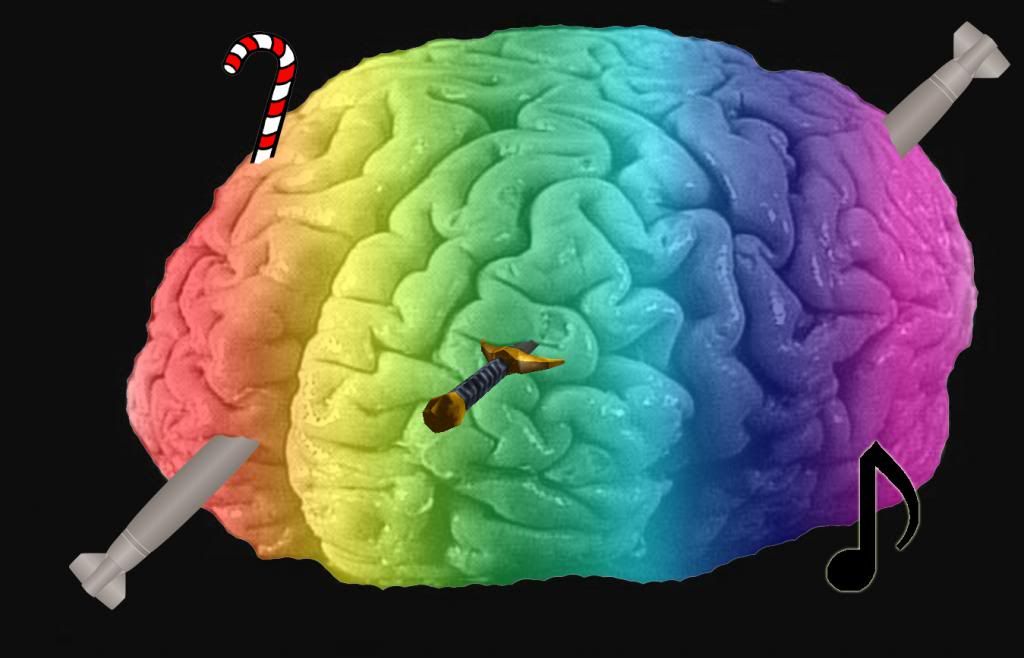

If you’ve been reading our recommendation posts, you know that I was not an easy convert to the Church of the Flying Rainbow Monster. For the first few episodes, all I could do was stare at the screen, admiring the show’s boundless creativity while struggling to connect to it in any meaningful way. And then Marceline was introduced.
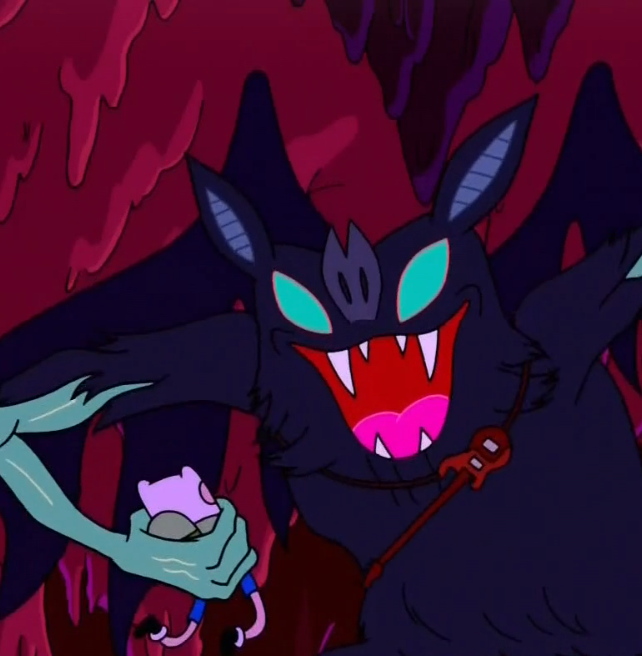
Despite being introduced as a kind of legend, Marceline the Vampire Queen acts as a much-needed grounding force in Adventure Time. Even in a show filled with impossible creatures, Marceline is a pretty improbable addition. She is a part-demon turned vampire with telekinetic and shape-shifting abilities. However, she is also the only character who remembers a world before the Great Mushroom War, who knew Earth before it became Ooo. In a slightly different story, she would be the main character, and we would follow her as she made her way through the ruins of civilization and watched it rebuild itself as an irradiated, technicolour fantasy. In this one, however, she is a throwback to a world nearly forgotten who nevertheless carves out a place in the new one.

Unlike a standard love interest, sidekick, or supporting character, Marceline has intriguing, complex relationships with a number of the show’s other denizens. We’re going to plumb the depths of Marceline’s character by breaking down each of these relationships. (These depths are several fathoms deep, so you’re going to want to settle in.)

Let’s start with Marceline’s origins. She has the kind of daddy issues that are usually reserved for male characters. Her father, Hunson Abadeer, is quite literally a soul-sucking demon who wants his daughter to take over the family business of running the Nightosphere (which is essentially Hell). He seems to bring out two conflicting aspects of Marceline: the child starving for affection and the teenager who just wants to be left alone. The former is probably best demonstrated in the bizarrely moving “Daddy, Why Did You Eat My Fries,” in which she sees her father’s tendency to take what he wants as proof that he doesn’t love her. When Finn summons Hunson to Ooo for a little unscheduled family bonding time, the demon takes Marceline’s bass (that she made using the family axe) on his journey to harvest all the land’s souls. Her single-minded focus on retrieving her bass from Hunson, even at the expense of other people’s souls, seems callous, but is certainly understandable in light of her father’s inability to let her have even this one thing of her own. She claims that she wants to be left alone, but what she really wants is to be left to make decisions on her own; she wants to be able to spend time with her father without him determining the course of her life. Her bass is actually an excellent symbol of this: it’s a family heirloom that she’s altered to suit her own purposes. She wants familial support, but only if it allows her to express herself on her own terms.
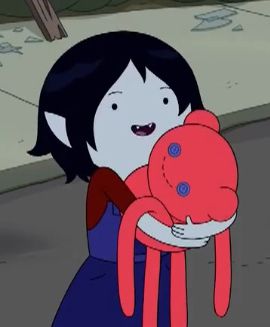
Because Marceline is too complex to have just one heart-breakingly genuine relationship with an inept father figure, the show gave us her relationship with Simon Petrikov, the man who became the Ice King. In “I Remember You,” we learn that Simon helped the young Marceline after the nuclear apocalypse wiped out humanity. He gave her Hambo, a stuffed toy that comforted her after he himself had to leave, driven mad by the crown that saved his life. A thousand years later, the Ice King approaches her about helping him write a song to “lure the honeys in,” using his old journals as inspiration. Marceline agrees to help him, knowing how much it will hurt to work with him when he can no longer remember her. When she finds a message that he wrote asking for her forgiveness after he inevitably lost his memory of her, she turns it into a song. She’s left helping the Ice King to sing her an apology that he will never understand. She is ultimately the one who suffers from his memory loss.

Next, on a much lighter note, it’s bro time with Finn and Jake. Marceline enters their lives as a seemingly malevolent force, evicting them from their tree fort when she proves that she lived there first. After they finally manage to find a new place to live (a bat-infested cave, so we can all see where this is going), Marceline turns up and informs them that this, too, is one of her abodes. Finn fights her and Marceline, having enjoyed their battle, lets them have the tree  back. In the episode that cements their friendship, “Henchman,” Marceline convinces Finn to help her do a host of apparently evil deeds, only to prove with each one that she’s actually a thoroughly decent person. This pranking spirit is something that she shares with Finn and Jake, who eventually come to consider her one of their best friends. This is especially impressive as it suggests that Marceline’s general awesomeness helps Jake overcome an intense fear of vampires. The friendship between the three involves pranks, jam sessions, dating advice, and journeys inside each other’s heads to save one of them from an eternity of sleep; basically, in a show that revolves around bromance, Marceline earns her status as another bro.

Although Marceline does seem to understand bromance, romance is another story. When Finn needs help convincing Bubblegum to go to the movies with him, Marceline suggests that he wrestle with her, because girls like fun. When that fails, she isolates the only thing that women like more than fun: excitement. Being chased by wolves will surely drive Bubblegum into Finn’s arms. When this plan not only fails, but gets Finn temporarily banished from the Candy Kingdom, he turns his attentions to Marceline, who transforms into a giant tentacle monster in response to his offer. They eventually do go to the movies together, once Marceline has been assured that Finn only wanted a platonic date. When everyone else in the audience pairs off to lock lips, Finn and Marceline not only leave, but destroy the screen. To say that Marceline has an unconventional approach to romance for a female character in a cartoon would be an understatement.
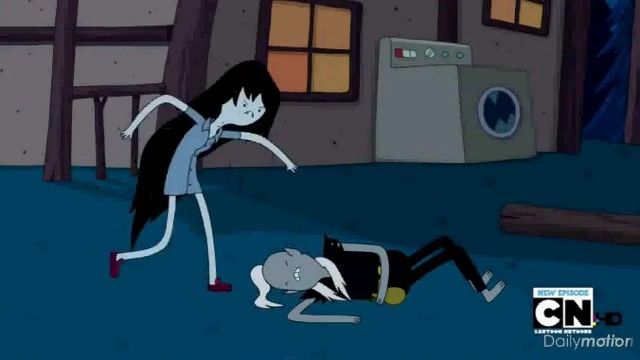
The writers don’t just subvert the trope of the romance-obsessed teenaged girl, but the recently popularized concept of vampiric love in its entirety. In “Memory of a Memory,” Finn and Jake must go inside Marceline’s head and remove a specific memory in order to restore her to wakefulness. This recollection is of the moment when she broke things off with her ex-boyfriend, Ash, after he knowingly sold Hambo, her most prized possession, in order to get himself a wand. It turns out that Ash had Finn and Jake destroy the memory so that Marceline would think that they were still dating, compounding his horrible betrayal by denying her the agency of her original decision to break up with him, with the added grossness of literally sending someone into her mind to do it.

Their relationship is clearly abusive, as Ash controls her access to other people, telling her who she can spend time with. He also expects her to serve him, reminding her that he eats dinner at a specific time and informing her that she needs to make it for him. Although she is more than a thousand years old, he infantilizes her and calls her “Mar-Mar.” His decision to sell her “favourite thing in the whole world” is indicative of his disrespect for her as a person; he’s willing to sell Marceline’s one link to Simon, now lost forever in the Ice King, just because it will allow him to produce more potent spells.

The Ash-Marceline relationship is important for a number of reasons. First, it shows that even someone as strong as Marceline can fall into an abusive relationship. Second, it shows that someone as strong as Marceline, aided by a caring support system, can break out of this situation. After Finn has reminded Marceline of the break-up, Ash legitimately tells her to go into the kitchen and make him a sandwich. With a righteous anger, Marceline kicks him in the crotch (Pow! Right in the Twilight!), and continues kicking him while he writhes on the ground. It’s awesome.

While Adventure Time handled that issue with aplomb, especially considering its intended audience, it stumbled a bit with an issue raised in one of Marceline’s other relationships. I am speaking, of course, of the somewhat infamous fallout from the “What Was Missing” episode. In the episode, a Door Lord steals beloved objects from the main characters before hiding behind a massive door that only opens in the presence of truth set to music. “I’m Just Your Problem,” Marceline’s attempt to open the door, begins as a sad sort of serenade and then, after Bubblegum deems it “too distasteful,” becomes a bitter, desperate plea for Bubblegum’s attention. The song hints at some serious past history between the two and reflects on the disintegration of their relationship, either friendly or romantic.
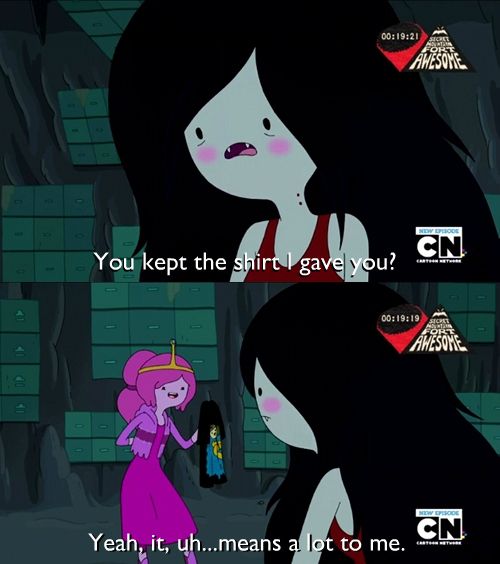
Once they get through the door and reclaim their belongings, it becomes obvious that Marceline didn’t actually lose anything and just went along to help her friends. However, Jake assumes that a black T-shirt emblazoned with an image of heads on spikes is Marceline’s, forcing Bubblegum to step forward and claim it as her own. Marceline is shocked to learn that Bubblegum kept the shirt she gave her, and Bubblegum tells her that she wears it all the time... as pyjamas.

This, in and of itself, would have prompted speculation among fans. This, in concert with this recap video, released by one of the show’s production companies, suggested that Adventure Time was, as they say, going there. Unfortunately, the there where it was apparently going was not actually a destination sanctioned by the Cartoon Network or the show’s creators. By that time, though, even people outside of the show’s fandom had heard that they could get in contact with the production company and voice their opinion. Fred Seibert, the show’s executive producer, issued a statement about the incident, claiming that they “got wrapped up by both fan conjecture and spicy fanart and went a little too far” and that he “let us goof in a staggering way and [he’s] deeply sorry it’s become such a distraction for so many people.” The producer of the video, Dan Rickmers, was fired and the “Mathematical!” promotional video series discontinued. And thus Adventure Time accidentally made itself the focus of a discussion about LGBTQ representation in children’s programming.

The thing is, this issue is not just a “distraction” for the people who made their voices heard. I hope you will indulge me in a little rant in the middle of this character discussion. In a world where people can be made out of candy and a dog and a rainicorn can reproduce, LGBTQ people and same-sex relationships should hardly strain the imagination. The problem is not just that the world of Adventure Time could use some queer content, but that children’s television in general could.

When the powers that be decided to backtrack on this particular issue, turning the possibility of a same-sex relationship into a matter of interpretation that might never be confirmed and could still be plausibly denied, they perpetuated a dangerous attitude. They implied that LGBTQ content was not acceptable in children’s television. This is not a new idea, as North American society still has a tendency to sexualize queer people, equating the presence of a gay character with the presence of gay sex. What is often forgotten is the fact that LGBTQ people, both adults and children, comprise part of the audience; when shows refuse to represent LGBTQ people onscreen, they are telling these audience members that they have no place in the world that the show creates. They cannot be heroes or princesses or badass vampires; they can only be silent and invisible. In this particular situation, the powers that be not only said “No homo” but, if you’ll forgive the term, “No homos.”

It’s too bad, because it would be amazing to see Marceline (and/or Bubblegum) become the first major out character in a children’s cartoon. Still, the writers have managed to make Marceline an incredibly subversive character just as she is. She’s a queen, not a princess (it’s a minor point, but we appreciate it). She has a typically masculine set of daddy issues, all revolving around their opposing ideas about legacy and autonomy, but she also tries to let herself acknowledge that her father loves her. She doesn’t wallow in her tragic past or avoid it, instead making a point of confronting it head-on. Although she could easily have become one of the show’s major antagonists, a demon vampire angry at the world and the people who displaced her from one of the few places she had managed to secure for herself, she becomes Finn and Jake’s ally and friend.
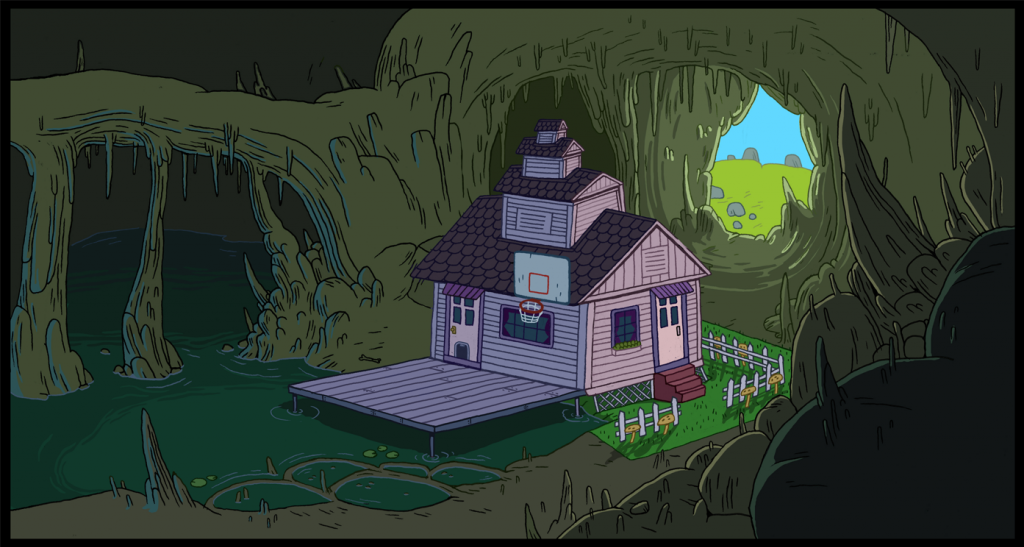
As a character, Marceline is a lot like her house: a quaint, normal home surrounded by the dark depths of a massive cave. She could have easily been transformed by her millennium of horror, twisted into a creature as dark and terrifying as the craggy blackness that surrounds her. Instead, she made herself into something more human, more civilized. She made it through the end of the world with her mind intact, and she continues to fight for the right to live in the way that she sees fit.


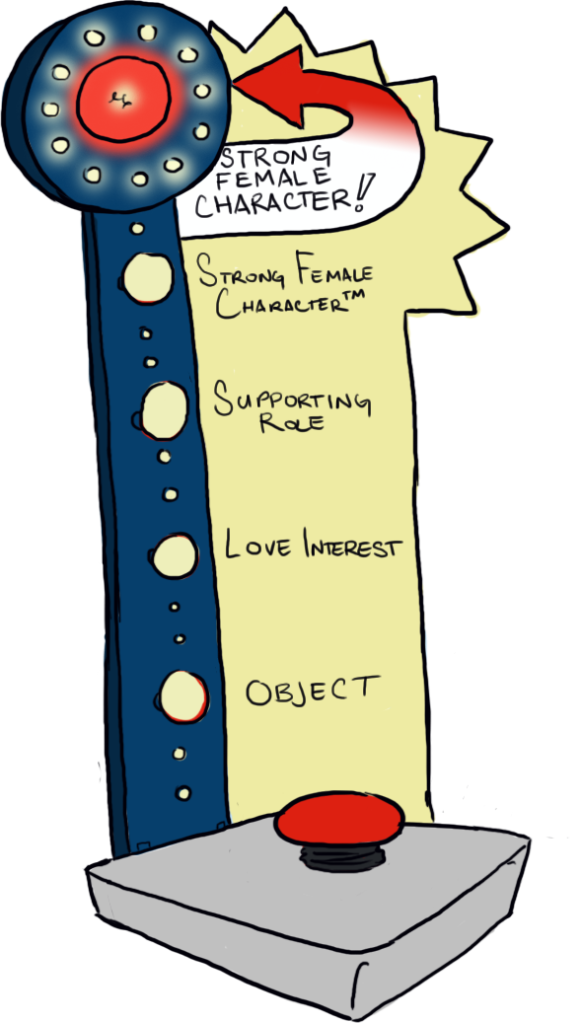
Verdict: Actual strong female character

Jumat, 07 Desember 2012

Buy Humbug

 In honour of the holiday season, this week we’re going to do something a little different. At this time of year more than any other, we face a constant onslaught of advertising, telling us what we should want and who we should want to be. To us, this is yet another opportunity for the media to misrepresent, well, whole swaths of people, but often women and girls in particular. So, in another nod to the commercial Christmas spirit, we’d like to discuss the gender segregation of holiday advertising and why it just might be the most frustrating part of the so-called happiest time of the year.

A couple of weeks ago, my mother and I went shopping for some clothing for my nephew and cousins. As we entered Carter’s-OshKosh, I was taken aback by the difference between the two sides of the store. On the right side, there was a wide variety of clothing styles in a vast array of colours; on the left there was... pink. One side looked like a kids’ clothing store, and the other looked like a Valentine’s Day display.

Now, don't get me wrong. Pink as a colour is lovely; pink as a visual indicator of an object's "girls only" status is not.

We checked out the boys’ side first, its gender affiliation made obvious by the fact that none of the shirts had random ruffles on them. When it came to picking things out for my nephew and cousin, we were spoiled for choice. Then we entered Girl World, where everything was pink and sequined, emblazoned with floral patterns or “cute” sayings (or, in many cases, just the word “cute”). Throwing a glance back into Boy World, I noticed a shirt that read “Boy Genius;” turning to the ultra-feminine landscape before me, I glimpsed the girls’ equivalent: a shirt emblazoned with a heart and the words “Seriously Cute.” Eventually, we completed our expedition, having secured a single specimen of the rare green shirt. I might have thought it had escaped from Boy World, if the ruffles didn’t prove that it was native to the region.

This was such a troubling experience, I think, not because the gender split was new or surprising, but because it was so starkly represented.

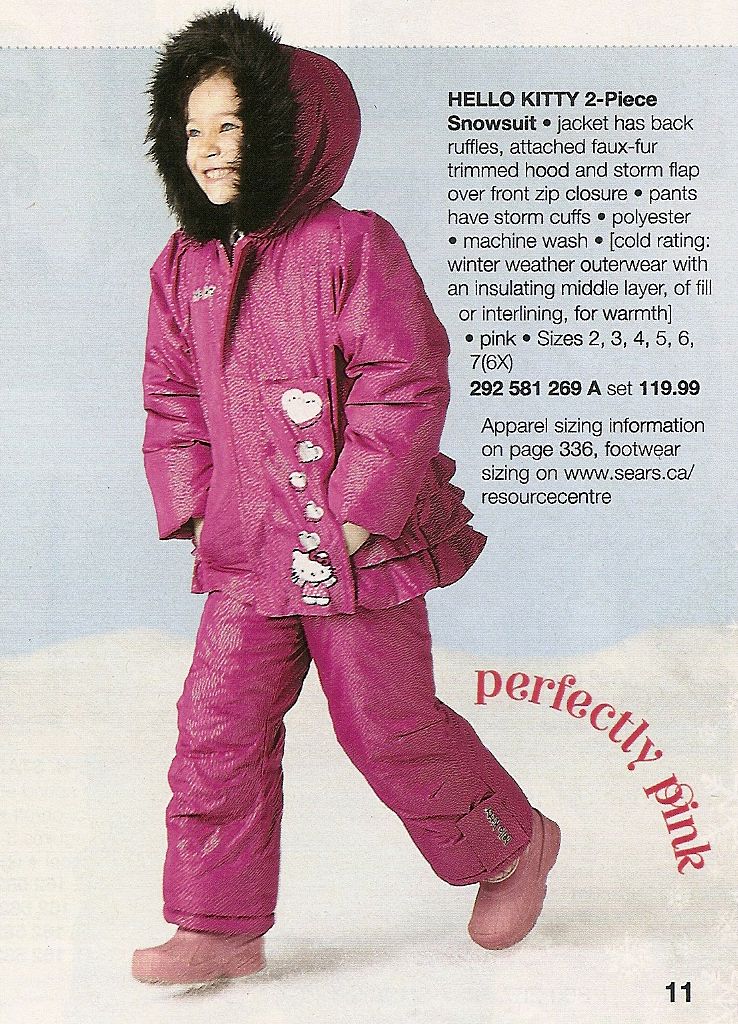
And brick and mortar kids’ clothing stores are hardly the only ones guilty of this rigid categorization. In the Sears Wish Book, a catalogue I’ve browsed every December for as long as I can remember, something like the first few dozen pages are split into gift types like “Cute Gifts” and “Gamer Gifts.” This seems like an admirably gender-neutral approach, until you actually pay attention to the models using the items advertised. “Gamer Gifts” features T-shirts that are only available in men’s sizes, “Totally Cool Gifts” shows a boy using spy gear, and “Galactic Gifts” (or “Star Wars Paraphernalia,” as it could also be known) contains both of these signs of female exclusion. Girls and women do get some items in “Super Gifts” (superhero things) and “Winning Gifts” (hockey stuff), but their only major categories are “Cute Gifts” (so much pink and Hello Kitty, it burns) and Playboy accessories. As if that weren’t enough, the “Galactic Gifts” spread shows a boy wielding a lightsaber with the words “take that, galactic empire” written across the image; by contrast, the “Cute Gifts” model is a girl in a pink Hello Kitty snowsuit just walking with an utterly unnecessary “perfectly pink” written next to her.

This continues throughout the catalogue, to the point that I actually started treating it as a bit of a guessing game. What gender was the model pictured using a punching bag? What about the superhero action figures, the fake guns, the toy cars, or anything from the movie Cars? Who could possibly be pictured playing with fairies, dolls, tea sets, or anything pink and princess-y? The answers are disturbingly obvious.

As for clothing, again, the shirts on offer for girls champion really dubious things. One has the image of Smurfette and the words “Born to be famous,” while another shows an image of Hello Kitty wearing glasses and the text, “Geek is the new cute.” While boys get shirts depicting superheroes and proclaiming their superior intelligence, girls get the message that their value is based on their appearance and their celebrity. And, while the latter would be pretty cool if the girl in question became famous for wielding major political power or making an important scientific discovery, the fact that they used Smurfette somehow suggests otherwise.

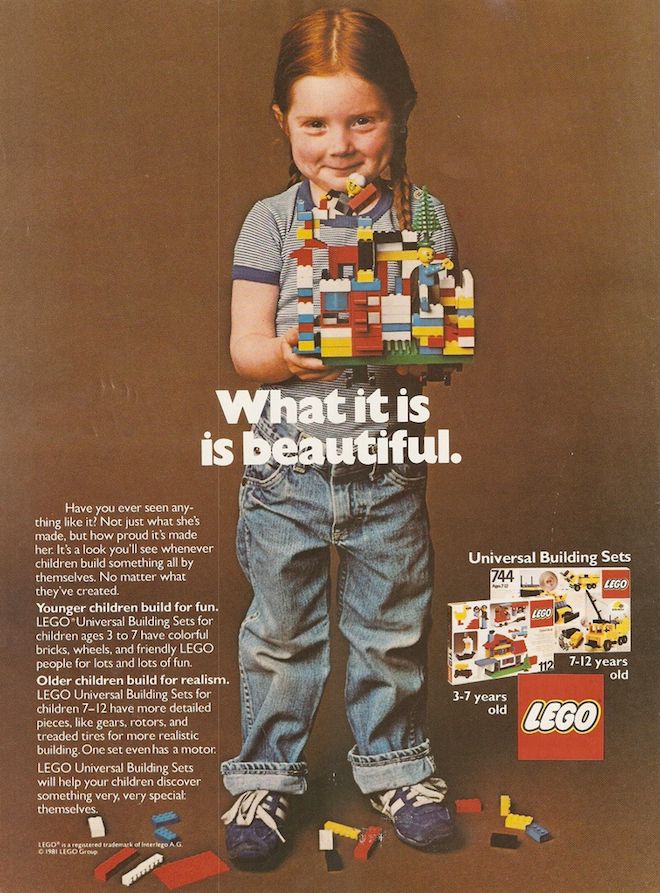
This is not to say that beauty can’t be part of the marketing for girls. Just look at this ad from 1981. First, nothing in this picture is pink. The girl is using real Lego and not the awful new Lego Friends sets; it’s a house that she created, not one that was pictured on the side of the box. More importantly, though, it’s the house that is labelled “beautiful,” not the girl. What is beautiful is the object she made and the imagination that produced it.

I mean, read the accompanying text: “Have you ever seen anything like it? Not just what she’s made, but how proud it’s made her. It’s a look you’ll see whenever children build something all by themselves. No matter what they’ve created.” That description, in and of itself, is a beautiful thing.

Unfortunately, that ad was released more than thirty years ago. Today, Lego produces ads like this one.

But all hope is not lost. In a viral video that has amassed over four million hits, a little girl named Riley Barry manages to isolate the problem of gender-stereotyped marketing while standing in the middle of an aisle of girls’ toys. She bemoans the fact that most of the toys being marketed to her demographic are pink, and argues that both girls and boys would like to play with both dolls and superheroes. Even if she is merely parroting what she’s heard her parents say, as some critics have claimed, there are certainly worse things for parents to teach their children than to question the social roles they are paying to embrace.

Thirteen-year-old Mckenna Pope has started a campaign to get Hasbro, the manufacturers of the Easy Bake Oven, to include boys in their marketing. Her younger brother wants the toy for Christmas, but he has been convinced by the advertisements that the product is only intended for girls. Mckenna’s petition on Change.org has collected over 31,000 signatures. (I signed it, because I had an Easy Bake Oven and I fully support any campaign that would allow all children to feel the pride that comes with eating that first batch of barely edible brownies.)

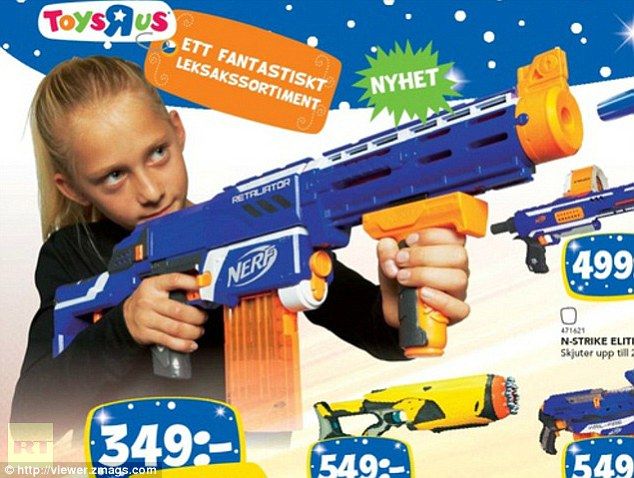
Real change has already occurred in Sweden, where the largest toy chain, Top Toy, has changed its marketing to a gender neutral model following a reprimand for discrimination by the country’s advertising watchdog. Their catalogue now shows boys playing with dolls and girls wielding toy assault weapons. It’s awesome.

Then there’s the response to one of my personal favourite marketing fiascos of the last year: the Bic for Her pen. Both men and women responded to the premiere of the “lady-pen” with often hilarious reviews, many female reviewers’ comments made all the more perfect by the thinly-veiled bitterness caused by a lifetime spent having to buy things that are strong enough for a man, but made for a woman. Even Ellen Degeneres weighed in, a few weeks late but scathing enough to make up for the delay.

We’d like to end this post on a truly positive note, but all we can really say is that, although gender stereotyped marketing is pervasive and pernicious, there is hope. Just, ironically, not around Christmas.