To celebrate our first six months at the end of February, we will be doing a month of reader appreciation.
We’ll be kicking things off with some reader-generated content. As the first Friday of March is also the first day of the Emerald City Comicon (which I will be attending), we’ve decided to dedicate the entire weekend to your picks for your favourite female, female-identifying, or genderqueer comic book characters. Just send us an email with a paragraph or two about your favourite four-colour female and we’ll prepare a three-day comic celebration.
For the other four Fridays in March, we’ll be writing posts based on your requests. If you have a character you’d like to see us cover, just leave a comment on this post. Remember, if your request isn’t written this time ‘round, it’s probably because we already have something planned for them.
Rabu, 06 Februari 2013

Senin, 04 Februari 2013
Miscellaneous Mondays: The Boy Who Lived Forever (Because Girls Made It Possible)
“Fan fiction is what literature might look like if it were reinvented from scratch after a nuclear apocalypse by a band of brilliant pop-culture junkies trapped in a sealed bunker. They don’t do it for money. That’s not what it’s about. The writers write it and put it up online just for the satisfaction. They’re fans, but they’re not silent, couchbound consumers of media. The culture talks to them, and they talk back to the culture in its own language.”
So argues Lev Grossman in his TIME Magazine article, “The Boy Who Lived Forever.” The piece represents an effort to lift the curtain and reveal the largely unseen world of fan creation to a mainstream audience. Grossman introduces the concepts of slash, mpreg, and alternate universes to people who have never wept bitter tears because their favourite WIP was abandoned or bemoaned the state of television because their OTP will never become canon. It is an article intended to illuminate this usually invisible realm, not in the guise of an exposé, but as a loving tribute to the symbiotic nature of narrative creation.
While the intended audience is clearly those not in the know, there’s a lot that those of us well versed in fandom can take from this article. First and foremost, it is a positive article about fanworks, with an introduction that implies that the efforts of fan creators are just as valid as the works on which they are based. It traces the history of storytelling and demonstrates both that the worship of originality is a relatively recent development and that great art has always been derivative. Grossman also recognizes that, far from being inherently inferior to the original works, fanfiction can improve upon its predecessors.
What we’re most interested in, however, is a point he makes about halfway through the article. Having established that most fan creators are women, he goes on to discuss what may very well be fanfiction’s most important function: “Diversity: the fan-fiction scene is hyperdiverse. You’ll find every race, nationality, ethnicity, language, religion, age and sexual orientation represented there, both as writers and as characters. For people who don’t recognize themselves in the media they watch, it’s a way of taking those media into their own hands and correcting the picture.” It is a way in which we can appropriate the narratives that the mainstream media deems suitable to tell, and show them that our stories are equally worthy.
Many of us are familiar with the argument that, if we aren’t happy with the way things are, we should write our own stories. Unfortunately, for a whole host of economic and social reasons, it’s almost impossible for our stories to compete with the corporation-backed media. Faced with such a situation, it should come as no surprise that we have decided to repurpose these narratives to suit us. Grossman argues that fan creators “talk back to the culture in its own language;” isn’t this the best way to ensure that we’re understood?
Jumat, 01 Februari 2013
The Snow Queen
 |
| Honor C. Appleton |
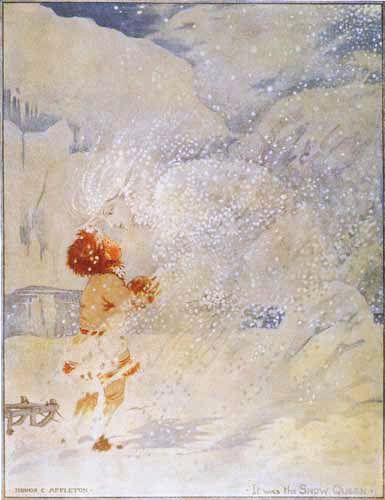
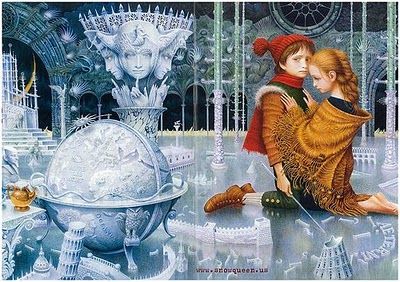
The subject of this first post is markedly different than the vast majority of the tales that have come to form the backbone of Western popular culture. Published in 1845, “The Snow Queen” by Hans Christian Andersen stands out from both the crowd of male-centric stories we tell today and the throng of cautionary tales starring girls and women that come to us from The Brothers Grimm. “The Snow Queen” is a story that revolves around and celebrates women, as evidenced by the fact that, of the seven sections, six are named in whole or in part after women. We are all familiar with tales in which the male hero saves the damsel in distress, and most of us are probably well-versed in the modern subversions of these stories, in which the dude in distress is saved by a heroine. What “The Snow Queen” offers us is a take on the latter before it was cool. (Consider yourself warned; that was not the last ice joke.)
 |
| Edmund Dulac |
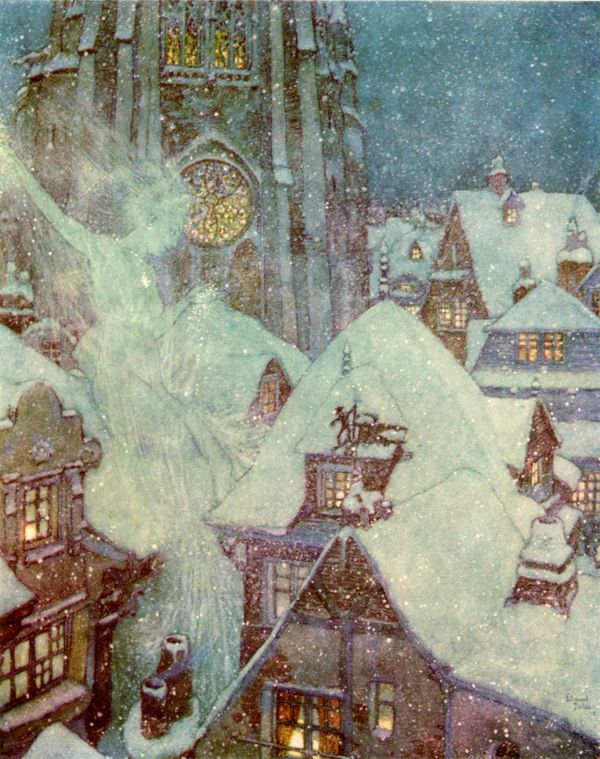
This is further demonstrated in her treatment of Kay. In order to take Kay further into her realm, she kisses him twice; the first kiss stops him from feeling the cold, while the second makes him forget Gerda and the rest of his loved ones. She states, “Now you will have no more kisses... or else I should kiss you to death!” The only affection her lips can provide is frostbite, and the expression of what others might term warmth results in her victims freezing to death.
Before she becomes a hero, Gerda is a little girl whose best friend, Kay, is taken by the Snow Queen after he is corrupted by pieces of a magic mirror that lodge in his eye and heart. There’s a lot of thinly veiled Christian symbolism here -- the creature who made the mirror is clearly the Devil -- but it’s enough for our character-based analysis to say merely that Kay is abducted to the Snow Queen’s palace. Gerda is devoted to Kay, and when he disappears, she takes the initiative to question all the witnesses of his disappearance. When they cannot provide satisfactory answers, she comes to the conclusion that he must have died.
Because literally everyone is rooting for Gerda, both the sun and the swallows assure her that Kay is not dead, and she decides to test this theory. She throws her most prized possession, a pair of red shoes, into the river in exchange for Kay’s presumably drowned body. When the river rejects her offering, she assumes that she just has to throw them further, and boards a boat to enable her to make this throw. Although she initially panics as she floats away, she eventually decides to sit back and enjoy the scenery while the river hopefully takes her to her lost friend. That’s how Gerda approaches most obstacles in the story: by accepting them as a necessary step in her journey to save Kay.
 |
| Errol le Cain |
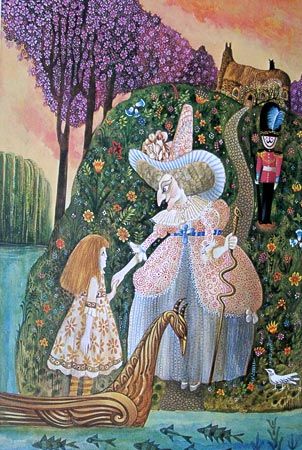
After interrogating the flowers and gaining nothing but confirmation of Kay’s continued existence, Gerda sets off, barefoot, to continue her quest. She comes upon a Raven, who tells her about another fascinating female character: a princess who is so clever that “she has read all the newspapers in the whole world, and has forgotten them again.” This princess decides to get married, but explicitly states that her prince will be someone intelligent and articulate, a man “who knew how to give an answer when he was spoken to--not one who looked only as if he were a great personage, for that is so tiresome.” She ends up choosing a suitor who had no intention of marrying her, but merely entered the castle in order to hear the princess’ wisdom. She chooses a husband who admires her brain, someone who, unlike the actual suitors, did not seek to win her but merely to hear her and enjoy her intellect.
Although Gerda sneaks into the princess’ castle -- her bare feet violate their strict “no shirt, no shoes, no royal assistance” policy -- the princess nevertheless allows her to stay the night and sends her on her way. Garbed in fine clothing and travelling in a carriage of pure gold, however, Gerda quickly gets robbed. The transition from the princess’ castle to the robbers’ woods marks the apparent shift from civilization to barbarism, from Disney-style aspirations to Grimm, violent reality.
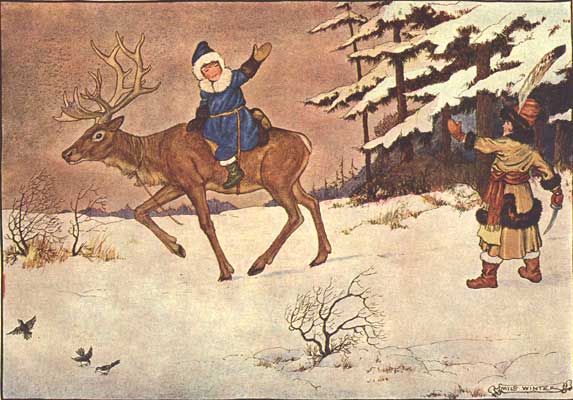
Luckily, Gerda is ambushed by a group including one of the more interesting characters in fairy tales, the little robber girl. She is described, on various occasions, as wild, unmanageable, spoiled, and headstrong, and it probably comes as no surprise that she’s also pretty awesome. When the robber girl’s mother, a woman with “a long, scrubby beard, and bushy eyebrows that hung down over her eyes,” verbalizes her plan to eat Gerda, the robber girl bites her mother. The girl offers another plan: she will keep Gerda’s fine things, as well as Gerda herself. She also assures Gerda that she will not be killed, so long as she doesn’t anger the robber girl; in that case, the robber girl will kill her herself. The girl sleeps surrounded by dozens of animals, all kept and terrorized by her. Among them is a reindeer, whom she torments nightly with the long knife that she also sleeps with, because she lives in a world where “there is no knowing what may happen.”
Still, her harsh existence has in no way destroyed her ability to feel compassion. While she finds amusement in tormenting animals, it appears that the robber girl has been raised with the idea that violent actions can be used to express love and affection. She also possesses the ability to express these things in more traditional ways, as demonstrated when she comforts Gerda and when she sends her off to continue her journey, this time with the reindeer as both transportation and navigator.
 |
| Milo Winter |
We return now to the rest of that journey. Before Gerda saves Kay, she receives help from two more women, one from Lapland and one from Finland. The Lapland woman offers sustenance, but can only refer Gerda to the Finland woman, to whom she writes a message on a dried fish. The Finland woman is an incredibly powerful figure, described by the reindeer thusly: "you can, I know, twist all the winds of the world together in a knot. If the seaman loosens one knot, then he has a good wind; if a second, then it blows pretty stiffly; if he undoes the third and fourth, then it rages so that the forests are upturned.” He requests that she give Gerda a potion to give her the strength of ten men, but she declines. This is not because she cannot brew such a potion, but because physical strength won’t help Gerda in the task ahead. She knows this because she, unlike everyone else in the story, appears to know exactly what has happened to Kay, down to the mirror shards embedded in his eye and heart. It is possible that she learns all of this from a parchment covered with strange figures. It’s almost as if she’s reading the story itself.
Even if she isn’t reading ahead, the Finland woman does have a kind of omniscience, as she figures out what has to happen next. She argues that she “can give [Gerda] no more power than what she has already. “Don't you see how great it is? Don't you see how men and animals are forced to serve her; how well she gets through the world barefooted? She must not hear of her power from us; that power lies in her heart, because she is a sweet and innocent child! If she cannot get to the Snow Queen by herself, and rid little Kay of the glass, we cannot help her.” Again, setting aside any symbolic implications for a narrative about good and evil, this is very cool. This is an incredibly powerful woman saying that she cannot empower a little girl any further, because the girl, in and of herself, has power enough on her own. She commands other living creatures, she receives intelligence from nature, and she does all of this without so much as a speck of foot protection. She’s something of an anti-Cinderella; instead of a set of ornamental shoes and a fairy godmother, she has her own feet and her own power.
Now, we must briefly address the symbolism. In order to infiltrate the Snow Queen’s castle, Gerda arms herself with the Lord’s Prayer. It summons a host of armoured angels to fight snowflakes and banish the cold from her limbs. The prayer also halts the winds that comprise the castle gate. Finally, it is a baptism of her “burning tears” that thaws Kay’s icy heart. Gerda’s power is, at the end, bolstered by the constancy of her faith and the innocence of youth.
 |
| Vadyslav Yerko |
Although this story is more than 165 years old, it seems bizarrely progressive in today’s media environment. While we’d like to commend Hans Christian Andersen for writing a tale that can still be considered forward-thinking today, we’d also like to take this opportunity to discuss why this progressiveness is, in itself, problematic. It all boils down to one question (which I, as is my wont, will stretch into two): If a 165-year-old story is still progressive, what does that say about the regressive nature of our contemporary storytelling? If it’s still progressive to write about a girl saving a boy, have we made any progress in dismantling the expectation that boys should save girls? Something can only be subversive if it is operating against an established norm; it can only be progressive if we are actually making progress.
This is one of the reasons we will be reviewing Disney’s Frozen. As a modern adaptation of “The Snow Queen,” the film could be expected to keep these same subversive qualities intact. From the information currently available, however, it appears as if Frozen will merely perpetuate the status quo. As far as we can tell, this film isn’t about the girl saving a boy, but about the girl falling for the boy; it’s not about women helping women, but about a new set of male sidekicks helping a woman in her quarrel with her sister. As we said in our preview, we hope that the film will prove us wrong. We would like nothing more than for Frozen to prove itself truly progressive, to ditch the same old freezer burnt tropes and use this opportunity to improve on a classic. Unfortunately, having seen no mention of the little robber girl or many of the other women in the story, we’re not holding out much hope.
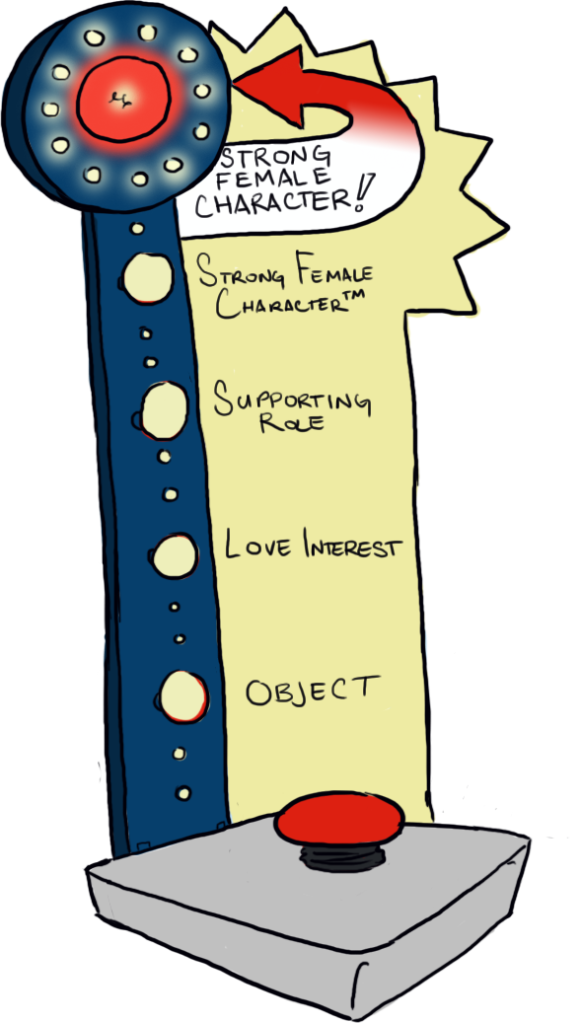
Verdict: Actual strong female character
Senin, 28 Januari 2013
Miscellaneous Mondays: Female Monsters
This week’s Miscellaneous Monday is brought to you by the brilliance of Tumblr user terror-incognita, who summed up a tremendous problem in media (and one of my pet issues) in a single paragraph:
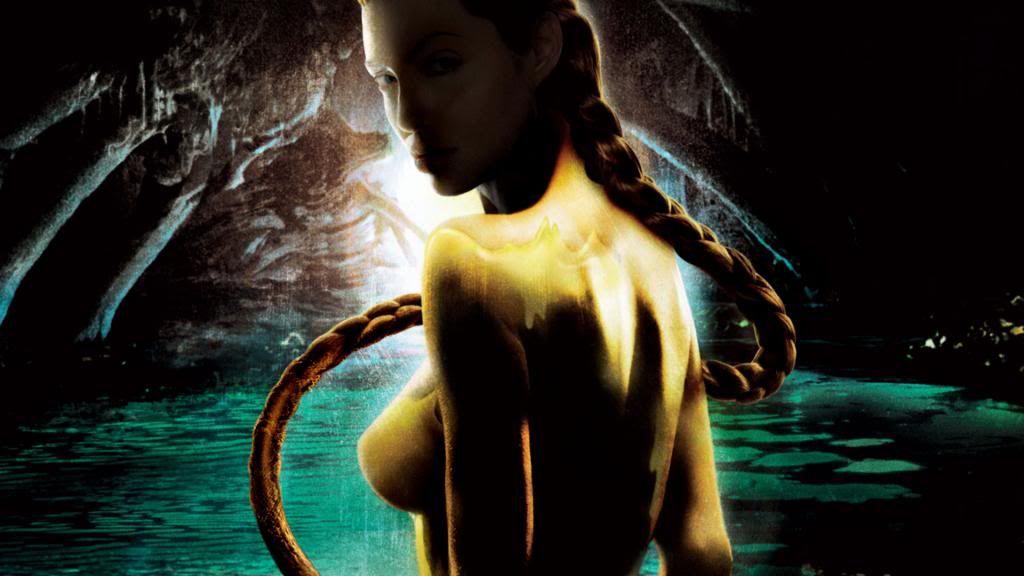
 I once had a lengthy argument about just this issue. My male conversation partner argued in favour of our current standard of female villainy, suggesting that women must enact their evil through their seductive appeal. What makes these women terrifying is the control they exert over men using the innate power of their sexuality. The example he gave was Angelina Jolie as Grendel’s mother in Beowulf (2007). I suggested that such an approach was reductive nonsense.
I, like terror-incognita, am sick of seeing monstrous women as pretty, humanoid corpses or gorgeous succubi. Hollywood dictates that female monsters must be attractive, causing pleasure while wreaking destruction. We rarely get the opportunity to see truly monstrous women, because it seems that being sexy is more important than being terrifying. What I’d like to see is more female Grendels, mutilating and consuming dozens of people at a time before having their arms ripped off in a violent struggle. I’d also like to see these kinds of monsters embrace their rage without this rage being reduced to some supernatural example of that time-tested adage that “bitches be crazy.”
What really strikes me in terror-incognita’s observations, however, are those final lines: “I want to see how you get strong without being broken first. Get strong and stay strong. Get big and bigger.” We started this blog with a post that riffed on Joss Whedon’s responses to the question of why he writes strong female characters. Although we wanted to use the form of his speech, we also wanted to begin by acknowledging a writer whose work with female characters is contentious. In many cases, his writing is contentious for just this reason: many of Whedon’s women must be broken before they can become strong.
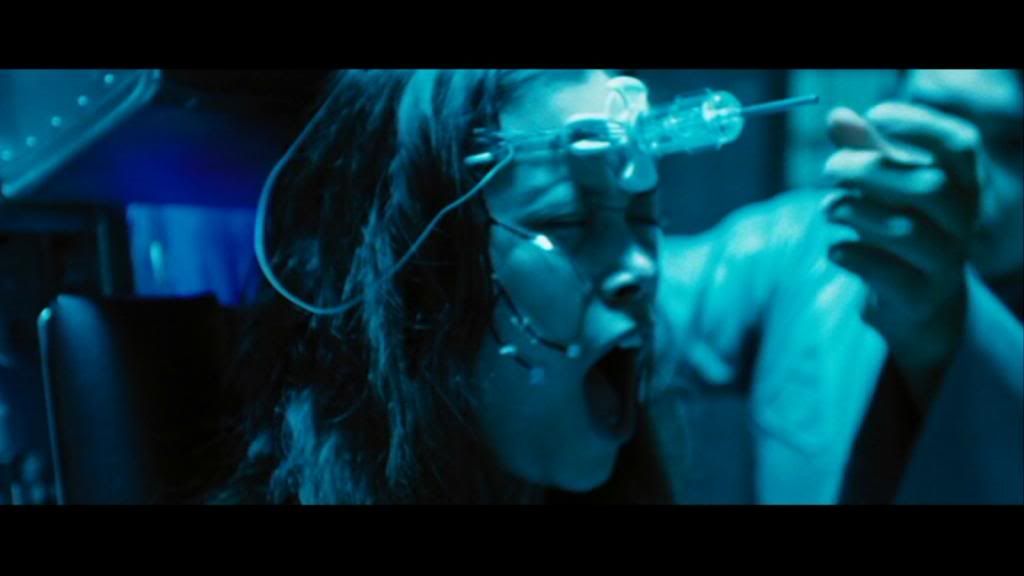
 A basic Internet search should produce a number of critical analyses of this trope in Whedon’s work. I’m not interested in getting into the details of these issues in this post -- though rest assured, we will be doing a whole host of Whedonverse series -- but I will offer two examples. In Firefly and its accompanying materials, we learn that River Tam underwent extensive, traumatic experimentation in order to become the perfect assassin. In Dollhouse, Echo had her self removed in order to have it replaced by a whole host of plug and play personalities before she ultimately fashioned a complete self.
As another tumblr user, sorveharth, observes, “I think the main difference between a hero and a heroine in traditional narratives is that a hero’s strength is defined by how much he can win, while a heroine’s is defined by how much loss she can endure.” I don’t know about you, but I agree with sorveharth in saying that “that’s kinda fucked up.”
For further discussion of the problematic implications of women being broken in order to become strong, see also: Rape As Backstory and Sorry, But Rape Won’t Make Your Female Character More Interesting.
I want to see more girl monsters. Girl giants, girl dragons, hulks & trolls. Scylla and hydra. Girl monsters who are huge and whole. Teeth and plush fur and long muscled tails. Heads enough to see you anywhere. Gleaming green or brown. But girl monsters are usually zombies or vampires. Pale and thin, bleeding or dead. Not Lady Lazarus, not a phoenix from the ash. I want to see how you get strong without being broken first. Get strong and stay strong. Get big and bigger.
I, like terror-incognita, am sick of seeing monstrous women as pretty, humanoid corpses or gorgeous succubi. Hollywood dictates that female monsters must be attractive, causing pleasure while wreaking destruction. We rarely get the opportunity to see truly monstrous women, because it seems that being sexy is more important than being terrifying. What I’d like to see is more female Grendels, mutilating and consuming dozens of people at a time before having their arms ripped off in a violent struggle. I’d also like to see these kinds of monsters embrace their rage without this rage being reduced to some supernatural example of that time-tested adage that “bitches be crazy.”
What really strikes me in terror-incognita’s observations, however, are those final lines: “I want to see how you get strong without being broken first. Get strong and stay strong. Get big and bigger.” We started this blog with a post that riffed on Joss Whedon’s responses to the question of why he writes strong female characters. Although we wanted to use the form of his speech, we also wanted to begin by acknowledging a writer whose work with female characters is contentious. In many cases, his writing is contentious for just this reason: many of Whedon’s women must be broken before they can become strong.
As another tumblr user, sorveharth, observes, “I think the main difference between a hero and a heroine in traditional narratives is that a hero’s strength is defined by how much he can win, while a heroine’s is defined by how much loss she can endure.” I don’t know about you, but I agree with sorveharth in saying that “that’s kinda fucked up.”
For further discussion of the problematic implications of women being broken in order to become strong, see also: Rape As Backstory and Sorry, But Rape Won’t Make Your Female Character More Interesting.
Jumat, 25 Januari 2013
The Preacher's Daughter and the Deviant Hero
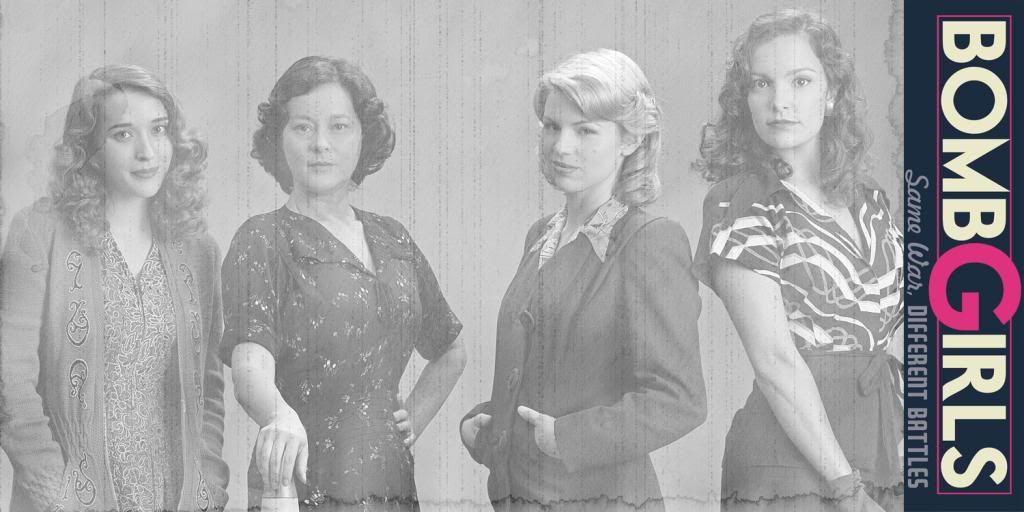
“Bomb Girls is unusual in several ways. For one thing, the four lead characters are women. Happily, MacLennan has a special affinity for creating female roles. The main trick, he says, is to avoid making them much different than male roles. Rather than portraying them as peripheral or sexually objectified, MacLennan’s women display depth, complexity and intelligence.”
In this excerpt from an article released to promote the second season of Bomb Girls, we see Michael MacLennan answering that age-old question: How do you write strong female characters? This may be one of my favourite questions asked of writers, simply because the answer is -- and always will be -- “treat them like human beings.”
However, MacLennan goes further. He suggests that women should be the focal point of their own stories, and that they should be portrayed as subjects, not objects. By figuring his show in opposition to the overwhelming majority of television and film, he shows that he and his writing staff are highly cognizant of what’s at stake. Mainstream media is quick to dismiss women’s stories, and studio executives tend to view the success of women-focused pieces as either a fluke or the result of employing typically masculine narrative tropes. (Case in point: any and all recent films in which women characters suddenly become knights.) If Bomb Girls had failed, its failure would likely have been seen to reflect not on the relative appeal of one show but on the validity of women-centered stories in general.
So it seems as if the creators decided to go big or go home. Instead of merely writing real, strong female characters, they chose to use this opportunity to critique the mainstream media’s portrayal of women and expose the social falsehoods that produce these flawed depictions. Whereas the treatment of Gladys and Vera explored the societal double standards that existed in the 1940s and continue to dominate our thinking today, the portrayal of Kate and Betty addresses the way in which media filters reality for mass consumption.
Kate Andrews
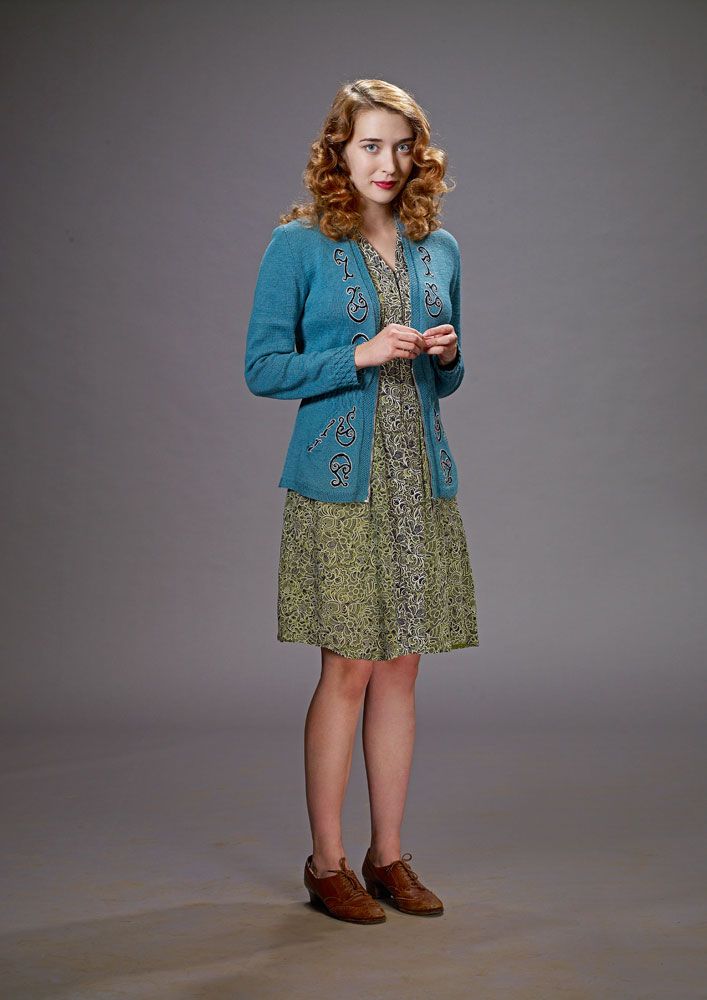
We are introduced to Marion Rowley on a street corner, singing hymns with her family and unsuccessfully hiding her interest in those legs. She is a preacher’s daughter, and when the preacher notices her noticing people -- a man, in this case -- he immediately turns to deliver his sermon to his ostensibly wayward daughter. To ensure that his message gets across, he grabs her hand in a punishing grip. The next time we see her, later in the introductory montage, Marion and her mother are making final preparations for her escape, a feat accomplished with her father’s assurances of her damnation ringing out behind her. And so Kate Andrews is born.
Kate is, arguably, the nicest character. When Edith gets word of her husband’s death, Kate attempts to soothe the nervous tension in the factory by singing Irving Berlin’s “It’s a Lovely Day Tomorrow.” When Gladys investigates Hazel Macdougall, she volunteers to accompany her and urges Betty to do the same. Having withstood her father’s destructive influence, it seems as if Kate has decided to become his opposite.
She further accomplishes this by breaking down the restrictive boundaries her father established. In the first episode, this is demonstrated quite subtly; whereas her father punished her for her appreciative gaze, now she openly looks. She sees two women dancing and asks Betty for a twirl, breaking a social taboo. She regards Gladys’ silk stockings -- yet another woman’s legs -- and asks to touch them. By taking these seemingly innocuous actions, she begins the process of actively engaging with a world that she was previously banned from seeing, much less enjoying.
While learning to exist beyond her father’s carefully constructed walls, Kate also demonstrates the ability to see the similarly arbitrary nature of certain social rules. When Lorna suspects Kate of theft, she assigns her to the storeroom, a vast, dark space that seems devoid of life until Kate hears a male voice singing. Looking for the owner of the voice in the canteen, she alerts a White male worker to her presence in the storeroom. He later attempts to rape her. In a subversion of the Birth of a Nation-style trope of Black masculinity violating White femininity, the owner of the voice, an African-Canadian man named Leon, saves her. While Betty cautions her to avoid Leon, arguing for the bigoted belief that he was merely saving her for himself, Kate spends much of the next two episodes seeking him out.
An argument could certainly be made that Kate displays a tremendous amount of privilege in constantly trying to converse with Leon in public, as it would be him who most likely suffered for the transgression. At the same time, however, this can be seen as a positive step in Kate’s progression toward becoming her own person. Harbouring little to no negative sentiment toward “Negroes,” she is unwilling to obey societal rules that dictate the people with whom she can and cannot converse. In this way, she is markedly more open-minded than Betty, whose racist attitudes can be only partially explained -- and certainly not excused -- by her fear that Kate is more attracted to Leon than to her.
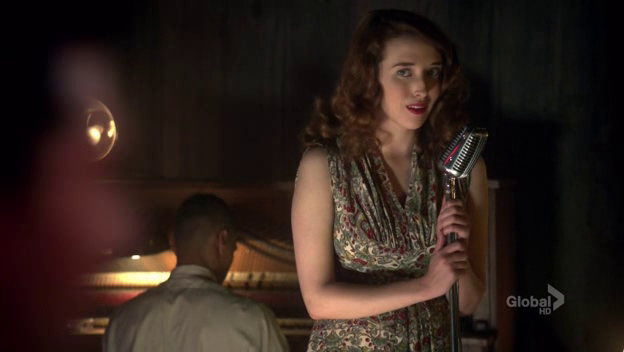 Leon is much more than mere evidence that Kate can disobey rules. Beyond his value as an intriguing -- if somewhat underdeveloped -- character in his own right, Leon is Kate’s gateway to music, and music is Marion’s gateway to Kate. As Marion, Kate was raised with religious music, but it is through Billie Holiday’s work (and Leon’s recommendation) that she becomes empowered by her singing. She appears to identify with the singer to the point of projection, interpreting Holiday’s musical stylings as the message, “Don’t judge me. We all have our secrets.” She sees in a musical career the potential to find happiness and proudly plans to pursue it despite the risk of failure: “I found something I love. I don’t care if I fall on my face.” Singing allows her to assert her desires, giving both literal and figurative voice to her new goals.
Music is Kate’s chosen form of self-expression. As she observes in the sixth episode, “You know, I used to sing to feel something. Now it’s more like I feel something and I sing.” As Marion, she was so divorced from her own emotions that she had to experience them vicariously, employing other people’s words in order to access other people’s feelings. As Kate, she has broken through this barrier and finds herself able to experience and express her own emotions, relying on the words of others merely to lend some order to her newly liberated feelings. It’s the difference between false Hallmark sentiment and a sonnet by Neruda.
In the most effective instance, however, it’s actually a song by Ralph Rainger and Dorothy Parker called “I Wished on the Moon.” Kate directs her performance toward Betty, her sort-of love interest and number one cheerleader. Despite this dedication and a number of other indicators of attraction on Kate’s end, her true feelings about Betty are left frustratingly ambiguous. What is perhaps even more frustrating is the fact that that is precisely how things should be. Kate has had any possibility of a healthy relationship to her sexuality quite literally beaten out of her. Although she has pushed her way into a world where she can physically look and touch, her new freedoms cannot completely obliterate the old, ingrained psychological restrictions.
We see her struggle with these internal blocks on several occasions, most notably the photoshoot with Betty’s associate, Chet. In order to secure papers for her new identity and render valid the person of Kate Andrews, Kate agrees to do a pin-up photoshoot. When she expresses reservations, Betty encourages her, stating that she has a “new name, new job, new life.” Marion cannot pose seductively, but Kate must, if only to establish herself as the new person she needs to become.

What helps to temper this brutal realization is the restoration of the queer female gaze. In her final scene of the episode, Betty sits on her bed, cross-legged, perusing Kate’s photos. She appears to view them with just as much sexual interest as the men, but the difference lies in her familiarity with the subject of the photographs: she is interested in Kate as a person, and the pictures merely allow her to enjoy her image. These looks were directed at her just as they were directed at the camera.
Unfortunately, Betty is not the only person who recognizes the person in the photos, as Kate’s father uses them to track her down. Despite leaving her father behind, Kate does not entirely escape him. If Gladys’ boundaries are societal, Kate’s are paternal. He is the towering figure in her life, the one true authority to which she turns when she seeks guidance, as evidenced by her tendency to quote her father when she is in need of an adage. He is her tormentor and warden, forcing her to adhere to his unconscionable moral code. Ever-vigilant and ever-present, he is an almost supernatural being, a corrupted god produced by Kate’s fear.
When he arrives, the show suggests that he may be a paranoia-produced apparition, a flashback like the one that featured a helpless Kate looking on as Marion was nearly drowned by her father’s hand. He soon proves himself all too real, and his influence immediately starts seeping back into Kate’s life despite her insistence that she would rather kill herself than return to him. Still, the signs that she is slipping back into her earlier identity are abundant. “You honestly think your father would rather hurt you than see you happy?” she inquires of Gladys, as if she didn’t have ample experience of this kind of paternal control. She apologizes for her father’s behaviour, telling Leon that “he worked so hard to find [her], [her] father, so very sorry for what he’d done.” She is justifying her decision to return home even before we learn that she has made the decision.
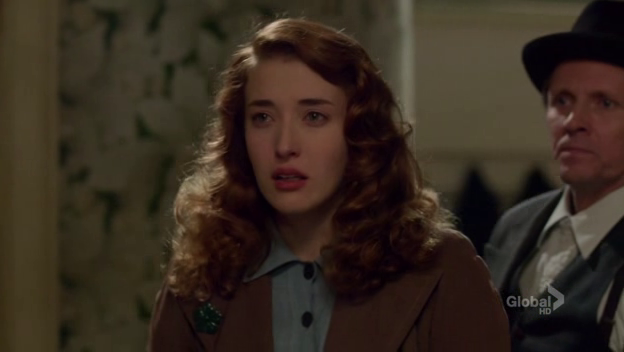
Many viewers of the show argue that Kate’s decision to return to her father in the final episode of the first season shows her to be weak. I contend, however, that there is basically no way in which Kate can be seen as weak. She survived traumatic physical, emotional and psychological abuse and managed to escape with only the help of her similarly abused mother. She forged a new identity (sometimes literally) and sought to make Kate Andrews a happier, more complete person than Marion Rowley had ever been. She did things that terrified her, simply because they had to be done. She also went back to her abuser because she needed to tend to her sick mother. She is anything but weak.
Verdict: Actual strong female character
Betty McRae
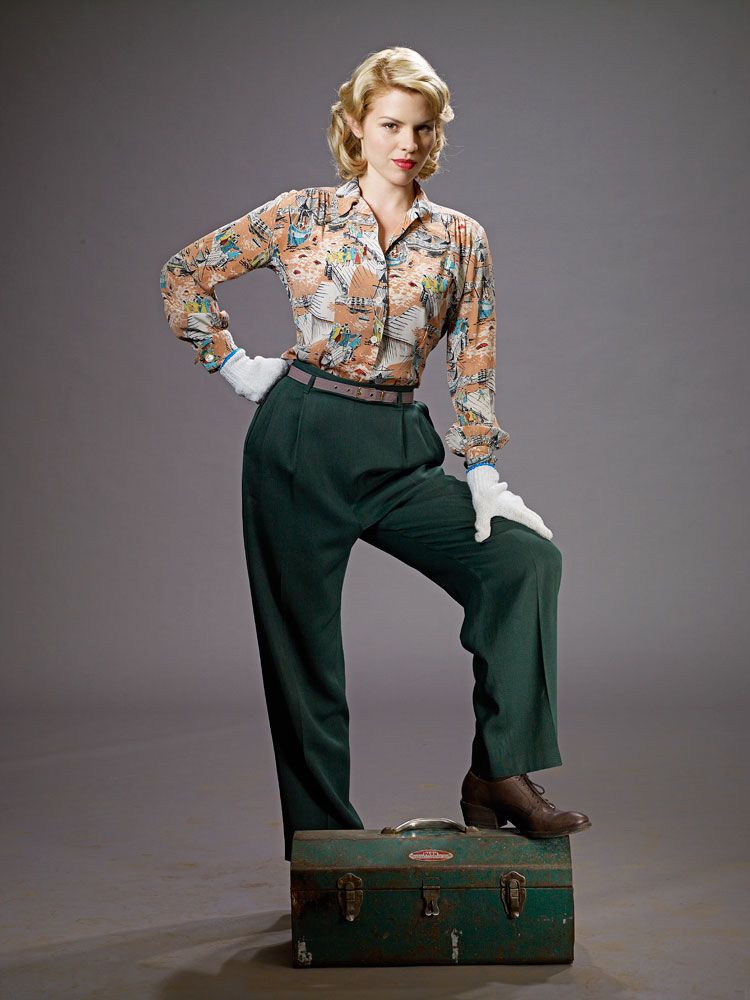
Betty is a young woman from the Prairies who fears the threat of German U-boats from any and all bodies of water. Betty is a master practitioner of the carefully careless lean. Betty is the best worker at Victory Munitions. And Betty, despite lacking the vocabulary to identify herself thusly, is very, very gay. Accordingly, her first season storyline revolves around the difficulties of being a queer person in the 1940s.
Betty’s secret is a strangely open one and she herself appears on paper as something of a stereotype. She wears trousers, keeps her hair short, and has a typically masculine gait. Raised on a farm before she moved to Toronto, she comes from a family of brothers and, as MacLennan suggested in the same interview already quoted, she is “really only comfortable in a male milieu.” She’s one of the guys, and now, faced with the prospect of a few years spent surrounded by women, she has to learn to adjust.
She is also one of the only women in the factory who is used to doing manual labour as a job, and it shows in her status in the factory. Not only is she the best bomb-maker on the line, but Betty is entrusted with training the new workers. She introduces them to their new jobs with a telling pep talk: “Here’s the deal, ladies: you do fine embroidery, you can assemble a time fuse. If you sew buttons, you can thread a detonator. If you can pour tea, you can pour amatol. It’s no big whoop. Except some folks don’t see it that way, and the guys are crapping bullets, afraid they might not get their easy street jobs back after you’ve helped them win the war. You ignore ‘em first, talk tough second... That doesn’t work? You slap ‘em silly.” In one speech, she dismantles the hierarchical value structure of gendered work, showing that women’s domestic tasks and men’s public jobs are differentiated by nothing more than the materials used. She also reminds the women that they have a right to defend themselves against disparaging comments, even offering violence as a possible tool. She wants to instill confidence in her co-workers.
However, after the bad bomb test, Betty proves herself somewhat unwilling to challenge the status quo. When the women are blamed for the bad bomb, she offers suggestions to improve their work environment. Still, she does not support Gladys’ attempt to stand up to Harold Akins. Instead, she dismisses their valid concerns as just talk, “like women do.” Confronting individual male workers is fine, but challenging the system itself is unthinkable.
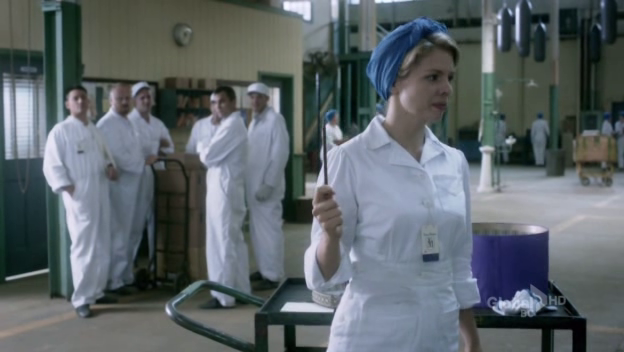 It is completely unthinkable, until Gladys Witham comes along with her suggestion hatbox. When the male workers read out the lewd, insulting suggestions with which they filled the box, they allow Betty to see the act of challenging the system as an opportunity to tell off the men whose behaviour, in and of itself, is a threat to workplace safety. Whereas Gladys is somewhat chastened by seeing her tool of empowerment become a weapon of oppression, Betty is spurred into action. She realizes that allowing the men to bully Gladys in this way will lead to them pressing their advantage and tormenting the rest of the women. So she steps forward and uses the box for its intended purpose, stating, “These pinheads think we should work six days a week and never have an idea in our pretty little heads about how to do our own damn job.” It’s a matter of pride; Betty might not buy into Gladys’ grand feminist ideals, but she’ll be damned if she lets a bunch of knuckle draggers tell her she doesn’t know how to do her job.
As the wealthy outsider, Gladys could not gain support for her suggestion box, but Betty, the star worker, convinces every woman on blue shift to make their voices heard. She also refuses to let Gladys take the blame, pulling a sort of “I am Spartacus” show of solidarity when Lorna demands to know who is responsible. What is particularly notable about this scene is the way in which it is framed within the episode. When Gladys began her unsuccessful crusade, Kate informed her that her failure was a sign that “nobody wants a Joan of Arc to lead us to battle.” After a working class woman steps up to lead, however, she assumes just this role. Gladys makes this explicit by referring to Betty as “our Joan of Arc.” In her moment of rebellion, Betty becomes a heroic figure.
The heroic narrative clings to Betty throughout this first season. When she is selected to star in a newsreel, Kate calms her nerves by telling her that “they’re all gonna see what [Kate] see[s]: a hero.” Even in the final scene of the season, when Gladys suggests that they will work together to find Kate, there are narrative underpinnings of a knight going to save her bewitched lady from a scripture-citing dragon. The figuring of a queer woman in this light suggests that the show is doing some deliberate critical work. As I argued in our post about Adventure Time’s Marceline, “when shows refuse to represent LGBTQ people onscreen, they are telling these audience members that they have no place in the world that the show creates. They cannot be heroes or princesses or badass vampires; they can only be silent and invisible.” Bomb Girls not only includes queer people, but explicitly argues for their recognition as heroes.
Because this critical work is carried out so subtly, the show couples it with an explicit critique of LGBTQ media representation. In the fourth episode, Victory Munitions is selected to be featured in a newsreel to recruit women for the bomb factories. Initially, the filmmaker, Russell Joseph, wants Gladys for the role of everywoman bomb maker. The show uses this opportunity to demonstrate the problems inherent in assuming that the women will be attracted to the kind of bomb girl that pleases the male gaze. Lorna points out the flaw in Russell Joseph’s plan: “Just because you’d like to get her out of that uniform and into your little movie, doesn’t mean the average girl will see her and think, ‘That’s me.’” When he responds that he knows how to sell this war, she responds, “To men, maybe.”
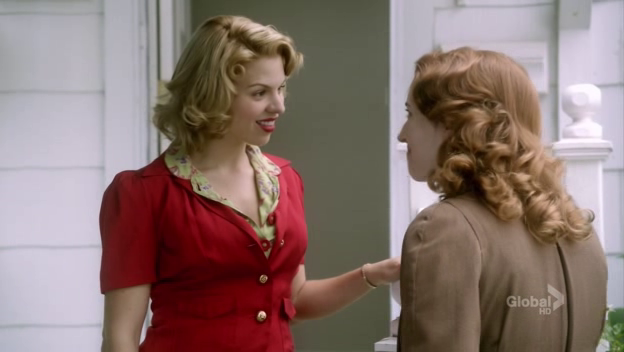
While most of the production focuses on making Betty something she detests, one element makes her fictional self someone she might aspire to be. The film crew does a location shoot at a picturesque, white house, and Betty reveals to Kate that that is what she is saving up for: a house of her own, to be shared with a “housemate.” She wants to take advantage of the opportunities afforded her by the changing social structures to make a life for herself that resembles the perfect white picket fence fantasy that she’s internalized. At the same time, she wants to subvert social norms by reimagining this scenario with a female partner. Unfortunately, her preferred partner has internalized the same image in its original form, responding to Betty’s plan to buy a house with “That’s what husbands are for.” Still, the dream remains, as Kate also agrees to be Betty’s housemate.
When the factory workers sit down to watch the newsreel, Bomb Girls makes its point about the devastating effects of queer erasure on real LGBTQ people. Betty sees that they have edited the scene shot at her dream house to include children running into her arms. To make matters worse, the voice-over states -- to the accompaniment of the male workers’ catcalls and sexual innuendo -- “It’s not just love of country that keeps Betty going, it’s her love of a very special man. Once her husband comes home from fighting Jerry, she’ll be happy to return to her wifely duties.” Like Kate before her, Betty finds that her image has been manipulated to suit the male gaze. In addition, her real identity as a lesbian has been erased in order to reinvent her as a false heterosexual ideal.
In so doing, the filmmakers unknowingly destroy Betty’s dream of a normal life. As she says, “It shows you what a freak I am. They had to make up a whole set of lies about me.” Lorna assures her that women will see her worth as a worker and as a person, and that they will want to be like her. Betty dismisses these words of comfort, stating, “Nobody would want to be me, Mrs. Corbett. Nobody.” Understanding that the fiction is the only acceptable truth, she can no longer see herself as a person worthy of audience identification.
Complicating this critique is Kate’s response. She dismisses Betty’s concerns with her portrayal, telling her that “people just thought it was fun” and thereby presenting the familiar “it’s just a TV show” argument. Betty, however, knows that what is just a TV show is also her life, and she confesses that she would sometimes like to be that person, if only to make her life easier. Kate responds by telling her that “you don’t need everybody liking you, just the ones that matter.” She tries to make Betty understand what she herself has discovered: you don’t have to be or do something just because other people think you should. Kate is reminding Betty that she isn’t her mass-produced image, but a person that other people appreciate.
This is why Kate’s rejection in the final episode is so crushing. Although she answers Betty’s love confession with an assertion that she never wanted Betty, I would argue that it’s the rest of Kate’s speech that causes the most lasting damage. By calling Betty a deviant and claiming that she seduced her, she is expressing the common belief of the time. She disavows knowledge of the actual Betty and condemns her by reducing her to a stereotype. Kate, the person who mattered most, delivers the cruelest blow.
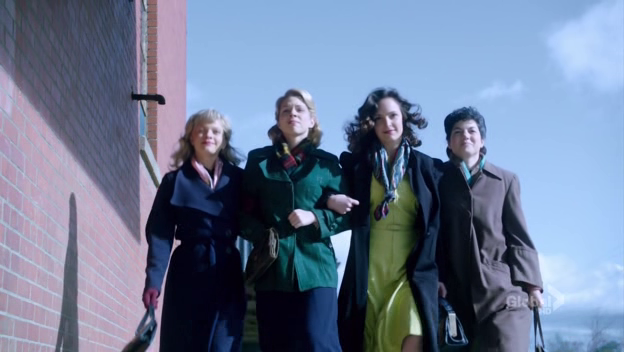
This war, while ostensibly the massive historical conflict around which the show revolves, could just as easily be read as the show’s battle for proper representation. In these final moments, Gladys links her arm with Betty’s and they both confidently stride toward the factory, Edith and Vera joining them. Playing over this proud march is a snippet of “Ain’t Nobody’s Business”: “There ain’t nothin’ I can do, or nothin’ I can say that folks don’t criticize me, but I’m gonna do just as I want to anyway. Ain’t nobody’s business if I do.” In the final shot, set to that final line, we see the four women, arms linked, the picture of female friendship and solidarity. Each one of them has done wonderful and awful things, but in every case they have done what they thought was right.
The season closes as it opened: on the image of women’s legs. This time, however, we know the women as people and know, therefore, that this final nod to objectification is actually a refusal to fall victim to it. These women have earned their subjectivity, and it is therefore particularly telling that the gaze in the last shot is not only not attributed to any character, but is indeed filmed from such an angle that it could not constitute a character’s point-of-view. After all, it ain’t nobody’s business what they do.
Verdict: Actual strong female character
Senin, 21 Januari 2013
Miscellaneous Mondays: LEGO my Eggo
This week we would once again like to bring attention to the gender segregation of the once-universal LEGO world. Anita Sarkeesian is a feminist video blogger who became famous due to the violently misogynistic backlash to her proposal to make a webseries about sexism in video games. In these less contentious videos -- part of her Feminist Frequency series -- she traces the history of LEGO’s marketing, as the product transformed from a fun-for-the-whole-family creative outlet to an exclusive mess of gender stereotyping.
I have a long history with LEGO. I used to spend hours playing with the basic sets. I actually had the Paradisa “Sand Dollar Café” set, as well as the complete LEGO soccer field. I played LEGO Island back in the nineties and now own most of the film franchise tie-in games. I made a point of visiting the impressive LEGO display at last year’s Emerald City Comicon. I’m a LEGO fan.
However, I know that I was able to get into the toys because my brothers and male friends owned sets. I know that I am enjoying playing video games intended for male fans of male-centered franchises. I know that, in order to walk around Gotham City as Black Canary, or Huntress, or Lois Lane, I have to spend hours adventuring as Batman and Robin. It’s a broken system but, as Sarkeesian suggests, it would be easy to fix.
Langganan:
Postingan (Atom)