Minggu, 03 Maret 2013
DC Women Kicking Ass
DC Women Kicking Ass is the blog I use to get all my DC news. When I need to know how soon we’re getting a Wonder Woman movie (never), or when my favourite characters are coming back from being benched (also never), or at what point DC will finally admit that appealing to women could save the comics industry (not any time soon), I check out DCWKA. Although the blog offers a host of interesting topics and features, from a Valentine’s couples tournament to the visibility campaign that is Women Read Comics in Public Day, it is the blogger’s dogged optimism that is most appealing. To be able to keep advocating for change in an industry that sometimes seems hell-bent on maintaining the status quo is admirable; to do so in a way that makes others feel that there’s hope is downright heroic.

Sabtu, 02 Maret 2013
Escher Girls
Escher Girls is a blog whose mission statement is “to archive and showcase the prevalence of certain ways women are depicted in illustrated pop media, specifically how women are posed, drawn, distorted, and sexualized out of context, often in ridiculous, impossible or disturbing ways that sacrifice storytelling.” In other words, it’s the blog you feel like creating every time you visit the local comic shop or the graphic novel section of a brick and mortar bookstore and see what passes for anatomical accuracy on the covers. It isolates in concise snippets of snark the disturbing attitude toward women that pervades the comics industry. It won't make you feel better about the state of comics, but it will make you laugh.
Jumat, 01 Maret 2013
Reader Submission: She-Hulk!
To kick off our Reader Appreciation Month we have a submission from Jai (resident artist and all-around excellent person), extolling the virtues of She-Hulk:
 |
| Art by Adi Granov. |
SHE-HULK. As Jen Walters, she's a really smart, well educated lawyer, but she's always been in the background of everything; once she gets a blood transfusion from her cousin Bruce Banner, she becomes She-Hulk - which affords her the chance to finally be the centre of attention!
I started reading She-Hulk is when there was a revival of her solo series; I bought (and still buy, when I have the money) the trades. At that point in Marvel 'verse, she was part of the Avengers. We're introduced to her through a party - a really big party - and then her waking up with a random dude the next morning. She's large and in charge and she takes every advantage of it; but the rest of the Avengers are worried it's taking a toll on her Superhero-ing. So they tell her they're worried about her, and think she should take some time off. The dude she was sleeping with tells her she's shallow. (He's an underwear model.)
Around the same time, she gets an offer at a Law firm - apparently one of the best in New York. So, given the suggestions of her teammates and this new opportunity, she decides to go for it. But there's a catch: she can't do it as She-Hulk. She has to do it as Jen.
For the most part that's played super well - it's about her learning to have confidence in herself and her awesomeness and the fact that she's a really good lawyer, even when she's not this super hot super strong super hero babe.
To top it all off, the law firm she ends up working for has a specific division of its company they want her for: the Super Human Law division. Where people who've just gained super-human powers can sue the companies that left the radioactive waste just out and about. Or villains can sue heroes for excessive force. It's pretty great, and doesn't take itself too seriously at all. The best story in the first trade (I think it's in the first trade) is when Spider-Man decides to sue J. Jonah Jameson for slander. Jameson eventually ends up saying "Well, shouldn't you be including Peter Parker in on this?! He's the one who sells me the photos!" And so Spider-Man (who is Peter Parker, of course) can't realistically say "Nah I don't wanna sue that guy, just you," without giving a really good reason. So he settles out of court.
What they end up settling on?
J. Jonah Jameson and Peter Parker have to stand right outside the Daily Bugle offices holding signs saying (I think) “I'm Sorry” and handing out leaflets about how they were wrong.
While wearing Chicken Suits.
The series does have its serious spots, as well, but overall it's a super well crafted fun romp with a really strong female lead learning to love herself FOR HERSELF and no one else, it's got lovable background characters who have character arcs of their own, the stories and well written, the art is great... All in all, I'm pretty in love with it.
Senin, 25 Februari 2013
Miscellaneous Mondays: A Death in Pictures
A Valentine’s Day killing of one half of a couple by the other seems like something out of an episode of a crime procedural, doubly so when the two halves in question are a model and a Paralympic champion whose story went global when he competed at the Olympics. Perhaps the writers would have given the athlete a suitably filmic nickname like, say, “Blade Runner”. Unfortunately, this is the kind of stuff that, as the adage goes, you just can’t make up.
The story of Reeva Steenkamp and Oscar Pistorius is a big deal in the way that all crimes committed by people sponsored by Nike are big deals. However, in an article written about the media coverage of the killing, Helen Lewis suggests that the most interesting aspect of this situation is not the downfall of an underdog athlete, but the media’s treatment of his victim.
As always, we heartily recommend checking this article out, though in this case it’s partially because the photographic evidence at the source must be seen to be believed. The thrust of Lewis’ article is that the slaying of Reeva Steenkamp has led to a particularly flagrant disregard for a potential murder victim’s personhood and the reduction of a human being to a sexual object. The newspapers “pay tribute” to Steenkamp not by discussing her law degree or her tragically relevant history of campaigning against violence against women, but by splashing the images from her most revealing photo shoots across their covers. Lewis discusses not only the sexual objectification of a dead woman, but the lengths people will go to in order to defend said objectification, from suggesting that attractive men would be treated in a similar fashion to stating that no other images existed of a woman whose job it was to be photographed.
We’ll be dealing with the issue of sexualizing women in death when we discuss comic book characters in July, but until then, let it suffice to say that we are sick of seeing dead women turned into pieces of meat for the consumption of the male gaze. Death should not make it easier to treat women as sexual objects, and the fact that it does indicates something deeply wrong with society.
Jumat, 22 Februari 2013
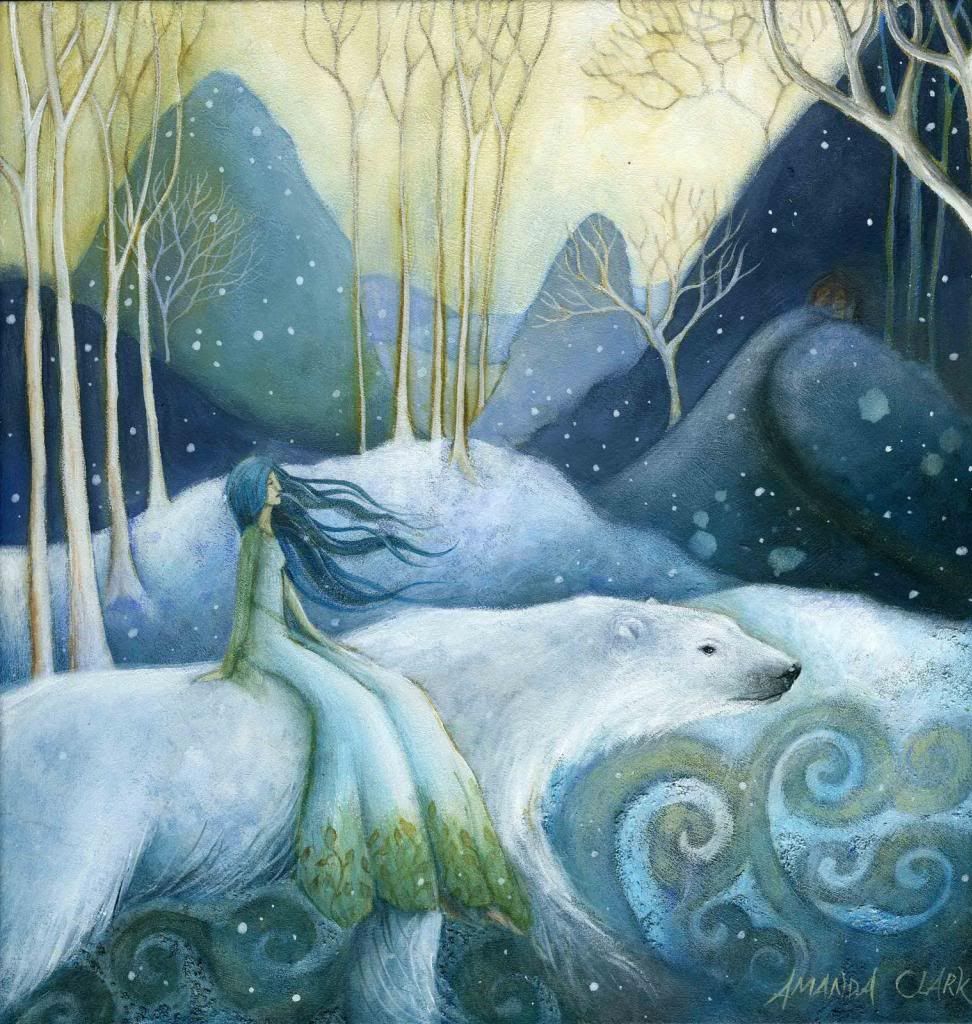
East of the Sun and West of the Moon
 |
| Amanda Clark |
One of the terribly interesting things about fairy tales is that they’re not just for kids. I don’t mean this just in the sense that the lessons they teach us are applicable to situations we experience throughout our lives, or that the current trend in film and television intended for adults is the retelling of these same stories. What I mean is that the tales themselves follow you into adulthood.
When I was a kid, my family acquired a paperback collection of First Nations stories native to the Pacific Northwest. The only story I remember from the collection, long since donated, is one about a young woman taken from her family by a spirit bear, who climbs into her bed each night in the shape of a man under the cover of darkness. Several years later, I borrowed Edith Pattou’s East from the library and came to recognize elements of the spirit bear story in the more widely known “East of the Sun and West of the Moon.” A decade later, I finally purchased East, having just made the connection between the trope of ursine bridegrooms and Brave’s subversive replacement of the bewitched love interest with the transformed mother. Now, as part of what we probably should have called “Fairy Tale February” or something equally alliterative, I want to talk about the original story.
Technically, in order to talk about the original version of this tale, we would probably have to go all the way back to the Cupid and Psyche myth. However, that’s a bit of a tangent, so the myth is perhaps best left as recommended reading. What you need to know about it is merely that variations of this story have been told for thousands of years. In the same way that it keeps popping up in my life, it resurfaces across countries and centuries.
“East of the Sun and West of the Moon” is a Norwegian folk tale, collected by Peter Christen Asbjørnsen and Jørgen Moe in the mid-nineteenth century. It begins on a dark and stormy night, when a mysterious visitor knocks at the window of a house belonging to a poor husbandman and his family. The father answers the door, only to find a white bear asking that he give him his youngest, most beautiful daughter in exchange for wealth equal to their current poverty. To his credit, the husbandman tells the bear that he’s going to at least run the idea by his kid before he sends her off with a talking animal he’s known for five minutes. When she declines the offer, her father tells the bear to come back in a week, when her answer will have changed. He then uses this time to guilt her into agreeing. When the bear returns, she has her rags all packed up and ready to go.
 |
| H.J. Ford |
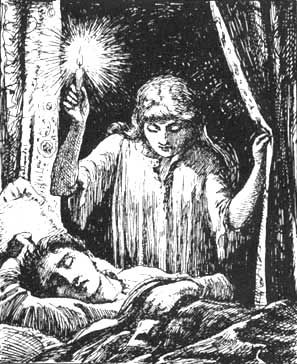
When her homesickness and loneliness become too overwhelming, she asks that the bear allow her to visit her family. He agrees, on the condition that she not speak with her mother alone, because doing so will bring both bear and girl great misery. Despite this ominous and unhelpfully vague warning, the girl eventually does speak to her mother, who suspects that the mystery man is, in fact, a mystery troll. She proposes a plan that involves the downright genius measure of lighting a candle and seeing who it is. Why this idea never occurs to the girl is not addressed. (Apparently some versions suggest that the candles in the castle cannot be used for this purpose. This is probably a later addition by a writer who didn’t want the girl to be dismissed as unforgivably stupid. We approve.)
When she returns to the castle, the girl puts her mother’s plan into action. She takes a look at the man and falls in love at first sight, as fairy tale maidens are wont to do. Again, in her defense, he’s apparently “the handsomest prince that eyes had ever beheld;” still, this doesn’t justify what she does next. Consumed with love for the sleeping prince, she kisses him, spilling three drops of tallow on his shirt and waking him up in the process. He then proceeds to freak out, telling her that if she had been able to unquestioningly accept a stranger into her bed every night for a year, he would have permanently shed the bear form he was cursed to wear during the day and they could have gotten married. Now that she has ruined everything, however, he must return to his stepmother’s realm, located east of the sun and west of the moon, where he will be forced to marry a troll princess with a distressingly long nose. Then he flounces, taking his castle with him and leaving the girl with her rags.
A major issue throughout this first half of the story is the matter of consent and control. Although the husbandman could easily have sent his daughter off with the bear without her consent, he explicitly asks for it. This act is complicated by the fact that he seems quite certain that he can change her mind, thereby proving that he doesn’t respect her decision. This issue arises again in the case of the bed companion. While this version of the story does not suggest that their encounters were in any way sexual, other versions certainly do; however, the Christian character that comes to define the girl later in the story seems to preclude the possibility of any premarital hanky-panky. Still, the bizarre situation in which a stranger shares a bed with you each night should, I think, set off a few more alarm bells than it does here. Perhaps the reason why it is not more of a problem is because the girl is so lonely. To stave off the intense loneliness she feels, she imagines the man as a probable friend instead of a potential threat.
The most intriguing treatment of the issue of consent and control outside of the pivotal tallow-spilling moment is the conflict between the girl’s respective allegiances to the bear and her mother. On the one hand, there is the pseudo-husband who extracts her promise not to speak to her mother alone. On the other, there is the mother who might offer some insight into the strange events at the castle. The girl must choose between ignorance and knowledge, between honouring her word and securing her safety. While we support the choice she makes, the story certainly doesn’t.
There is a fairly obvious parallel between “East of the Sun and West of the Moon” and “Sleeping Beauty.” In both stories, a kiss delivered to a sleeping person breaks a spell laid on the sleeper. However, whereas the prince kissing the sleeping princess is a necessary step on the road to happily-ever-after, the girl kissing the prince potentially annihilates her chances of marrying him and, in fact, forces him into the arms of another. While it is apparently beneficial to both parties when the man engages in non-consensual kissing, a woman taking the same action not only chases her man away but becomes a literal home wrecker.
 |
| Mercer Mayer |
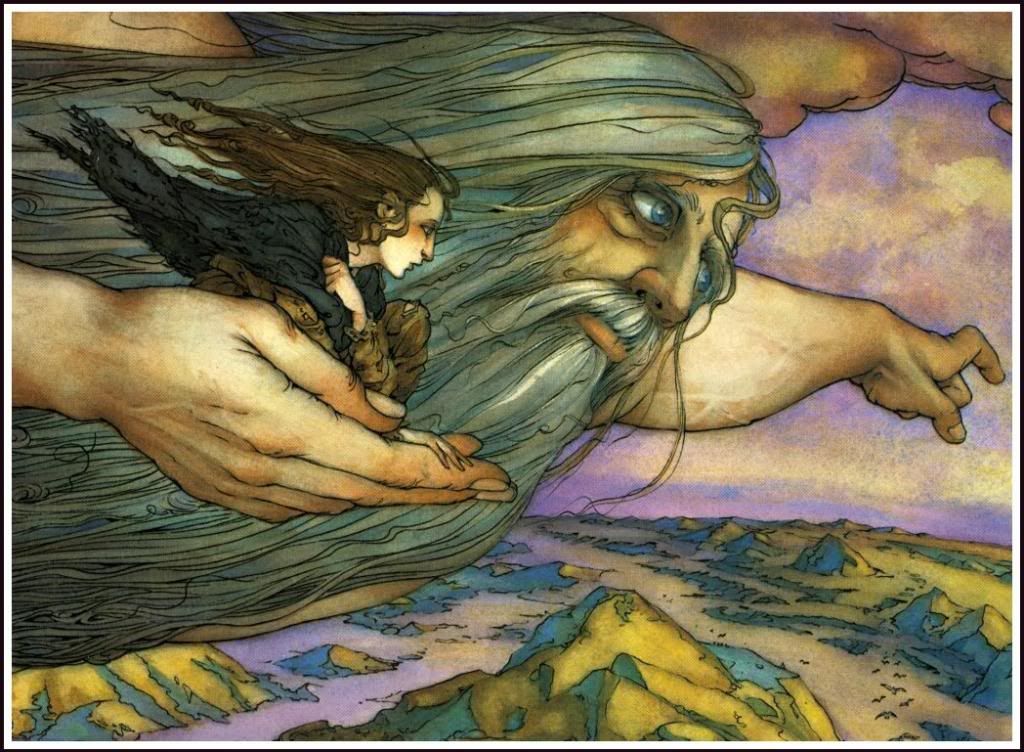
That someone is the North Wind, who volunteers to take her to the land east of the sun and west of the moon, which is so far away that even blowing a leaf across the distance exhausted him. Still, the prospect of being dropped by a mythological figure while on the way to a possibly imaginary place doesn’t faze her. When the North Wind asks if she is afraid, she states that she isn’t, echoing her own sentiments upon initially leaving with the bear. What she seems to lack in intelligence, she more than makes up for in reckless bravery.
Unfortunately, she really lacks in intelligence. Once she arrives at the stepmother’s castle, she encounters her prince’s troll fiancée and trades her one of the three golden objects for entry to the prince’s room for the night. (Yes, it is just that dubious in the text.) However, in a delicious twist of irony, she can’t wake him up. So she makes the same deal again with the second object, and is apparently surprised when the prince is in an obviously enchanted or drugged sleep for the second time in a row. Finally, she offers the third and final object to the princess without thinking to add any stipulations to the deal such as, say, the prince being awake.
Luckily, help arrives in the form of a group of Christians who, through some particularly contrived coincidence, are staying (as captives) in the room next to the prince’s chamber. They warn the prince not to drink the troll princess’ sleeping draught, leaving him awake to reunite with the girl. Just in case you were wondering if the power balance would continue to work in the girl’s favour once the prince was back in the picture, it doesn’t. Instead, he greets her with an assurance that he’s thought of a plan to save himself, in which she is to have a starring role.
The next day, he sets a challenge for any woman hoping to marry him: wash the tallow out of his shirt and he’s yours, ‘cause domestic proficiency, a pretty face, and a willingness to sleep next to a stranger you’ve never seen for a year are all he’s looking for in a wife. While every other woman manages only to stain the shirt further, the girl merely has to dip it in water to restore it to whiteness. Although this was apparently a common requirement for marriage at the time in which the story is set, it is troubling to see it used as a triumphant, climactic moment, especially in light of the fact that the prince isn’t required to make a similar show of marital value.
 |
| Kay Nielsen |
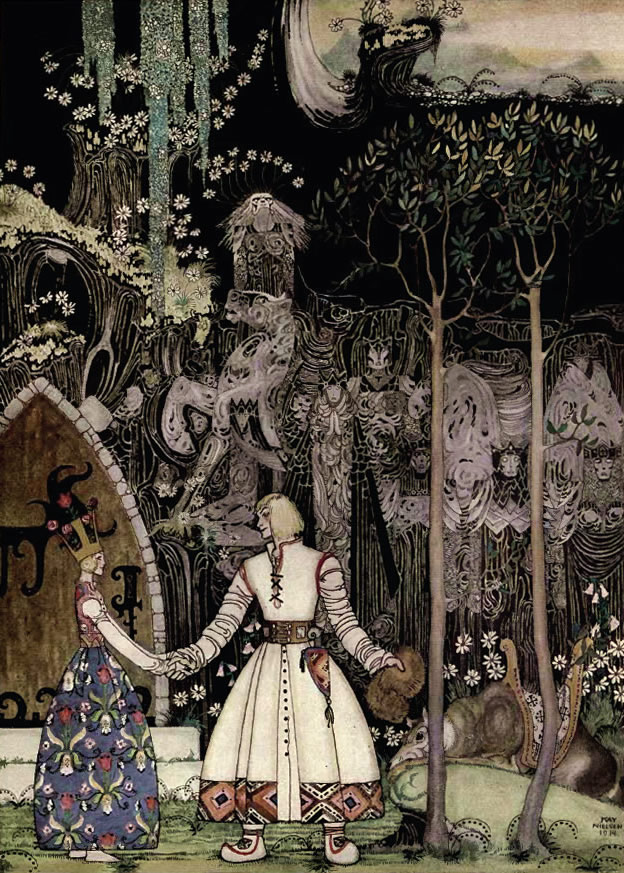
A popular reading of this folk tale holds that it makes a case for the necessity of women’s obedience; women who disobey their husbands, even when such disobedience is in their own best interests, will suffer. I might offer another interpretation: that the story can be read -- and used, if it was adapted to suit modern sensibilities -- as a cautionary tale against keeping women in ignorance in unequal relationships. Ultimately, the careful cultivation of her ignorance leads to a bunch of dead trolls, a looted castle, and a marriage to a prince whose pretty face cannot possibly make up for the fact that his plan still leaves them stranded in a land that shouldn’t exist. That’s not exactly what I’d call a fairy tale ending.
Verdict: Strong Female Character™

Selasa, 19 Februari 2013
Call for Reader Submissions
 |
| George Perez |
Dear readers,
We just want to remind you that March is Reader Appreciation Month, an opportunity for us to say thank you and for you to give us your opinion about the characters you love. While we welcome you to sit back and enjoy the posts, we need your help to make this happen. If you want to request a character for us to analyze, leave a comment on this post. If you want to write a paragraph or two telling us about your favourite female comic book character, send us an email. We'll post your messages during the weekend of the Emerald City Comicon (March 1-3). This blog could do with some more voices; make yours heard!
Sincerely,
The Management
Senin, 18 Februari 2013
Miscellaneous Mondays: The Brain Scoop vs. Nincompoops
Emily Graslie is the volunteer curatorial assistant for the Philip L. Wright Zoological Museum at the University of Montana. She hosts a YouTube series called “The Brain Scoop,” in which she discusses her work and her workplace with a candid enthusiasm (it's awesome and you should watch it). She once saved a taxidermied raccoon from the dark depths of storage oblivion. She's skinned a wolf. And she, we can assume based on a recent blog post, does not suffer fools gladly.
Here we see the Badass Woman in her natural habitat, schooling morons. Graslie responds to two YouTube comments from people who encourage her to wear “racier” clothing, one going so far as to blame her outfits for his “antiboner.” Graslie handles the comments well, letting her followers know that she wants to be a role model for young women who think that they cannot pursue a career in science. We’re especially glad to see her taking this opportunity to remind her viewers of the title of her channel; she’s here to encourage the mind, not the libido.
And, honestly, why would anyone need to wear more revealing clothing to attract viewers when they included a taxidermied animal race in one of their videos? That should be sexy enough for anyone.
Langganan:
Postingan (Atom)