Jumat, 15 Februari 2013

Sedna, Inuit Sea Goddess

Hrana Janto

In the last semester of my B.A., I took a class on the popular writing of Indigenous writers. There, I was introduced to Ajjiit: Dark Dreams of the Ancient Arctic, a collection of short stories drawing on Inuit culture and lore. Lurking in the margins of these stories is a character who never sees the light of day: Sedna the sea goddess, the “Deep Mother,” the “greatest Agony of the deep.”

Sedna, also known as Nuliajuk and Taleelayu, is the most powerful being in Inuit mythology. She is typically depicted as a mermaid-like figure, with a woman’s body and a whale tail. However, the Taleelayu is not like the traditional mermaid. Kinngait artist Pitaloosie Saila describes her thusly: “I believe in Taleelayus -- not mermaids, the way that qalunnaat (white people) seem to think about them. Their mermaids are just beautiful creatures, sitting on top of rocks, but for us, Taleelayu is the great leader of the animals, underneath the sea.”

Sedna is certainly more than a pretty face. She rules the realm of Adlivun, the Underworld of the North. There, souls are purified in preparation for the journey to the moon, or Quidlivun, where they find their eternal rest. When Sedna is angry, she produces storms; however, she can be assuaged by a shaman descending into the deep to wash and braid her hair. When she is content, she provides the Inuit with the sea creatures on which they rely for food and oil.

There are several versions of Sedna’s origin story, all featuring a woman unwilling to bend to the will of society. In one, she is a giant with a voracious hunger that causes her to attack her parents. In another, she rejects all of her suitors only to marry a dog. In the tale that I will be discussing, she begins as an ordinary woman unhappy with her marriage prospects.
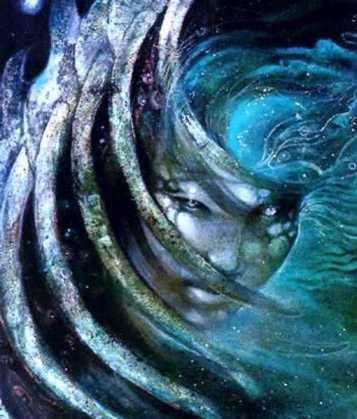
Susan Seddon Boulet
Published in Franz Boas’ 1888 monograph, The Central Eskimo, this version begins with a familiar scenario: Sedna, the daughter of a single father, has attracted numerous suitors, none of whom interest her in the least. Then a fulmar -- or a bird in the guise of a man, depending on the version -- shows up and woos her with promises of everything her heart desires. She will have a warm tent, soft bedding, plentiful meat and oil, and clothing made of feathers; in short, she will want for nothing.

Unfortunately, it turns out life with a bird for a husband isn’t all it’s cracked up to be. Her tent is covered with tattered fishskins, her bed is made of tough walrus hides, and she has to live on fish brought by a bunch of birds. The lesson here is intended to be something along the lines of “don’t let your pride blind you to real opportunities,” but I’m inclined to read it as something more like “marrying a bird may lead to some pretty intense culture shock.”

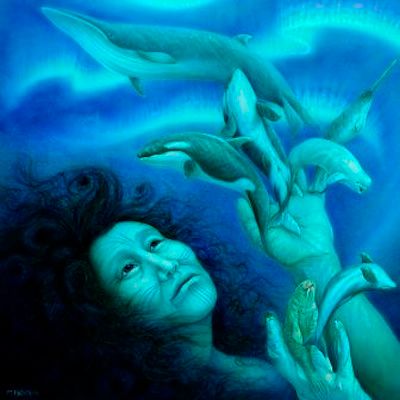
A year passes, and Sedna’s father comes to visit. After she tells him about her horrible living conditions, he kills the fulmar and tries to take Sedna home. Understandably, the fulmars are not impressed to find their dead companion and an empty tent where his wife ought to be, so they leave in pursuit. When they reach Sedna and her father, they create a deadly storm. Sedna’s father, in fear for his life, flings Sedna overboard in an attempt to appease the birds. When she clings to the side of the boat, he cuts off her fingers, which become whales, seals, and walruses.

Here the two versions I’m working with split off. In the one recorded by Boas, the storm dies down because the birds think that Sedna has drowned. Her father brings her back into the boat, but she pronounces herself well and truly done with him, vowing revenge. Once they arrive back home, she sics her dogs on him and they gnaw her father’s hands and feet off while he sleeps. He responds by cursing her, himself, and the dogs, all of which get swallowed by the Earth. They end up in Adlivun, where Sedna somehow becomes the ruler of the realm. I must admit that I find myself dissatisfied with this ending, as it deteriorates into nothing but a battle between two destructive personalities. The alternate ending, however, shows promise.

In many versions of the legend, Sedna sinks to the bottom of the sea following the loss of her fingers. In some mysterious way, she defies the death that usually awaits a person left to drown while bleeding copiously. Instead, she emerges from this traumatic experience as a powerful goddess, reborn in the ocean’s womb. This is a fascinating moment for a number of reasons.

The first lies in the transformation itself. The transformation from human to god is demonstrated by two important figures in Western culture: Jesus and Hercules/Heracles. The former undergoes crucifixion and the latter death by poison in order to attain godhood. Like these two towering cultural figures, Sedna achieves apotheosis through intense suffering. Unlike these men, however, she does so without a head start. Although, in some versions, she is the daughter of a god, the Sedna of Boas’ tale and many others seems to enjoy no such lineage. Instead of asserting her birthright, then, she is claiming something more.
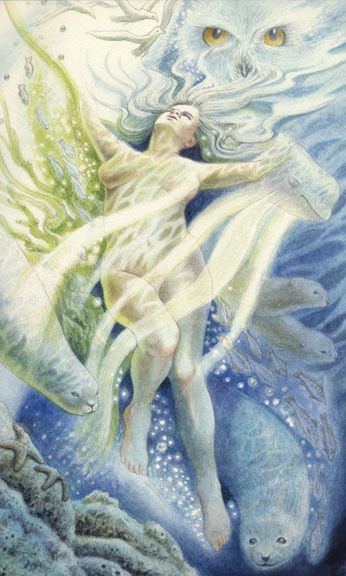
Lisa Hunt
The question is: How does she claim it? What causes the transformation in the first place? Based on the fact that her father literally has to chop off her fingers to get her to let go of the boat, it’s a pretty fair assumption that she wishes to live. Perhaps she survives through sheer willpower, unwilling to give up and let her father have the satisfaction of winning. Another option is that she not only survives, but flourishes due to the transformative power of rage. This could recast the ending as a portrait of positive rage, that forgoes destruction and condemnation in favour of construction and salvation. It could be seen as a model of response to trauma, as Sedna uses her justifiable anger in order to transform herself into a necessary creative force.

Unfortunately, as much as I would love to give her the “actual strong female character” stamp of approval, the vast differences in the various versions of her story leave me at a bit of a loss for a final label. Still, however you interpret her story, Sedna is a compelling figure from a little-known but fascinating legendary tradition, and it’s well worth your time to check it out.

Senin, 11 Februari 2013

Miscellaneous Mondays: Beyoncé Edition


For weeks, the Internet has been buzzing over Beyoncé’s Super Bowl performance. Before the show, a poll showed that 51% of Bravo viewers thought that the singer, despite not actually playing in the game, would win the match. Still, Beyoncé faced something of an uphill battle, following a much-criticized lip-syncing performance at the presidential inauguration. Even after proving that she could, in fact, outperform any of her detractors while singing the national anthem live, it was obvious that many viewers had their phasers set to “roast.”

Everyone had an opinion, and we’ve found four that you might enjoy reading or watching.

The first concerns Beyoncé’s all-female band, a major change from the usual all-male outfits that populate stages at pop performances across the country. The singer has said that she started the ten-piece band, called “The Sugar Mamas,” in order to provide role models for girls who want to play instruments. Commenting on the establishment of this group in a BlogHer post, an anonymous writer suggests that the group is definite step in the right direction:
“This act, I think is absolutely feminist, to include these amazing women, because as I have stated before, if you don’t make note of women, to include them, they won’t be included, and they will become invisible to the point that we think it is ‘strange’ to see so many of them in a band.”

In another article, David Henson argues that those who saw the performance as a sexual display misread it. Instead, he claims that Beyoncé was using the half-time show, usually governed by the hegemonic structures of patriarchy and capitalism, to fight against the objectifying male gaze:
“So here, in the midst of commercials and a culture that objectified women and their bodies and in the middle of a sports spectacle that construes power in terms of violence, Beyoncé began her performance by upending the narrative. As she walked the length of the stage, Beyoncé showed more power in a handful of purposeful, defiant strides than both sports teams had during the entire first half. In short, during those few steps, walking as a woman, Beyoncé declared ownership of that stage -- that stadium -- and, more importantly, claimed ownership of her own body in the most misogynist and objectifying four hours of mass culture.”
You should also check out Henson’s follow-up article, prompted by the conversation in the comments.

In a less positive take on the performance, social psychologist Dr. Christena Cleveland contends that it is the very hegemonic structures that Henson claims Beyoncé defies that allowed her to “own” that stage in the first place:
“As ‘powerful’ as she appeared on stage, Beyonce was still subject to the stringent rules and standards that white men set for black women.  All other things (e.g., talent) being equal, she was only given ‘power’ because she happens to be the kind of black woman that white men like and because she was sure to ‘perform’ in a way that would be pleasing to them.  To be blunt, she was treated like a 21st century ‘house nigger’ whose value will never outlast the duration of an erection.”
Again, it’s worth your time to check out Dr. Cleveland’s addendum.

Finally, while guest-hosting The Rachel Maddow Show, Dr. Melissa Harris-Perry confronted the concept of “blame.” Was Beyoncé’s fierceness responsible for the power outage that followed her show? Was her outfit to blame for the moral degradation of millions of viewers? Dr. Harris-Perry links this issue back to the power of time-worn narratives:
“Feel free to debate and disagree about the aesthetic, musical, or artistic value of Beyoncé’s performance. But once you start blaming electrical engineering failures of moral disintegration on a thirty-one-year-old, married mom and businesswoman with an enviable pair of thighs, you have entered into mythological woman-blaming. You know, like the story of Pandora, a woman who opens a box that unleashes sadness and misfortune onto the world, or of Eve, another woman, who ate that apple and brought sin to all humanity? Now it’s Beyoncé and her bootyliciousness that will make it unsafe for American children to enjoy the brain-crushing performative violence of Sunday afternoon football, punctuated by Go Daddy commercials. Right.”
Her own self-titled show airs on weekends on MSNBC, and she often focuses on women’s issues.

So, sit back, relax, maybe put on a little “Run the World (Girls)” and enjoy.

Jumat, 08 Februari 2013

Scheherazade


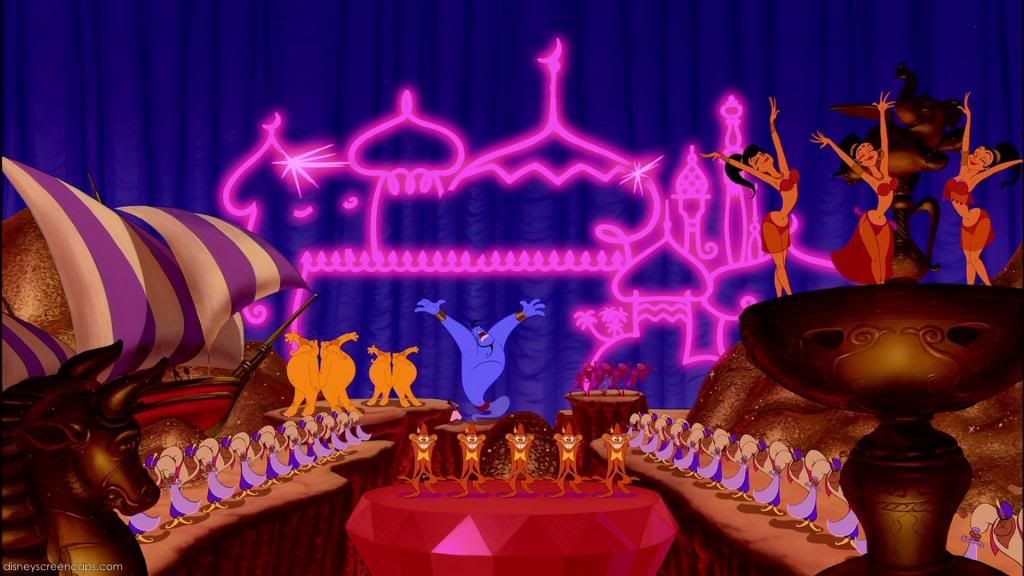
Many of us in the West probably got our first exposure to this week’s featured character while singing along with the Genie. He told us that “Ali Baba had them forty thieves, Scheherazad-ie had a thousand tales;” being a character in one of these tales, he should know.

In his introduction to a recent edition of The Arabian Nights, otherwise known as One Thousand and One Nights, Ken Mondschein describes the collection, in its many and varied forms, as “the text from the Muslim world that is most widely read in the West and thus the most identified, in popular culture, with Arabic history and customs.” We see its influence in everything from Budweiser commercials to Disney movies, from symphonies to comics. However, although it is in many ways the West’s favourite gateway to the East, it is one that we built, leading to a land that we envisioned. The collection is a work of literary transmission spearheaded by the West and, as Mondschein suggests, “there is no transmission without transformation, and in many ways, the reception of the Nights tells us more about our own culture than it does about the Muslim world.”

The edition that I will be using is a translation originally issued in 1885-6 by Sir Richard Burton, a figure heavily identified with the spread of the stories in the English-speaking world. This is a deliberate choice, as this post is intended to be read alongside this week’s Miscellaneous Monday post. While that article discussed many of the positive, transformative aspects of reworking stories, Burton’s version of the Nights demonstrates the negative consequences of creative translation. His problematic work includes what Mondschein terms “salacious details,” intended to indulge his contemporaries’ orientalist attitudes at the expense of accuracy.

From the Reader's Digest edition
If you’ve been in a college or university-level English class in the past few decades, you probably know which critical text I’m going to reference next. For all those who have no wish to be exposed to Edward Said’s seminal 1978 work, Orientalism, or academic writing in general, skip ahead to the next paragraph. Said describes the kind of creative action taken by Burton thusly: “In any instance of at least written language, there is no such thing as a delivered presence, but a re-presence, or a representation. The value, efficacy, strength, apparent veracity of a written statement about the Orient therefore relies very little, and cannot instrumentally depend, on the Orient as such. On the contrary, the written statement is a presence to the reader by virtue of its having excluded, displaced, made supererogatory any such real thing as ‘the Orient.’ Thus all of Orientalism stands forth and away from the Orient: that Orientalism makes sense at all depends more on the West than on the Orient, and this sense is directly indebted to various Western techniques of representation that make the Orient visible, clear, ‘there’ in discourse about it. And these representations rely upon institutions, traditions, conventions, agreed-upon codes of understanding for their effects, not upon a distant and amorphous Orient.” Basically, the West creates a false representation of the East using Western methods, so what is represented reflects what the West imagines the East to be: mysterious, mystical, homogeneous, and utterly fictional. It makes sense, then, that one of the abiding cultural icons that emerges from the Nights is a storyteller.

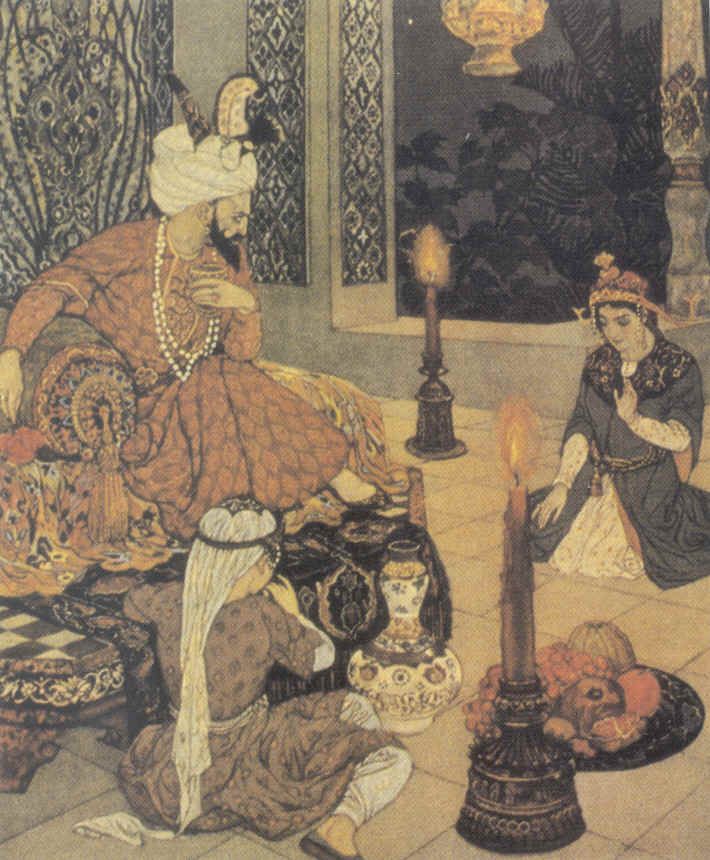
The frame story in which the thousand tales are told begins with a smorgasbord of infidelity. Two kings, Shahryar and Shah Zaman learn that their wives are cheating on them and, after a brief, self-fulfilling quest to find another man who has been similarly wronged, they conclude that all women are malicious, untrustworthy, and unworthy of power. They return to their respective kingdoms, where they -- having both already executed their wives -- put into action a plan to wed a virgin each night, bed her, and put her to death in the morning. This goes on for three years before Shahryar finds himself all out of virgins, all of them having fled or been killed, and all out of goodwill from his subjects.

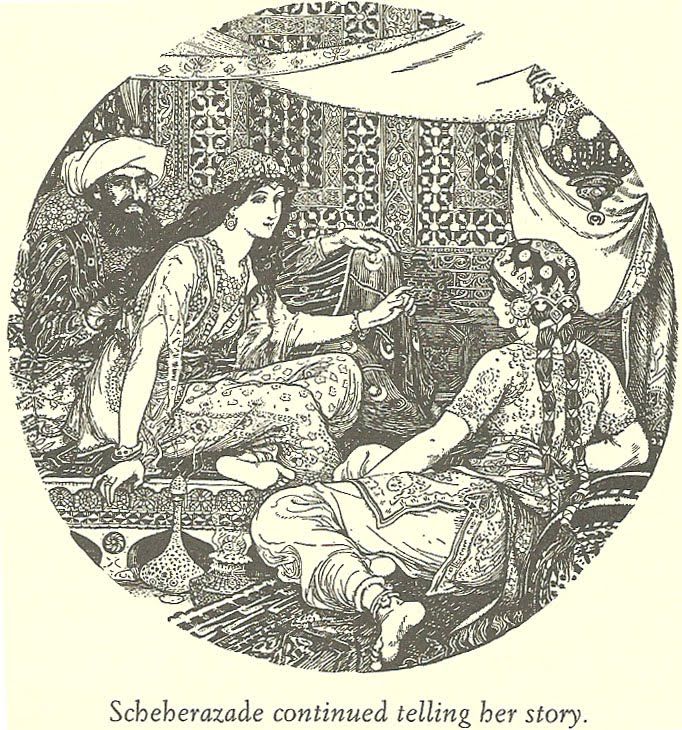
This is where Scheherazade enters the story. She is something of a narrative nerd and has “perused the books, annals and legends of preceding Kings, and the stories, examples and instances of bygone men and things; indeed it was said that she had collected a thousand books of histories relating to antique races and departed rulers. She had perused the works of the poets and knew them by heart; she had studied philosophy and the sciences, arts and accomplishments; and she was pleasant and polite, wise and witty, well read and well bred.” She is an academic par excellence and something of an inspiration for those of us who spend most of our lives consuming and discussing stories. Who knows when we might find ourselves in a situation where we need to tell hundreds of stories in order to distract a mass murderer for years at a time?

Scheherazade is the elder daughter of the king’s vizier and, as the vizier has been responsible for carrying out the executions, she and her sister, Dunyazad, have been spared. When her father refuses to let her marry the king, she defies his authority in such a way that proves that he has no real power over her. Even after he threatens to beat her, she remains defiant, secure in the knowledge that she could bring the king’s ire upon him should she tell Shahryar that her father prevented the marriage. She also proves herself able to resist the lessons of stories, as she does when her father uses a tale to try to dissuade her from her task. As she says, “I will never desist, O my father, nor shall this tale change my purpose. Leave such talk and tattle. I will not listen to thy words and, if thou deny me, I will marry myself to him despite the nose of thee.”

Léon Carré
This is an important point to remember: at no point does Scheherazade have to step forward, because self-preservation dictates that she would be better off doing nothing. Instead, she chooses to offer herself in marriage to a psychopath and either live or “be a ransom for the virgin daughters of Moslems and the cause of their deliverance from his hands and [her father’s].” Hers is an act of heroism: forsaking her own safety and, potentially, her life, she sets out to save untold thousands. She is not an accidental hero, who looks back at her deeds and finds herself surprised at their import, but a deliberate saviour, who plans to become a champion of women.

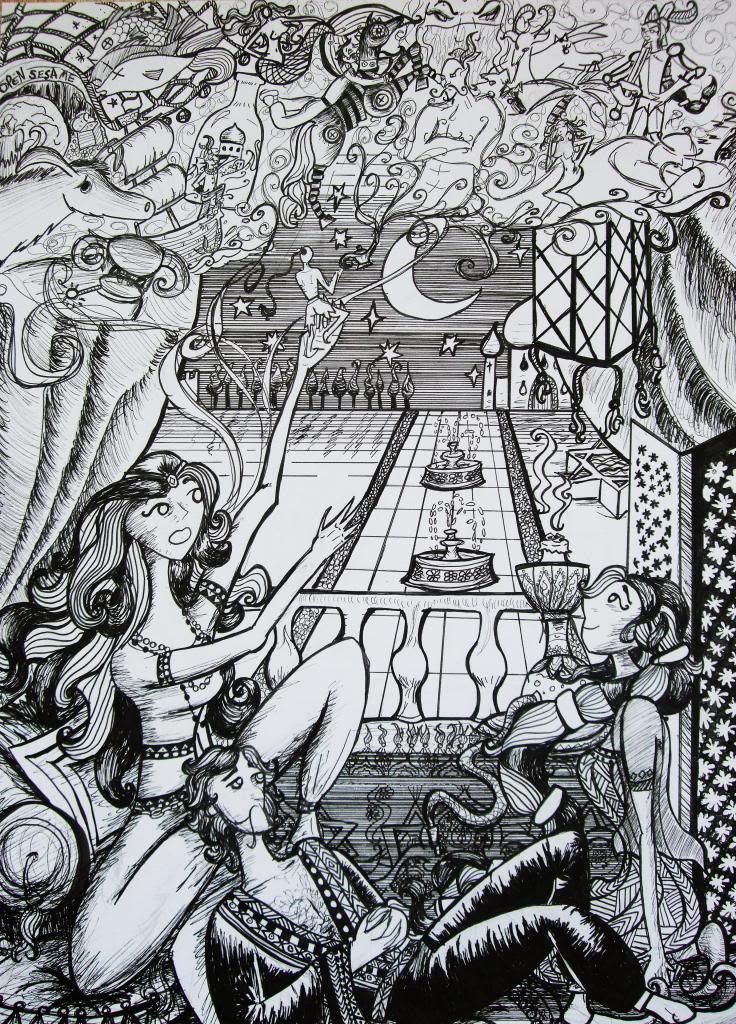
To do this, she enlists the help of her sister, who will request that Scheherazade tell her (and the king) a story on the wedding night. Scheherazade plans to tell only part of a story each night, keeping the king in suspense and herself alive to finish the story -- and start another -- the next evening. This continues for 1001 nights, during which time Scheherazade gives birth to three sons. While she suggests that the latter accomplishment should earn her a pardon, Shahryar assures her that it was her ingenuity, piety, and purity that convinced him to spare her life. It seems, however, that it was actually her stories that did the trick. When she concludes her last tale, she reminds him that he should keep things in perspective, as many of the characters she told him about had to deal with far worse troubles than his own. Then, with her stories complete, “she ceased to speak, and when King Shahryar heard her speech and profited by that which she said, he summoned up his reasoning powers and cleansed his heart and caused his understanding revert.” It is her words, specifically, that restore the king’s sense and allow him to relinquish his prejudice. The man who condemned women comes to view Scheherazade as a saviour sent to stop the oppression and slaughter of Allah’s creatures.

Before I get into the more symbolic meaning of Scheherazade’s storytelling, I’d like to take a moment to discuss it on a literal level. This woman, with the threat of death hanging over her head for the better part of three years, manages to remember and retell a thousand stories. Not only does she remember them, but she recounts them with enough style and timing to keep her audience riveted for more than thirty months. So, for a period of time during which many television shows cannot hold our attention airing once a week with hiatuses, Scheherazade tells stories that earn her her continued existence. That’s pretty damn impressive. (It also makes me wonder if we wouldn’t have better programming if we implemented a similar model for modern writers. I jest, but this may be the only way to make Glee bearable again.)

Laura Swinton
In addition to the already extraordinary task of merely relating a thousand interesting tales, Scheherazade manages another feat: becoming the hero she planned to be. Not only does she end Shahryar’s reign of terror, but she also indirectly does the same for Shah Zaman when Shahryar, in telling his brother of Scheherazade’s tales, convinces him to stop the executions in his own kingdom. Through her stories, she ends the kings’ vindictive slaughter, proving the adage that “the pen is mightier than the sword;” as she demonstrates, words can overcome violence. Her storytelling proves that language has a transformative ability, healing the king and restoring prosperity to the kingdom.

Beyond her status as the fictional character telling stories about fictional characters that have become the West’s basis for imagining the Middle East, what gives Scheherazade her lasting (pop) cultural importance? On some level, she is a kind of cultural liaison to an imaginary culture and, despite being fictional herself, her presence legitimizes the stories. For a Western audience, she is the narrator who allows us to pretend that the tales remain authentic despite decades of translation. For some modern women, she is a point of identification, a homegrown alternative to the kind of Western feminism that so rarely grasps the intricacies of Middle Eastern life.

In the age of fanfiction, we can also find value in Scheherazade as the prototypical female fan creator. She familiarizes herself with stories in order to remake them to suit her needs. Like William Shakespeare, Jean Rhys, and Gregory Maguire, she validates derivative work, proving that it can build upon the original. She demonstrates the necessity of storytelling and the power of words; in Scheherazade, we see a woman who appropriates men’s stories in order to save women’s lives.

Verdict: Actual strong female character


Rabu, 06 Februari 2013

Reader Appreciation Month

To celebrate our first six months at the end of February, we will be doing a month of reader appreciation.

We’ll be kicking things off with some reader-generated content. As the first Friday of March is also the first day of the Emerald City Comicon (which I will be attending), we’ve decided to dedicate the entire weekend to your picks for your favourite female, female-identifying, or genderqueer comic book characters. Just send us an email with a paragraph or two about your favourite four-colour female and we’ll prepare a three-day comic celebration.

For the other four Fridays in March, we’ll be writing posts based on your requests. If you have a character you’d like to see us cover, just leave a comment on this post. Remember, if your request isn’t written this time ‘round, it’s probably because we already have something planned for them.

Senin, 04 Februari 2013

Miscellaneous Mondays: The Boy Who Lived Forever (Because Girls Made It Possible)

“Fan fiction is what literature might look like if it were reinvented from scratch after a nuclear apocalypse by a band of brilliant pop-culture junkies trapped in a sealed bunker. They don’t do it for money. That’s not what it’s about. The writers write it and put it up online just for the satisfaction. They’re fans, but they’re not silent, couchbound consumers of media. The culture talks to them, and they talk back to the culture in its own language.”

So argues Lev Grossman in his TIME Magazine article, “The Boy Who Lived Forever.” The piece represents an effort to lift the curtain and reveal the largely unseen world of fan creation to a mainstream audience. Grossman introduces the concepts of slash, mpreg, and alternate universes to people who have never wept bitter tears because their favourite WIP was abandoned or bemoaned the state of television because their OTP will never become canon. It is an article intended to illuminate this usually invisible realm, not in the guise of an exposé, but as a loving tribute to the symbiotic nature of narrative creation.

While the intended audience is clearly those not in the know, there’s a lot that those of us well versed in fandom can take from this article. First and foremost, it is a positive article about fanworks, with an introduction that implies that the efforts of fan creators are just as valid as the works on which they are based. It traces the history of storytelling and demonstrates both that the worship of originality is a relatively recent development and that great art has always been derivative. Grossman also recognizes that, far from being inherently inferior to the original works, fanfiction can improve upon its predecessors.

What we’re most interested in, however, is a point he makes about halfway through the article. Having established that most fan creators are women, he goes on to discuss what may very well be fanfiction’s most important function: “Diversity: the fan-fiction scene is hyperdiverse. You’ll find every race, nationality, ethnicity, language, religion, age and sexual orientation represented there, both as writers and as characters. For people who don’t recognize themselves in the media they watch, it’s a way of taking those media into their own hands and correcting the picture.” It is a way in which we can appropriate the narratives that the mainstream media deems suitable to tell, and show them that our stories are equally worthy.

Many of us are familiar with the argument that, if we aren’t happy with the way things are, we should write our own stories. Unfortunately, for a whole host of economic and social reasons, it’s almost impossible for our stories to compete with the corporation-backed media. Faced with such a situation, it should come as no surprise that we have decided to repurpose these narratives to suit us. Grossman argues that fan creators “talk back to the culture in its own language;” isn’t this the best way to ensure that we’re understood?

Jumat, 01 Februari 2013

The Snow Queen

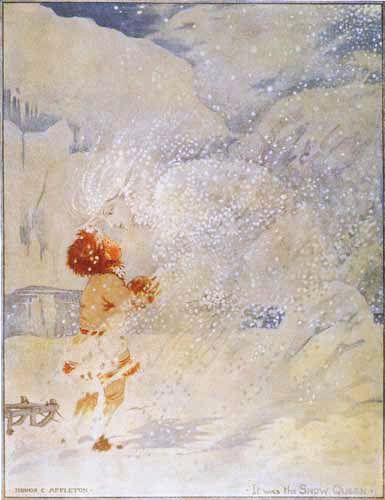
Honor C. Appleton

This week we begin a series of women from legends and fairy tales, the enduring figures that are used to instil in us important life lessons and teach us the rules of social life. We are particularly interested in these characters because of their longevity; their influence has lasted hundreds of years and their stories are retold in various media as legions of adapters reaffirm their relevance for generations of audiences.

The subject of this first post is markedly different than the vast majority of the tales that have come to form the backbone of Western popular culture. Published in 1845, “The Snow Queen” by Hans Christian Andersen stands out from both the crowd of male-centric stories we tell today and the throng of cautionary tales starring girls and women that come to us from The Brothers Grimm. “The Snow Queen” is a story that revolves around and celebrates women, as evidenced by the fact that, of the seven sections, six are named in whole or in part after women. We are all familiar with tales in which the male hero saves the damsel in distress, and most of us are probably well-versed in the modern subversions of these stories, in which the dude in distress is saved by a heroine. What “The Snow Queen” offers us is a take on the latter before it was cool. (Consider yourself warned; that was not the last ice joke.)
 
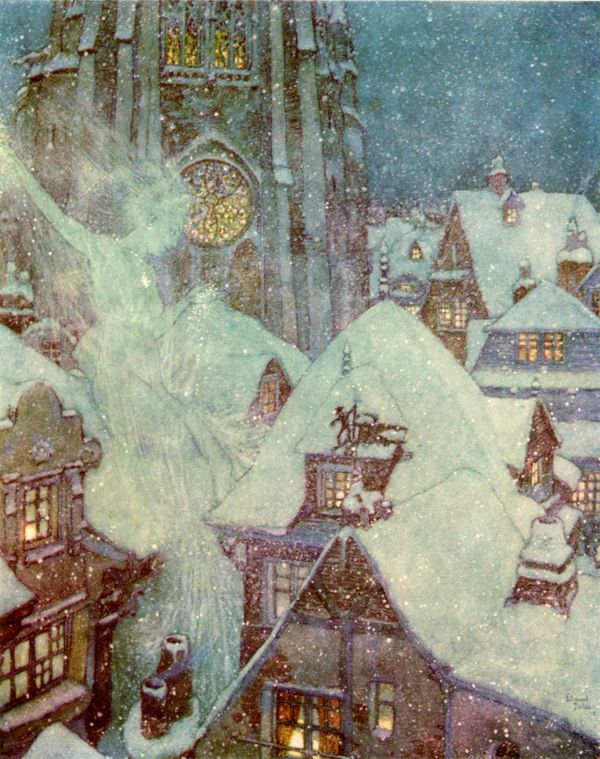
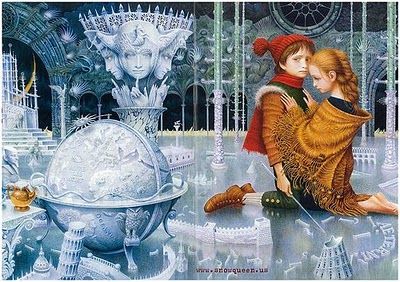
Edmund Dulac
We begin with the Snow Queen herself. As we learn when Kay’s grandmother tells her story to the children, Kay, the dude in distress, and Gerda, the heroine, the Snow Queen is an entity like a queen bee, who “flies where the swarm [of snow or ‘white bees’] hangs in the thickest clusters. She is the largest of all; and she can never remain quietly on the earth, but goes up again into the black clouds. Many a winter’s night she flies through the streets of the town, and peeps in at the windows; and they then freeze in so wondrous a manner that they look like flowers.” She is a force of nature, the embodiment of winter, but she is also a woman: “a young lady, dressed in the finest white gauze, made of a million little flakes like stars. She was so beautiful and delicate, but she was of ice, of dazzling, sparkling ice; yet she lived; her eyes gazed fixedly, like two stars; but there was neither quiet nor repose in them.” She is both the beauty and the lethality of winter.

This is further demonstrated in her treatment of Kay. In order to take Kay further into her realm, she kisses him twice; the first kiss stops him from feeling the cold, while the second makes him forget Gerda and the rest of his loved ones. She states, “Now you will have no more kisses... or else I should kiss you to death!” The only affection her lips can provide is frostbite, and the expression of what others might term warmth results in her victims freezing to death.

Before she becomes a hero, Gerda is a little girl whose best friend, Kay, is taken by the Snow Queen after he is corrupted by pieces of a magic mirror that lodge in his eye and heart. There’s a lot of thinly veiled Christian symbolism here -- the creature who made the mirror is clearly the Devil -- but it’s enough for our character-based analysis to say merely that Kay is abducted to the Snow Queen’s palace. Gerda is devoted to Kay, and when he disappears, she takes the initiative to question all the witnesses of his disappearance. When they cannot provide satisfactory answers, she comes to the conclusion that he must have died.

Because literally everyone is rooting for Gerda, both the sun and the swallows assure her that Kay is not dead, and she decides to test this theory. She throws her most prized possession, a pair of red shoes, into the river in exchange for Kay’s presumably drowned body. When the river rejects her offering, she assumes that she just has to throw them further, and boards a boat to enable her to make this throw. Although she initially panics as she floats away, she eventually decides to sit back and enjoy the scenery while the river hopefully takes her to her lost friend. That’s how Gerda approaches most obstacles in the story: by accepting them as a necessary step in her journey to save Kay.

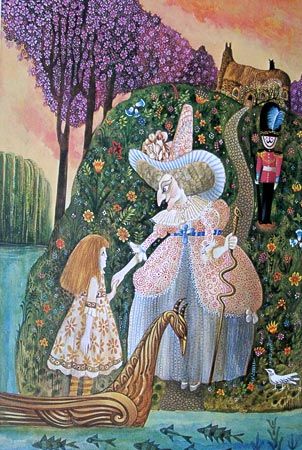
Errol le Cain
The person who saves her from this predicament is an old woman who knows magic. Unfortunately, the woman decides to keep Gerda, and enchants her to forget Kay and her quest. This woman is something of a mirror image of the Snow Queen; the Snow Queen spreads winter across the globe while the old woman cultivates a garden of everlasting spring. Unlike the Snow Queen, however, who can use Kay’s prior corruption to keep him in line, the old woman finds that she cannot prevent Gerda from discovering her own captivity. When the old woman removes all the roses from her garden to stop Gerda from remembering Kay, Gerda is bothered by an unknown absence, only revealed when her tears cause the roses to spring from the ground. In this way, Gerda overcomes the old woman’s magic, feeling an absence that she comes to realize is a stand-in for a more profound lack.

After interrogating the flowers and gaining nothing but confirmation of Kay’s continued existence, Gerda sets off, barefoot, to continue her quest. She comes upon a Raven, who tells her about another fascinating female character: a princess who is so clever that “she has read all the newspapers in the whole world, and has forgotten them again.” This princess decides to get married, but explicitly states that her prince will be someone intelligent and articulate, a man “who knew how to give an answer when he was spoken to--not one who looked only as if he were a great personage, for that is so tiresome.” She ends up choosing a suitor who had no intention of marrying her, but merely entered the castle in order to hear the princess’ wisdom. She chooses a husband who admires her brain, someone who, unlike the actual suitors, did not seek to win her but merely to hear her and enjoy her intellect.

Although Gerda sneaks into the princess’ castle -- her bare feet violate their strict “no shirt, no shoes, no royal assistance” policy -- the princess nevertheless allows her to stay the night and sends her on her way. Garbed in fine clothing and travelling in a carriage of pure gold, however, Gerda quickly gets robbed. The transition from the princess’ castle to the robbers’ woods marks the apparent shift from civilization to barbarism, from Disney-style aspirations to Grimm, violent reality.

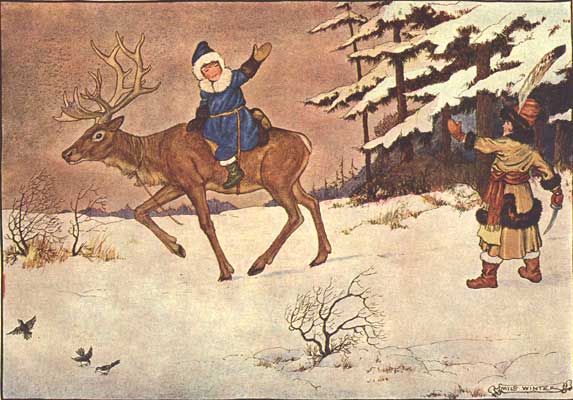
Luckily, Gerda is ambushed by a group including one of the more interesting characters in fairy tales, the little robber girl. She is described, on various occasions, as wild, unmanageable, spoiled, and headstrong, and it probably comes as no surprise that she’s also pretty awesome. When the robber girl’s mother, a woman with “a long, scrubby beard, and bushy eyebrows that hung down over her eyes,” verbalizes her plan to eat Gerda, the robber girl bites her mother. The girl offers another plan: she will keep Gerda’s fine things, as well as Gerda herself. She also assures Gerda that she will not be killed, so long as she doesn’t anger the robber girl; in that case, the robber girl will kill her herself. The girl sleeps surrounded by dozens of animals, all kept and terrorized by her. Among them is a reindeer, whom she torments nightly with the long knife that she also sleeps with, because she lives in a world where “there is no knowing what may happen.”

Still, her harsh existence has in no way destroyed her ability to feel compassion. While she finds amusement in tormenting animals, it appears that the robber girl has been raised with the idea that violent actions can be used to express love and affection. She also possesses the ability to express these things in more traditional ways, as demonstrated when she comforts Gerda and when she sends her off to continue her journey, this time with the reindeer as both transportation and navigator.

Milo Winter
When we last see her, the robber girl is “a young damsel with a bright-red cap on her head, and armed with pistols,” riding a magnificent horse. She has undertaken her own journey, not because she needed to save someone, but merely because she was bored. It’s a refreshing move to have a female character decide to do something just for the hell of it, with no thought for anyone’s amusement but her own. We’re used to reading about and watching people who must be pushed into action, so it is especially interesting to see a character go on a quest for their own pleasure. In a further subversion of unquestioned narrative tropes, the robber girl asks Gerda whether her quest was even worth it: “‘You are a fine fellow for tramping about,’ said she to little Kay; ‘I should like to know, faith, if you deserve that one should run from one end of the world to the other for your sake?’” We almost never ask whether the damsel deserved to be saved, but here the robber girl poses just that question. Was the person worth the hero’s time, or was it the character growth that made it all worthwhile?

We return now to the rest of that journey. Before Gerda saves Kay, she receives help from two more women, one from Lapland and one from Finland. The Lapland woman offers sustenance, but can only refer Gerda to the Finland woman, to whom she writes a message on a dried fish. The Finland woman is an incredibly powerful figure, described by the reindeer thusly: "you can, I know, twist all the winds of the world together in a knot. If the seaman loosens one knot, then he has a good wind; if a second, then it blows pretty stiffly; if he undoes the third and fourth, then it rages so that the forests are upturned.” He requests that she give Gerda a potion to give her the strength of ten men, but she declines. This is not because she cannot brew such a potion, but because physical strength won’t help Gerda in the task ahead. She knows this because she, unlike everyone else in the story, appears to know exactly what has happened to Kay, down to the mirror shards embedded in his eye and heart. It is possible that she learns all of this from a parchment covered with strange figures. It’s almost as if she’s reading the story itself.

Even if she isn’t reading ahead, the Finland woman does have a kind of omniscience, as she figures out what has to happen next. She argues that she “can give [Gerda] no more power than what she has already. “Don't you see how great it is? Don't you see how men and animals are forced to serve her; how well she gets through the world barefooted? She must not hear of her power from us; that power lies in her heart, because she is a sweet and innocent child! If she cannot get to the Snow Queen by herself, and rid little Kay of the glass, we cannot help her.” Again, setting aside any symbolic implications for a narrative about good and evil, this is very cool. This is an incredibly powerful woman saying that she cannot empower a little girl any further, because the girl, in and of herself, has power enough on her own. She commands other living creatures, she receives intelligence from nature, and she does all of this without so much as a speck of foot protection. She’s something of an anti-Cinderella; instead of a set of ornamental shoes and a fairy godmother, she has her own feet and her own power.

Now, we must briefly address the symbolism. In order to infiltrate the Snow Queen’s castle, Gerda arms herself with the Lord’s Prayer. It summons a host of armoured angels to fight snowflakes and banish the cold from her limbs. The prayer also halts the winds that comprise the castle gate. Finally, it is a baptism of her “burning tears” that thaws Kay’s icy heart. Gerda’s power is, at the end, bolstered by the constancy of her faith and the innocence of youth.

Vadyslav Yerko
At the same time, the nature of her victory is well worth considering from another angle. You may have noticed the recent trend in Hollywood of having the female protagonist spend the third act in a suit of armour. In order to make these characters more palatable to the masses, the filmmakers relocate their struggles to the battlefield; this suggests that the proper ending for any adventure necessarily involves violence. “The Snow Queen,” by contrast, argues that no such resolution is required. Gerda doesn’t have to face the Snow Queen to win; she merely has to brave the elements and use the physical results of the love she bears Kay to save him. While we have railed against the idea that a woman’s power comes from love, what redeems this story for us in that regard is the fact that this is explicitly friendly, not romantic, love.

Although this story is more than 165 years old, it seems bizarrely progressive in today’s media environment. While we’d like to commend Hans Christian Andersen for writing a tale that can still be considered forward-thinking today, we’d also like to take this opportunity to discuss why this progressiveness is, in itself, problematic. It all boils down to one question (which I, as is my wont, will stretch into two): If a 165-year-old story is still progressive, what does that say about the regressive nature of our contemporary storytelling? If it’s still progressive to write about a girl saving a boy, have we made any progress in dismantling the expectation that boys should save girls? Something can only be subversive if it is operating against an established norm; it can only be progressive if we are actually making progress.

This is one of the reasons we will be reviewing Disney’s Frozen. As a modern adaptation of “The Snow Queen,” the film could be expected to keep these same subversive qualities intact. From the information currently available, however, it appears as if Frozen will merely perpetuate the status quo. As far as we can tell, this film isn’t about the girl saving a boy, but about the girl falling for the boy; it’s not about women helping women, but about a new set of male sidekicks helping a woman in her quarrel with her sister. As we said in our preview, we hope that the film will prove us wrong. We would like nothing more than for Frozen to prove itself truly progressive, to ditch the same old freezer burnt tropes and use this opportunity to improve on a classic. Unfortunately, having seen no mention of the little robber girl or many of the other women in the story, we’re not holding out much hope.

Verdict: Actual strong female character