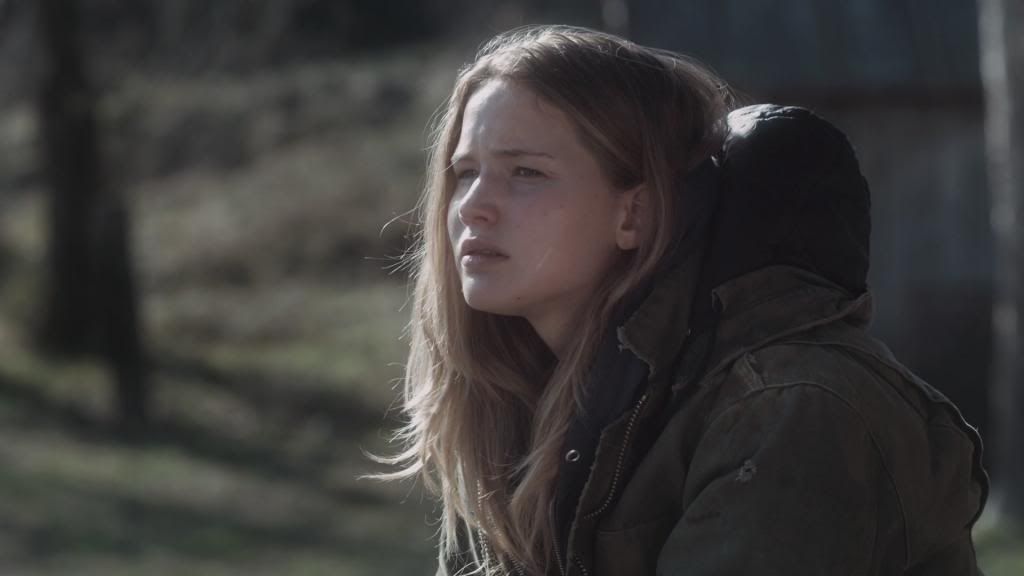
Now that it’s Hunger Games season again, it’s difficult to go anywhere without seeing Jennifer Lawrence. Her image can be found on buses and T-shirts, and her perfect archery form and eccentric interview style have made her the darling of a massive online fanbase. However, before playing the 74th Hunger Games victor made her famous, her portrayal of another strong female character made people take notice.
In Winter’s Bone, Lawrence plays Ree Dolly, a teenage girl in the Ozarks who is left to care for her younger siblings after her mother descends into a catatonic state and her often absent father disappears. When her father, Jessup, misses a court date, the sheriff informs her that their house and land are forfeit as part of his bail. Desperate to save her home and her family, Ree vows to find her father, alive or dead, and hand him over to the law. Unfortunately, while family is Ree’s greatest motivation, it is also her greatest hindrance and, more often than not, her greatest enemy.
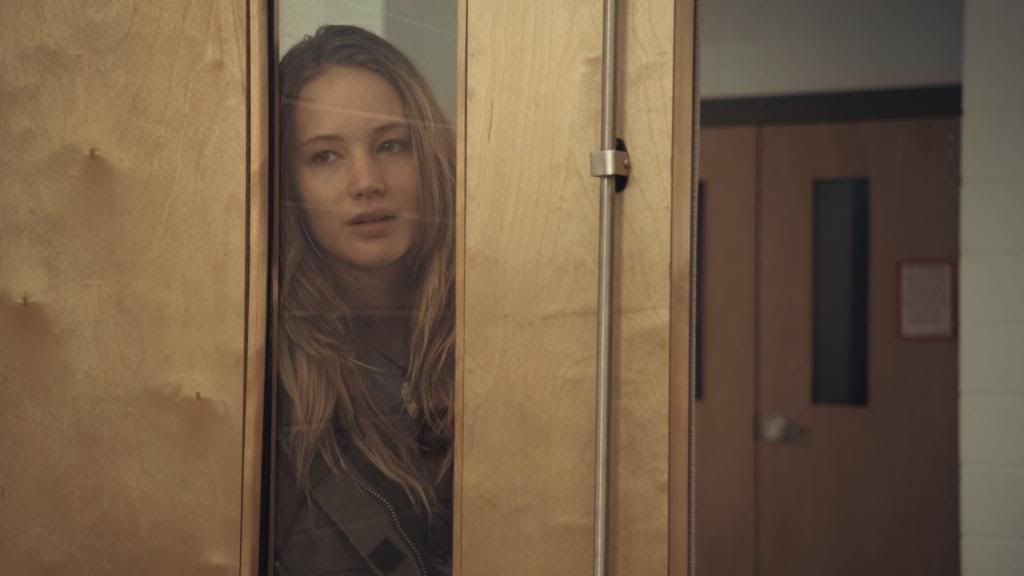
The entire first act of the film establishes Ree’s strength of character, showing us the enormity of the challenge she faces in merely keeping things running. Over the first few scenes is overlaid the sound of a woman’s voice singing “Missouri Waltz”; while its mournful singer nostalgically recalls being a child on her mother’s knee, we see the seventeen-year-old Ree acting as a maternal figure for her younger siblings while her own mother is essentially dead to the world. She does the laundry and her mother’s hair, and she makes the meals as well as the decisions to keep or get rid of pets. She has had to grow up too fast, and this is made abundantly clear when she walks Sonny and Ashlee to school. After dropping them off, she wanders the halls, looking in on the classes that she should be taking. In one, the students are receiving dolls to teach them how to take care of children; while they are learning responsibility in practice, Ree is practicing it in reality.
The most poignant moment in this sequence, however, involves Ree looking in on her old JROTC drill team practicing a routine. Here we see just what she’s lost: the future she wanted. We learn over the course of the film that Ree had hoped to join the army, but those dreams were dashed when she took over caring for her siblings. Later, she tries to join up in desperation, hoping to use the money to provide for her family. She is denied, rejected according to a set of age restrictions that deem her a minor even as she acts as a parent.
Ultimately, it is poverty that is Ree’s worst enemy and her driving force. She provides for her family using the hunting skills that her father taught her, but it is clear that squirrels can only feed them for so long. Their meager supplies are supplemented by neighbours, but Ree warns her siblings not to rely too heavily on their kindness, as they should “never ask for what ought to be offered.” It turns out that these neighbours are motivated by more than the thought of a friend in need; they want to know how much Ree has told the police. In addition, we later learn that Sonny is the man’s biological son, and their donations appear to be almost a form of child support. The code that these characters live by is not one based on altruism, but of taking care of one’s own.
When Ree learns of her father’s betrayal, she begins to learn just how weak even these loyalties can be. Because Jessup mostly worked with his relatives in the meth-making business, Ree must ask them about his whereabouts, increasingly aware that they may be to blame for his disappearance. Ree promises the bail bondsman that she’s a Dolly, “bred and buttered,” and that is what allows her to realize that her father is not just missing, but dead. This certainty isn’t due to any particular psychic talent common to Dollys, but to the fact that her kinship grants Ree familiarity with their brutal code of honour. Familial ties are sacrificed the moment someone violates this code, and Ree quickly realizes that Jessup stepped out of line. However, to save her home, she herself has to risk committing the same violation that got her father killed. As she learns, “come the neck-cutting, blood don’t really mean shit to the big man.”
It turns out that Jessup’s crime was becoming a snitch. He couldn’t handle ten years in prison, so he sacrificed both his standing with the Dollys and the family that he didn’t want to lose for a decade. Much of the other characters’ hostility toward Ree can be traced to their assumption that she will crack as her father did. This complicates Ree’s quest, as she has to get proof for the sheriff, while ensuring that she doesn’t lead the law back to her father’s murderers. Also complicating her quest is her uneasy alliance with her father’s brother, Teardrop. Teardrop initially respects the code, discouraging Ree’s search. As she gets closer to the truth, however, he takes responsibility for her in order to protect her from the others. He aches for vengeance, and the last time we see him, he departs on a suicidal mission to kill Jessup’s killer. The film juxtaposes Ree with these two men, whose respective weaknesses led to their demise. Jessup betrays the family’s secrets, while Ree is able to hold her tongue, even under immense emotional pressure. Teardrop’s need for vengeance is his undoing, but Ree makes a point of not seeking the kind of firm answers that would allow her to punish those responsible. She is willing to keep quiet and move on, and in this way proves herself to be stronger than either of the two men. She may not be a righteous avenger of wrongs, but she is alive at the end of the film.
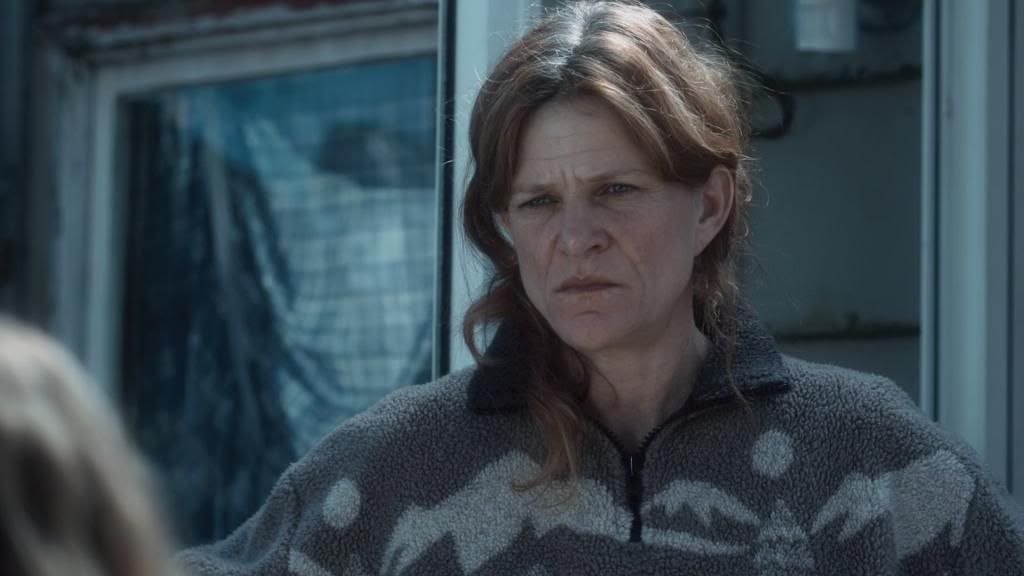
The code by which all Dollys must abide is not the only governing force in their community; operating alongside these rigid guidelines is an equally rigid, if untraditional, set of gender roles. Because the people Jessup worked with were mostly men, Ree seeks them out to ask her questions. At no time, however, does she speak directly to any of them without first talking to a woman acting as gatekeeper. In this community, it is the women who form the first line of defense against intruders. When Ree refuses to give up the search for her father’s body, the wife of the man in charge of the drug operation, Merab, enlists the help of her sisters in beating her up. Because the violence occurs between women, Teardrop cannot punish Ree’s attackers for their brutality.
Unfortunately, this does not mean that women are safe from men’s violence and control. Teardrop himself physically threatens Ree when he thinks she’s out of line, and he operates within an environment of overt domestic abuse, telling his wife, “I said ‘shut up’ once already with my mouth.” The extent of men’s control over women is evident in the case of Ree’s best friend, Gail, who has to ask her husband to borrow his truck. When he refuses, she tells Ree, “He never says why not to me, Ree, he just says no.” Ree responds that “it’s so sad to hear you say he won’t let you do something, and then you don’t do it.” Gail explains that it’s different when you’re married, and that is clearly true. In this community, the formation of close bonds is a double-edged sword: you may gain protection, but you also risk harm at the hands of the person who offers it. At the same time, the protection that women offer men does not necessarily extend to themselves.
Still, in this film, the women are the plot’s movers and shakers. Ree sets out on a quest through a familiar landscape made alien by the other characters’ hostility. Gail provides her with transportation and tends to her wounds after the beating. Merab and her sisters discourage her from her task, but when word of Ree’s mission spreads across the area, they help her in order to avoid further talk about their illicit activities. The men cause the problems, and the women solve them.

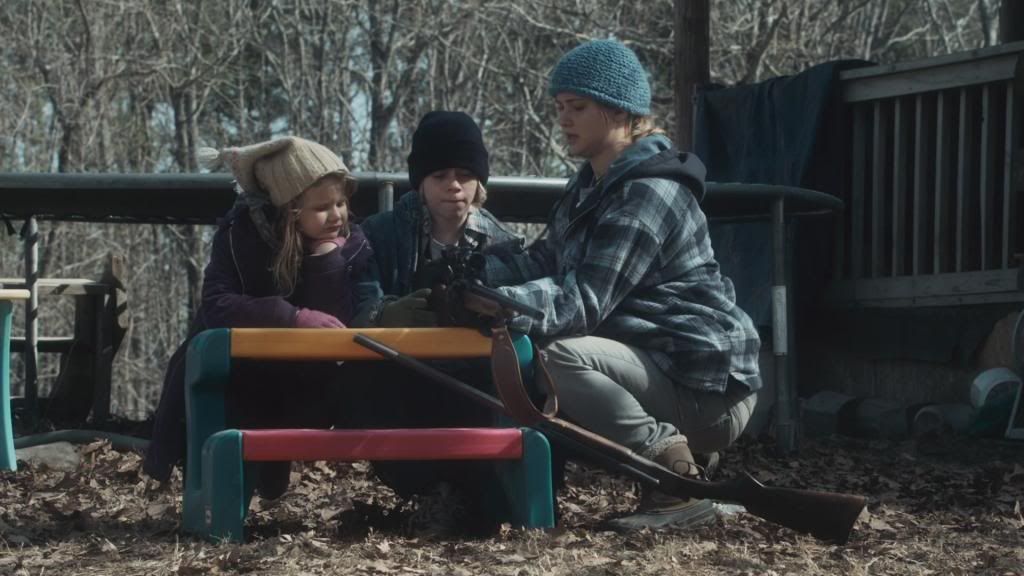
One of the things that sets Ree apart from the other female characters is her ability to occupy a kind of liminal gender space. At their first meeting, Merab asks Ree, “Ain’t you got no men to do this?” “No, ma’am, I don’t,” Ree replies. With her father gone, she must take his place in order to look for him. She informs her siblings that Jessup taught her how to shoot, and she inherits this task from him, preparing them for a time when they will help provide food for the family. She also performs the tough physical labour often considered to be men’s work, like chopping wood, and hopes to embark on a typically masculine career path. At the same time, she occupies the traditionally maternal space left vacant by their mother, cooking and doing other domestic chores. Ree’s characterization strikes a near perfect balance between nurturing softness and stalwart toughness, without gendering either aspect of her personality.
Because Ree is such a pillar of strength, some of her most compelling moments occur when she is weak or vulnerable. Throughout the film, we see the toll her situation takes on her, as she soldiers on while admitting on several occasions that she’s reaching the end of her rope. One particularly effective instance involves Ree taking her catatonic mother out into the woods and crying in desperation, “Can you please help me this one time?” That moment reminds us that Ree is still only a teenage girl, taking on responsibilities and challenges that have destroyed the adults in her life. After the beating, Ree can barely move, but she still engages in sarcastic banter from the floor; to Merab’s question of what they’re going to do with her, she says, “Help me. Ain’t nobody’s said that idea yet, have they?”
Her most difficult trial occurs at the climactic moment of the film, when she is arguably at her most vulnerable. The women who beat her show up, claiming to be taking her to her father’s bones, which essentially means that they will be taking a defenseless Ree out to a secret burial location where they could easily kill her and dispose of her body. Still, Ree accompanies them. They take her out onto a swamp in a small boat, stopping by a tree. Then Merab tells Ree to reach in and grab Jessup’s wrist. Finally, she hands her a chainsaw.

This is where Ree fails, though it’s hard to count it as a failure. She holds her father’s hand, but she cannot bring herself to cut it off. Merab wields the chainsaw instead. It’s difficult to overstate the visceral horror of this scene. The young woman who has faced every other challenge head-on, no matter the danger or unpleasantness, hesitates at the thought of carving up her father’s corpse. This is the one obstacle that she cannot entirely bring herself to overcome, and it is obviously the most traumatic. Sitting there in the boat, Ree initially sobs, then tries (and utterly fails) to distance herself from the horrific act in which she takes part. Later, when the bail bondsman asks her how she did it, she reiterates that she’s “bred and buttered.” In order to save her siblings, she must maim the body of the man who helped give them life; in order to challenge the brutal actions of her extended family, she must draw on the resilience that they share.
Although the original novel was written by a man, Daniel Woodrell, a fair portion of Ree’s onscreen strength can be attributed to the film’s director and co-screenwriter, Debra Granik. The scenes following the beating, in particular, appear to bear the mark of a woman’s lens. Unlike the majority of Western media, which often fetishizes women’s battered bodies and glamourizes the violence that caused their bruises, Winter’s Bone doesn’t show most of the beating. When it shows Ree afterward, her pose is not sexualized, and the process of tending to her wounds does not include a voyeuristic moment in the shower to wash away the blood. The focus rests firmly on her pain, not the pleasure that a viewer might derive from it.
Winter’s Bone is the portrait of a young woman who is born and bred to survive the harshness of her environment. Still, for all Ree’s claims that it is the Dolly blood that empowers her, the death and corruption of almost every other Dolly suggests that Ree is more than the blood that flows through her veins. She may be “bred and buttered” but she has also adapted, grown, and resisted. In the film’s final scene, Ree tells Sonny and Ashlee that she would be lost without their weight on her back. By that point, it’s hard to imagine anything she couldn’t carry.
Verdict: Actual strong female character
related article: