Tampilkan postingan dengan label lauren faust. Tampilkan semua postingan

Jumat, 31 Mei 2013

Pinkie Pie

MyLittleVisuals

In our original plan, there was going to be a Glee month in either May or June. That was before the fourth season aired, and a show that had been going downhill made it its mission to burrow deep into the Earth’s mantle. We were left to ask what deserves our attention more: an offensive mess that insults its viewers’ intelligence and makes all the wrong decisions while thumbing its nose at the right ones, or technicolour ponies. Do you choose the show that makes you happy, or the show that got picked up for two more seasons and will therefore still be there when you’re feeling particularly vitriolic and need a deserving punching bag? It wasn’t exactly a dilemma.

The choice became even easier when I was reminded of Glee’s ostensible mission statement, that glee, by its very definition, is about opening yourself up to joy. While the eponymous show has well and truly failed in this mission, My Little Pony: Friendship is Magic hasn’t. In fact, MLP features a character who has made it her mission to bring joy into other ponies’ lives.
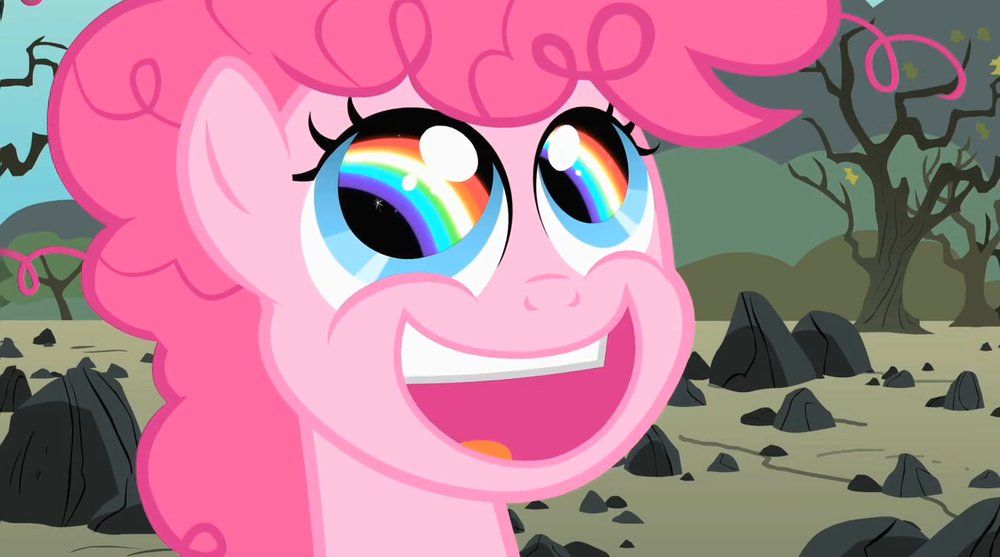
Pinkie Pie is the ultimate people pleaser. As we see in the story of how she got her Cutie Mark, she spent her early years on a rock farm grayer than Dorothy’s Kansas. She and her family never smiled, and life in general was about as dismal as it could get. One day, while moving rocks from one field to another, she spotted a rainbow that infused her world with colour and joy (and her hair with volumizing products). The intense joy she felt convinced her not only to make a habit of smiling herself, but to make a lifelong mission out of getting others to smile. To this end, she throws a party for her family, and the joy she receives from their consequent smiles causes her Cutie Mark to form.

Pleasing others is so fundamental to Pinkie Pie’s character that her Element of Harmony is laughter. When she and the other members of the Mane Six find themselves in the Everfree Forest in the second episode, she weaponizes laughter and basically Riddikuluses a set of terrifying trees back to their original form. What the show never mentions, however, is that laughter doesn’t really fit in with the other Elements. Loyalty, kindness, generosity, and honesty -- the other constitutive elements of friendship, which, as we all know, is magic -- are qualities, while laughter is an action. On the face of it, it seems like humour might be a more suitable descriptor for the concept embodied by Pinkie Pie.

At the same time, I would posit that “laughter,” by virtue of being the odd one out, was actually very specifically chosen. While the other Elements represent qualities that are exemplified through actions, Pinkie’s is an action unto itself. For a pony who explicitly states that she wants to bring joy to others, the active aspect of inciting laughter seems fitting. I also wonder if the writers intended for Pinkie’s Element to be the most limited and limiting.

I know that that sounds a bit nebulous, so I’ll explain what I mean. For the rest of the Mane Six, their respective Elements represent one aspect of their personalities. While Twilight nurtures her magical ability, she also cultivates her analytical mind, hones her leadership skills, and learns to cope with her sometimes crippling anxiety. Applejack is honest, but she is also hard-working, competitive, and heroic. Fluttershy’s kindness is an integral part of her personality, but the show focuses more on her shyness and her efforts to overcome traumatic experiences from her childhood. Rainbow Dash and Rarity actually undergo a lot of character development that directly relates to the seeming inconsistencies between their self-centeredness and their respective Elements of loyalty and generosity.

And then there’s Pinkie Pie. Her episodes focus on the Element of laughter, of fun, of pleasing and entertaining others. The show suggests, on numerous occasions, that there’s not a lot more to Pinkie Pie than her smile-spreading quest. At the same time, however, it shows Pinkie Pie fighting this very assumption. In “Baby Cakes,” for example, she sets out to prove that she can be a responsible person by babysitting the Cakes’ two children. This requires her to learn that babies need more than a playmate, and that she needs to be able to do things that aren’t fun.
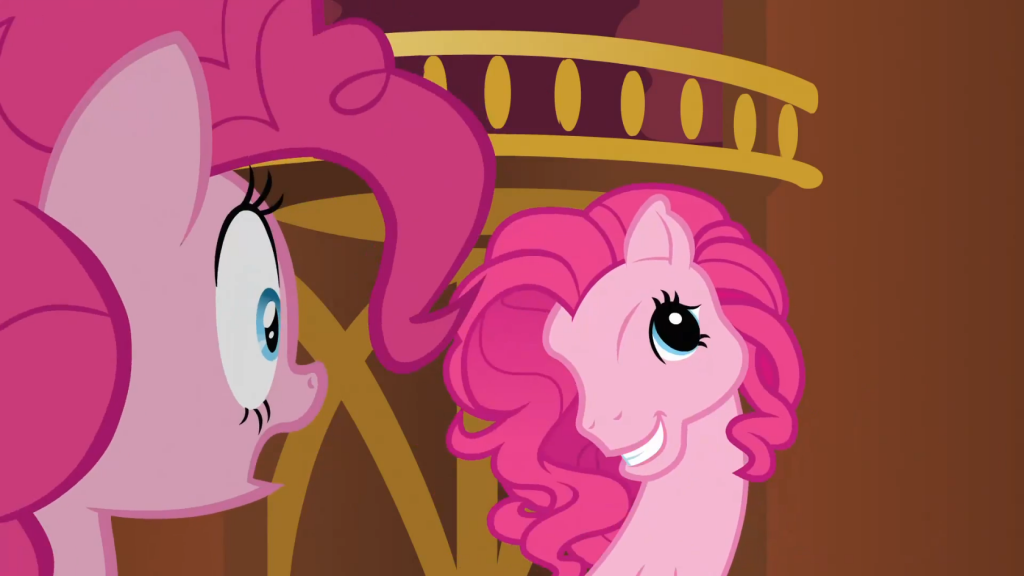
The best example, however, occurs in “Too Many Pinkie Pies.” In this episode, Pinkie Pie struggles to accept the fact that she can only take part in one fun activity at a time. Realizing that she lives in a world where frogs can be transformed into oranges, she quite understandably goes looking for a magical solution, which she finds in the Mirror Pool. Using this pool, Pinkie Pie duplicates herself, creating a double obsessed with fun to the detriment of sustaining actual relationships. When two Pinkie Pies can’t experience all the fun in Ponyville, they create two more, who duplicate themselves into a herd of Pinkie Pies. The clones terrorize Ponyville in their single-minded search for fun, destroying all the things they were created to enjoy.

The original Pinkie, meanwhile, is caught in the grip of an existential crisis. Unlike other duplication storylines, in which the doubled character fiercely asserts their original status, Pinkie Pie accepts that there is no way to tell her apart from the clones. Even she, despite knowing that they lack her memories of her friends and, really, any higher brain function than that required to process “fun”, comes to think that she is just another double. Instead of joining her other selves, she becomes depressed. When Spike observes this, he suggests that this might be the original Pinkie Pie; Twilight responds that the real Pinkie “never sat that long in one place her whole life.”

To my mind, this is where the episode takes a turn for the tragic. On a show about the power of friendship, one would hope that one of Pinkie’s friends would realize that she was the original. Maybe they could have tested the Pinkies’ knowledge of their adventures or of the Mane Six themselves; after all, Pinkie Pie prides herself on her preternaturally good memory for her friends’ personal information. Instead, Pinkie Pie herself comes up with a solution: give the clones a challenge, to do something that is not fun at all, and the real Pinkie will be the one who most wants to stay with her friends, despite the fact that they couldn’t tell her apart from an army of fun-obsessed robots. Pinkie is expected to prove that her love for her friends is greater than her love of fun (and, perhaps, greater than the ADHD she might very well have), while her friends don’t have to prove a thing. The problem is that we know that Pinkie is devoted to them -- the brief delusional episode she suffers in “Party of One” when she thinks her best friends are kicking her out of the group is ample proof -- but we rarely see any of her friends showing a similar devotion to Pinkie Pie.

In fact, in several of the Pinkie Pie-focused episodes, we actually see her become something of an unwitting nemesis for Twilight Sparkle. This begins in “Feeling Pinkie Keen,” when Twilight learns about her friend’s “Pinkie sense” -- a form of extrasensory perception that manifests in uncontrollable muscle spasms -- and immediately dismisses it as hogwash. Pinkie argues that a magician has no leg to stand on when it comes to rejecting scientifically impossible things, but Twilight literally gets on a soapbox to defend the inherent logic of magic. Nevertheless, as all of Pinkie’s premonitions prove accurate, Twilight must concede that there are some things that have to believed whether or not they can be explained.
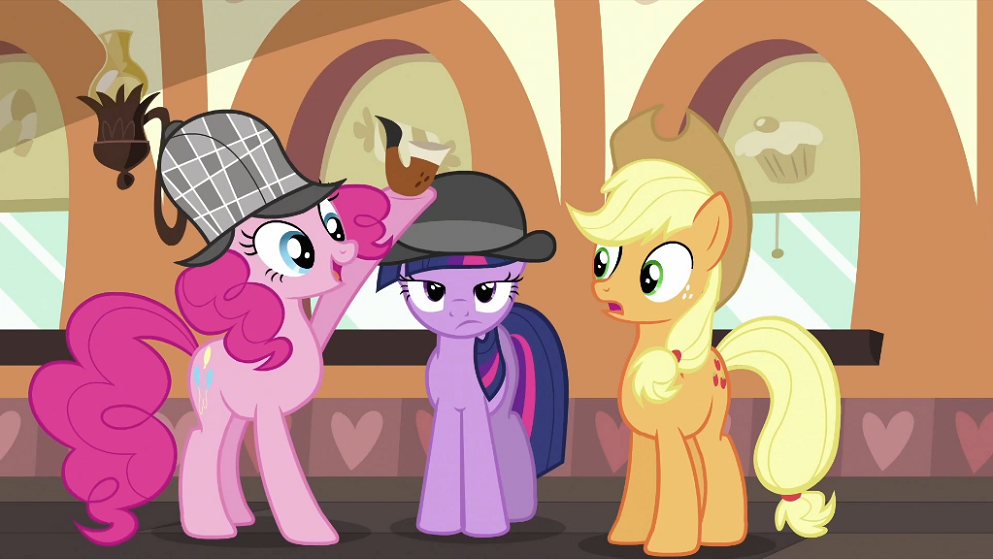
The conflict between logic and intuition continues in “MMMystery on the Friendship Express,” in which Pinkie Pie, who has failed to protect the Cakes’ entry in a dessert competition from hungry vandals, takes it upon herself to identify the perpetrators. Unfortunately, she is more interested in accusation than investigation, and Twilight promptly takes over as Chief Investigator (and Wearer of the Deerstalker) on the strength of her long mystery-reading career. Only after Twilight has solved one mystery does she let Pinkie try her hand at playing Sherlock, using the deduction methods Twilight employed. One of the reasons why Pinkie Pie appears to be so strange may simply be because we often see her actions filtered through the lens of Twilight’s perception, and Twilight simply doesn’t get her.

Then again, neither does anyone else. Pinkie Pie’s a tough nut to crack, partly because she’s so open. In “Griffon the Brush-off,” Rainbow Dash calls Pinkie Pie random, but I’d argue that there’s more to it than that. Sure, Pinkie plays ten instruments at once, stores balls around Ponyville in case of ball shortages, and agonizes over calling her culinary invention a chimicherry or a cherrychanga, but most of her actions make sense in a roundabout way. Most of the time, Pinkie Pie herself is willing to walk people around that roundabout, verbalizing the mental processes that took her from Point A to Point Q. Usually, what leads her to make her least overtly logical leaps is a literal or lexical connection. She understands words exactly as they are, and, while other ponies grasp the connotations that make figures of speech make sense, Pinkie Pie must try to connect them as best she can.

In light of her literal understanding of language, it’s a little strange that Pinkie Pie has such a liberated view of the world in which she lives. Pinkie Pie possesses the ability to manipulate the world around her, allowing her to defy the laws of physics and logic. On several occasions, she beats pegasi to locations to which they had to fly, with no explanation as to how she got there. Her internal monologue takes the form of felt stop motion animation. When she explains her theories about the identity of the cake vandals, she envisions them in the style of a silent film, a James Bond movie, and a Japanese ninja flick. In “Too Many Pinkie Pies,” one of the clones rearranges her face into that of a G3 My Little Pony, saying, “Bet ya can’t make a face crazier than this!” On some level, Pinkie Pie seems to realize that she is in a cartoon, and she is making the most of it.

Verdict: Pinkie Pie defies categorization
Sabtu, 25 Mei 2013

Rainbow Dash

MyLittleVisuals

Brace yourselves -- this blog is about to become 20% cooler. Or 20% awesomer. Or maybe 20% radical-er? Like Twilight Sparkle, I’m not sure what the difference is, nor do I particularly care.

However, I do care about a character who not only knows the difference, but probably defined it. Rainbow Dash is the self-proclaimed coolest pony in Ponyville, a pegasus whose weather-regulating duties and enormous ego place her both literally and figuratively above the rest of the population. While the other ponies explicitly recognize her positive qualities on several occasions, she’s her own best cheerleader; as Applejack observes, she has a habit of “tootin’ her own horn louder than the brass section of a marching band.” Taking the opportunity to describe herself in a single word, she chooses “super-ultra-extreme-awesomazing.” According to Rainbow Dash, the world revolves around her; it’s no surprise, then, that most Rainbow Dash-focused episodes revolve around her need to be the best.

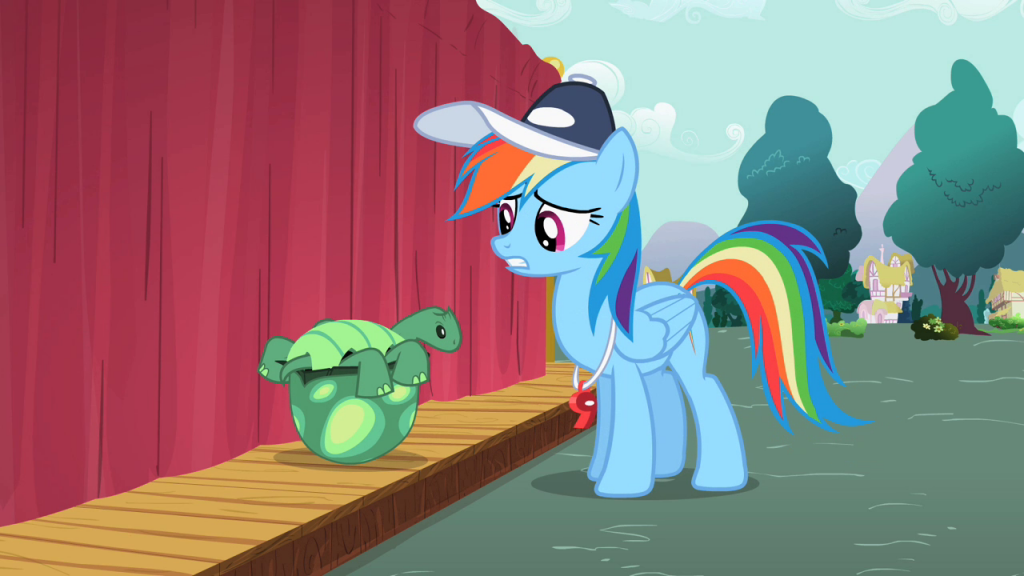
Rainbow Dash has built her identity on her presumed superiority, and there’s no better way to prove it than in competition. This is why she goes up against Applejack in the Iron Pony competition, and why she stoops to cheating: her self-perception depends on her victory. When she decides to get a pet, she pits the top candidates against each other in a series of tests of their athleticism and personality. It doesn’t occur to her that this might be a strange way to find a companion until she is saved by an animal that seems to be the least suitable pet for a lightning fast flier: a tortoise. She comes to understand that tenacity and faithfulness trump speed, agility, and radicalness.

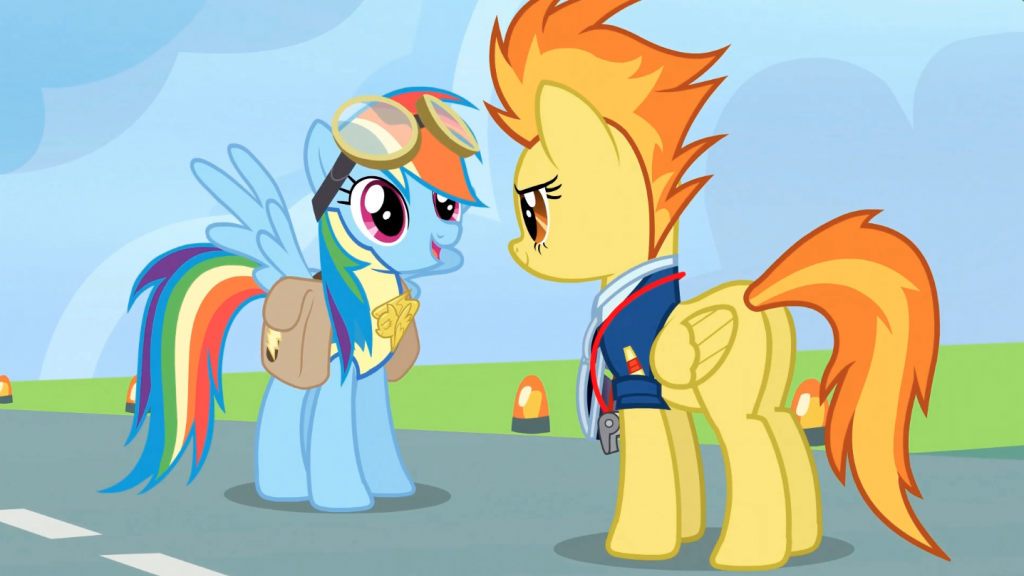
This is a particularly interesting lesson for one reason: Rainbow Dash’s Element of Harmony is loyalty. The first time she demonstrates this quality is in the first two-part episode, when she is forced to choose between helping her friends and joining an elite flying team. Since her only dream is to become a Wonderbolt, the latter represents a real temptation. This becomes even more apparent with further viewing, as we come to realize that, this early in the show, Rainbow Dash finds Pinkie Pie irritating, thinks that Fluttershy is largely useless, and hasn’t had a chance to get to know Twilight Sparkle. It’s hard to imagine any scenario in which she would have spent time with Rarity, and her relationship with Applejack seems to be based on a shared competitiveness. She owes these people her loyalty only because they’ve been stuck together by circumstance. Still, she chooses them over her dream, and saving Equestria over satisfying her own self-interest. Like Rarity, whose Element of generosity seems more than a little at odds with her overtly selfish nature, Rainbow Dash must overcome negative aspects of her own personality to bring positive aspects to light.

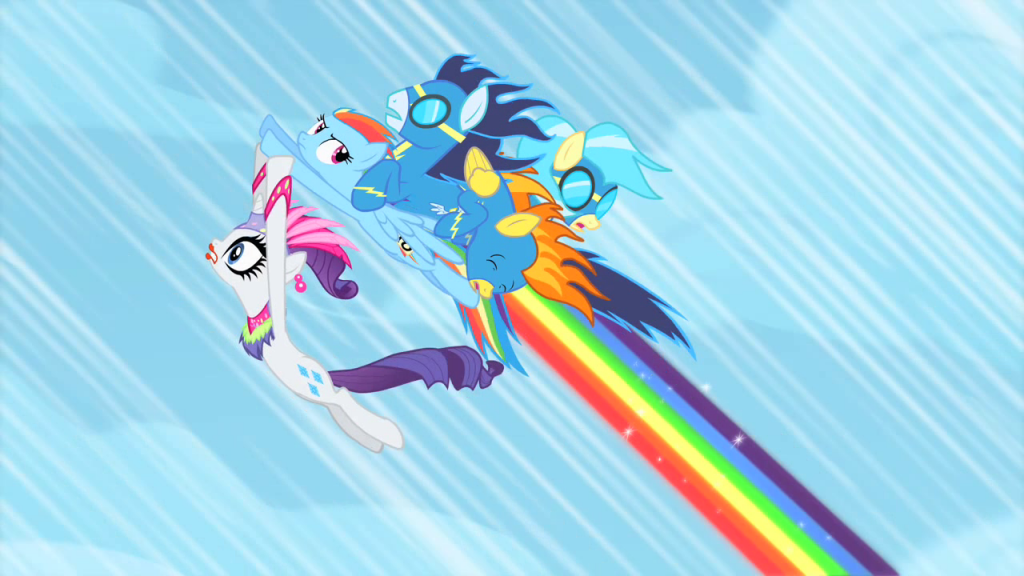
This leads us to an interesting path of inquiry, as we have to wonder what produces an ego the size of a small planet in a pony who is supposed to be the embodiment of devotion to others. I’d like to posit a couple of theories, suggested by the events of “Sonic Rainboom” and “The Cutie Mark Chronicles.” The first is that Rainbow Dash was something of a flying prodigy, a fact which she discovered the first time she successfully performed a sonic rainboom, a feat so rare that it’s usually dismissed as an “old mares’ tale.” Rainbow Dash herself describes the experience as the time that she “made the impossible happen.” Knowing that you can do something that everyone else can only dream of is bound to go to your head.

The second theory draws its inspiration from the evidence that Rainbow Dash was bullied. Their shared experience with bullying connects Rainbow Dash and Fluttershy as foils. Fluttershy’s response to bullying was to withdraw even further into herself, and her experiences cause her to have panic attacks brought on by flashbacks. By contrast, Rainbow Dash responds directly to her bullies, parrying their threat that she’s going down with a jab of “In history, maybe.” She stands up to them when they tease Fluttershy, and she explicitly frames this confrontation and the ensuing race to prove herself against the bullies as a situation in which she “stood alone against all odds to defend Fluttershy’s honour.” She builds herself up, and it makes me wonder if it was an attempt to prevent them from breaking her down. Initially, it’s possible that she developed her self-confidence as a shield against barbed insults.

There are moments when her self-confidence flags and she is left vulnerable. This occurs most obviously in “Sonic Rainboom,” in which Rainbow Dash suffers a blow, finding that she can no longer create a sonic rainboom. In this episode, all of her bluster becomes just so much hot air, as she tries not to show her friends that she doubts her abilities. The problem with knowing that you’re the best is that you are inevitably faced with situations that could prove you wrong. This early in Rainbow Dash’s character arc, however, she is far too fragile to face a fact that would undermine her entire worldview. She emerges from the competition as the winner, but her confidence has nevertheless been shaken by the very idea that she could fail.

In the second season, Rainbow Dash is once again confronted with the possibility that she is not, as Wolverine might say, the best there is at what she does. This occurs in one of my favourite episodes, “The Mysterious Mare Do Well.” In this episode, Rainbow Dash becomes addicted to the attention she receives for performing heroic, life-saving deeds. As one might expect, the extra accolades turn the already egotistical pegasus into the kind of person who waits until she has finished signing autographs to save ponies in imminent danger. Just when it seems like Rainbow Dash’s ego has grown to the point that it needs its own punny, equine town name (may I suggest Naneighmo?), a new hero bursts onto the scene. A combination of Batman and Darkwing Duck, the Mysterious Mare Do Well quickly proves herself more powerful, more perceptive, more effective, more modest, and more popular than Your Friendly Neighbourhood Rainbow Dash. Feeling threatened, Rainbow Dash seeks to expose Mare Do Well’s identity, only to learn that her rival was actually her friends, working together to teach her to act with grace and humility.

In the third season, we see how well this lesson took. “Wonderbolts Academy” takes Rainbow Dash to the eponymous training camp, where she has the opportunity to prove her mettle and impress her idols. There she meets Lightning Dust, a pegasus who shares her need to be the best. When the trainees are paired off, Lightning Dust and Rainbow Dash become a team, the former as lead, the latter as wing pony. Rainbow Dash protests her placement, but the instructors inform her that Lightning Dust is willing to push herself harder. The problem is that, while she is pushing herself, she pays no mind to the ponies she’s pushing out of her way. Finally, after a cyclone Lightning Dust created almost kills the other members of the Mane Six, Rainbow Dash gives the instructor a report of her partner’s dangerous antics. Interpreting the instructor’s silence as tacit approval of Lightning Dust’s methods, Rainbow Dash quits.

This is Rainbow Dash’s defining moment and the zenith of her character arc thus far. Lightning Dust can be read as the embodiment of Rainbow Dash’s reckless ambition or, perhaps, a reflection of what she might have been had she not had the mellowing influence of her friends. By turning her in, Rainbow Dash rejects this part of herself. While she still wants to be the best and yearns for a spot on the Wonderbolts, if the only way to achieve these goals is to endanger other people, she is willing to let these dreams go. Rainbow Dash’s reward for this action is a kind of anagnorisis, as she realizes that being decent is more important than being the best. The fact that the instructor kicks Lightning Dust out, reinstates Rainbow Dash as a lead pony, and praises her for sticking to her principles is just a bonus.

Last week, I argued that the show’s treatment of Fluttershy and Rarity demonstrates a commitment to rehabilitating girliness as a positive concept. This week, I’d like to suggest that Rainbow Dash’s characterization as an arrogant jock, a role usually reserved for male characters, represents another part of the show’s pro-woman project. Before I get into the specifics of Rainbow Dash’s treatment, I’d like to discuss a subtle linguistic shift that the show employs that affects the ponies more generally. In Equestria, all-female groups are never called “guys -- in fact, if I’m not mistaken, otherwise all-female groups that include Spike are also never described using this masculine terminology. Instead, the Mane Six address their group as “ladies” or “girls.” Female, not male, operates as the assumed norm.

This is why it’s important to incorporate a well-known male character type into a group of girls; MLP’s target audience is growing up in a media environment that shows them time and time again that there is one set of activities and behaviours for girls and another, much larger, much more well-regarded set of activities and behaviours for boys. By making Rainbow Dash an athlete, the show suggests that sports should not be considered an inherently masculine pursuit. By giving her a massive ego, the show affords itself the opportunity to teach girls how to act with grace and humility without having to stay silent about the full extent of their awesomeness. By having her discover a love of reading, the show lets its young viewers know that brawn and brains aren’t mutually exclusive, and that girls should be proud of having both. Finally, by not drawing attention to its subversion of the stereotypical male jock character, My Little Pony: Friendship is Magic normalizes the idea of the self-confident, athletic girl. I’ll be honest: that kind of critical work makes the show about 20% cooler all on its own.

Verdict: Actual strong female character

Jumat, 17 Mei 2013

Fluttershy and Rarity

MyLittleVisuals

If you’re a regular reader of this blog (and a less-than-regular viewer of My Little Pony), you might have wondered why we’re being so positive about this show. After all, isn’t it essentially an episodic advertisement for what amounts to an equine version of the LEGO Friends line? Isn’t Hasbro feeding girls an unnecessarily pink-ified idea of femininity? Isn’t the “girliness” of this show the very antithesis of what we want girls to internalize?

The short answer is no. In my opinion, MLP:FiM represents the rehabilitation of “girliness.” Twilight Sparkle’s journey toward royal status is comprised of both the epic, world-preserving feats typical of masculine narratives and the emotional development that forms the focus of many traditionally feminine stories. Indeed, the so-called “girly” stuff is actually what empowers Twilight to save Equestria. On an episode by episode basis, however, no one does more to combat the stigmatization of girliness than Fluttershy and Rarity.

Many children’s shows that focus on a group of five or six characters assign them one of a set of familiar roles. Twilight Sparkle is the brainy scientist, Rainbow Dash the arrogant jock, Applejack the voice of reason, and Pinkie Pie the comic relief. In most shows, the only role left would be that of “the girl,” the figure whose primary function is to dissuade accusations of sexism despite the fact that, while her teammates contribute to the group by virtue of their varied personalities and skill sets, she contributes by being not-a-dude. If each group member is identified by a colour, invariably, hers will be pink.

My Little Pony features not one, but two “girls” and, in so doing, it completely re-imagines the role.

Fluttershy

Possessed of heavily accented eyelashes, a pink mane and tail, and a butterfly Cutie Mark, Fluttershy looks every inch the “girl” of the group. Her special skill is nurturing animals, and her focus on caretaking makes her the most overtly maternal member of the Mane Six. She is quiet, shy, and fearful. She is also, if I may say so, a complete BAMF.

This is not readily apparent during the bulk of Fluttershy’s screentime. In a group filled with so many big personalities, Fluttershy’s contributions tend to get lost. On at least two occasions, she solves a problem before the others, only to be ignored and spoken over when she tries to tell her friends. While the other ponies seek adventure, she wants “to be brave at home, locked in [her] closet with [her] teddy bear.”

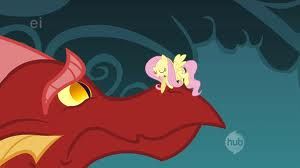
This makes the moments when she can overcome her fear all the more impressive. When a dragon’s breath threatens to cover Equestria in a cloud of smoke for a hundred years, the Mane Six climb up to his mountain lair to convince him to relocate. Fluttershy resists at every turn, eventually having to be dragged up the mountain by Applejack. Faced with the imminent confrontation, Fluttershy explains that, though she adores animals of almost every kind, she is terrified of dragons. Still, when she sees her friends in danger, she stands up to the beast. Not only does she stand up to it, she scolds it, saying, “Listen here, Mister, just because you’re big doesn’t mean you get to be a bully. You may have huge teeth and sharp scales and snore smoke and breathe fire, but you do not -- I repeat, you do not -- hurt my friends! You got that?” While threatening a creature fifty or so times your size is pretty awesome, what makes this scene is how Fluttershy concludes her reprimand: “There, there. No need to cry. You’re not a bad dragon; you just made a bad decision.”

That’s basically all you need to know about Fluttershy in one scene. She is terrified, but the moment her friends are in danger, she overcomes her fears to save them. While a lesser pony would leave it at that, she manages to look beyond the threat the dragon poses to acknowledge him as a person and comfort him. Her Element of Harmony is kindness, and an important aspect of her character is that she is willing to show kindness to everyone.

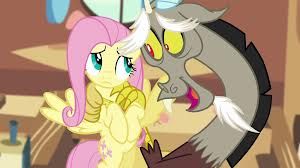
The greatest test of her capacity for kindness comes when Princess Celestia asks her to begin the rehabilitation of Discord. To fully grasp the enormity of this challenge, it’s important to know that Discord is the physical embodiment of the forces of chaos, originally imprisoned by the princesses Celestia and Luna, who control the passage of day and night in Equestria, with the help of all six Elements of Harmony. Beating him isn’t easy. Reforming him seems nigh impossible.

Regardless, Fluttershy takes on the task. Throughout the episode, she must withstand peer pressure as her friends argue again and again that Princess Celestia would understand if they gave up and just imprisoned him again. She must also cope with Discord abusing her hospitality and spreading his chaotic influence across Ponyville; indeed, she is made complicit in his actions when she promises not to use her Element of Harmony against him. Seeing that she has been used, Fluttershy rescinds her friendship, making Discord choose between companionship and chaos. He picks the former, and thereby proves the transformative power of kindness. If you treat people well, they may choose to become worthy of your efforts.

On the other hand, they might not. One of the interesting aspects of Fluttershy’s character is that, despite her ability to confront dragons, manticores, and the forces of chaos and emerge victorious, she cannot seem to extend this success into her everyday life. She can handle the smallest woodland creatures and the biggest monsters, but other ponies throw her for a bit of a loop.

The show takes up this issue in “Putting Your Hoof Down,” an episode that begins with a timid Fluttershy struggling to stand up for herself in simple social situations. Already serving as a doormat for her picky pet rabbit, she gets cheated and pushed around at the local marketplace because she struggles to assert herself. Fluttershy seeks help from a minotaur who boils down his assertiveness lessons into easily remembered catchphrases, and she begins to stand up for herself. Unfortunately, she goes too far and assertiveness becomes aggression. She begins to treat other ponies worse than she has treated any monster, and she becomes frightened of her own capacity for meanness. With the help of Rarity and Pinkie Pie, she learns that she can be assertive without being aggressive, and she manages to be firm but kind when she refuses to pay the minotaur for his teachings.

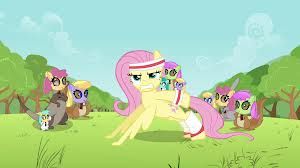
Having learned how to overcome monsters, animals, and other ponies, Fluttershy must face one final opponent: herself. As much fun as it would be to see a battle between Fluttershy and Nega Fluttershy, this is less a literal battle than an internal struggle. “Hurricane Fluttershy” revolves around the Ponyville pegasi having to create a cyclone to transport water to Cloudsdale. Fluttershy, who has a tendency to forget that she even has wings, dreads such a public performance; she still suffers flashbacks to the teasing she endured as a child at flight school. When it becomes clear that she cannot get out of it, Fluttershy commits to training her mind and body for the event. Finally, when it becomes clear that they will fail in their mission unless Fluttershy steps up, Twilight tells her to “Do it for Equestria! Do it for Rainbow Dash! Do it for yourself!” With this encouragement, Fluttershy manages to vanquish the ghosts of past bullies and produce the wing power necessary to create the cyclone.

Fluttershy’s Element basically amounts to the power of Heart, so it’s no surprise that she is one of the more stereotypically “girly” characters on the show. What is a surprise is just how often this power allows her to step into the hero’s role and completely own it in her own unique way.

Verdict: Actual strong female character


Rarity

When I first started watching this show, Rarity was far and away my least favourite character. This was, in large part, due to her stereotypically feminine traits. She is a unicorn obsessed with appearances, who often forgoes practical work in order to beautify her surroundings. She becomes jealous very easily, and she has a tendency to forget that relationships are a matter of give and take, not just take and take. Despite the fact that her Element of Harmony is generosity, she is remarkably self-centred. For the majority of the first season, I thought that her best trait was her ability to riff on Sondheim. I have since been thoroughly disabused of that notion.

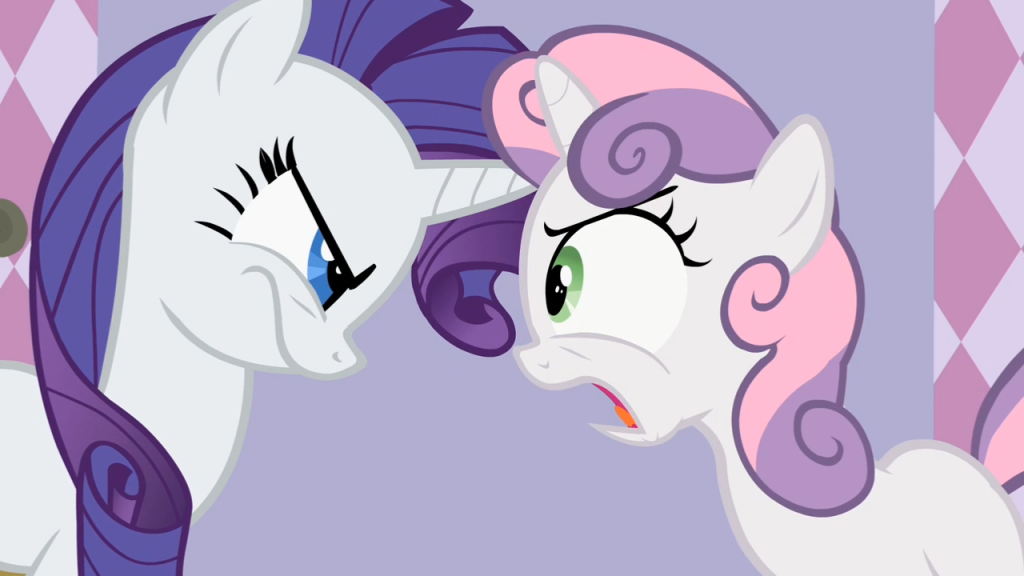
One of the most compelling things about Rarity is the tension that results when her self-centred focus meets her inherently generous spirit. Unlike most of the other ponies, who exemplify their Elements in their everyday lives, Rarity seems to act in direct opposition to her Element. For example, she makes little time for her sister, Sweetie Belle, and when she does, the only generosity she displays is in giving lessons and “reasonable demands.” While other members of the Mane Six embrace their Elements with ease, Rarity must consolidate the diametrically opposed attributes of selfishness and selflessness.

In most cases, the former prevails. In the first episode, the superlatively vain Rarity sacrifices her tail to complete a sea serpent’s mustache. On a trip to Canterlot, she rises through the ranks of high society and, when faced with a choice between friends and status, she chooses the ponies she loves over the social standing she craves. In “Suited for Success,” she decides to make gowns for all of her friends to wear to the Great Galloping Gala, making the ensuing fashion show and subsequent sales boost secondary to her friends’ satisfaction.

“Suited for Success” brings up another aspect of Rarity that I find interesting: her focus on her career. Jobs occupy a weird space in Equestria, as most of them appear to be a matter of destiny. Doing a job is not about earning money and experience, but about performing a task that matches your innate skill set and contributes to the wellbeing of the town. Applejack was fated to run Sweet Apple Acres, Pinkie Pie was born to party, and Fluttershy discovered her calling on the ground with the animals. Twilight Sparkle is basically a professional student, and her studies are meant to improve her inborn talent for magic. They all earn money, but only Applejack treats her work as a business, and no one is as ambitious as Rarity.

Rarity appears to be the only pony whose business has expanded beyond Ponyville. The second fashion show in “Suited for Success” draws the attention of Hoity Toity, a big name in the Canterlot fashion world. He requests copies of the outfits for his store. In “A Dog and Pony Show,” the plot’s catalyst comes in the form of pop star Sapphire Shores, who commissions concert outfits from Rarity. Finally, in “Green Isn’t Your Colour,” her work is noticed by fashion photographer Photo Finish.

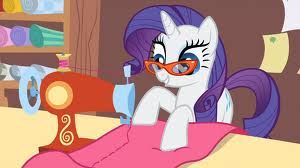
I have read in the past that Lauren Faust fought for Rarity to be a fashion designer instead of simply a fan of beautiful clothing. (Any help locating a link to an article that addresses this would be appreciated.) It’s an important change; as a fashion plate, she would be very little more than a mannequin showing off other people’s work, but as a designer, she plays an active, creative role.

While I admire both Rarity’s focus on her career and her ability to balance the duelling sides of her personality, the thing that really made me like her was, bizarrely, the very thing that initially repelled me: her girliness. In the aptly titled “A Dog and Pony Show,” a group of gem-seeking canines abduct Rarity and carry her down to their underground mine. While she is below ground, we follow her friends, who have made it their mission to save her.

One person in particular takes this task very seriously. Spike, who spends the series nursing a crush on the unicorn, fantasizes about a swooning Rarity as the quintessential damsel in distress. In his fantasy, he casts himself in the role of the daring knight sent to save the captured maiden and win her hand as his prize. Wielding a stalactite as a sword and riding his trusty steed, Twilight Sparkle, he bursts into Rarity’s prison only to find her already free. In the time that it took to “save” her, Rarity has already saved herself.

The way in which she does this reveals a lot about not only Rarity, but the performativity of femininity. When the diamond dogs set her to work locating gemstones, she refuses to dig, claiming concern for her pedicure. She goes on to request respect from her captors, stating that she is to be addressed by “Miss.” When the dogs accuse her of whining, she demonstrates the difference between whining and complaining to prove just how irritating she can be. Eventually, she refuses to work at all, on account of one of the dogs calling her a mule, which she deliberately misconstrues as a slight against her appearance. At every opportunity, she exaggerates the negative traits of a stereotypical girly girl, essentially weaponizing girliness.

The best part of the episode, however, is the moment Rarity reveals that she has been using the diamond dogs to gather gems for her. As she says, “Just because I am a lady doesn’t mean I cannot handle myself in a sticky situation. I had them wrapped around my hoof the entire time.” In the MLP universe, a damsel in distress can be a damsel in control. Twilight Sparkle makes this abundantly clear: “Just because some pony is ladylike doesn’t make her weak. In fact, by using her wits, a seemingly defenseless pony can be the one who outsmarts and outshines them all.” Far from being a weakness, girliness is a potential source of strength.

Like Fluttershy, Rarity employs her own special brand of femininity to perform a unique kind of heroism.

Verdict: Actual strong female character


Jumat, 10 Mei 2013

Applejack


MyLittleVisuals

While watching a show with “Friendship is Magic” in the title, it’s almost inevitable that you would try to figure out which character is the best friend. Well, perhaps not inevitable, but I’m sure that people who are not feminist bloggers who overidentify with cartoon unicorns also, on occasion, have these thoughts. In my case, these thoughts have led me to proclaim Applejack the quintessential friend.

An argument could be made that Twilight Sparkle actually holds this title, but I think that her storyline almost precludes her from it. As I see it, Twilight’s quest to embrace friendship is part of her larger arc of becoming a princess. She has to learn the ins and outs of social interaction because doing so will allow her to become a better leader, someone who can combine historical knowledge, a critical mind, and a compassionate heart. Becoming a princess and an Alicorn also necessarily distances her from her friends -- even if the show, by nature of being for children, never actually explores this. As a princess, Twilight is now in a position of authority, a teacher instead of a fellow student; as an Alicorn, she is a sort of superbeing whose lifespan will likely greatly exceed those of her friends. Even her friendship, while sometimes demonstrated in normal situations, receives greater focus when it helps her to save her friends or, on several occasions, whole cities. She does friendship on an epic scale.

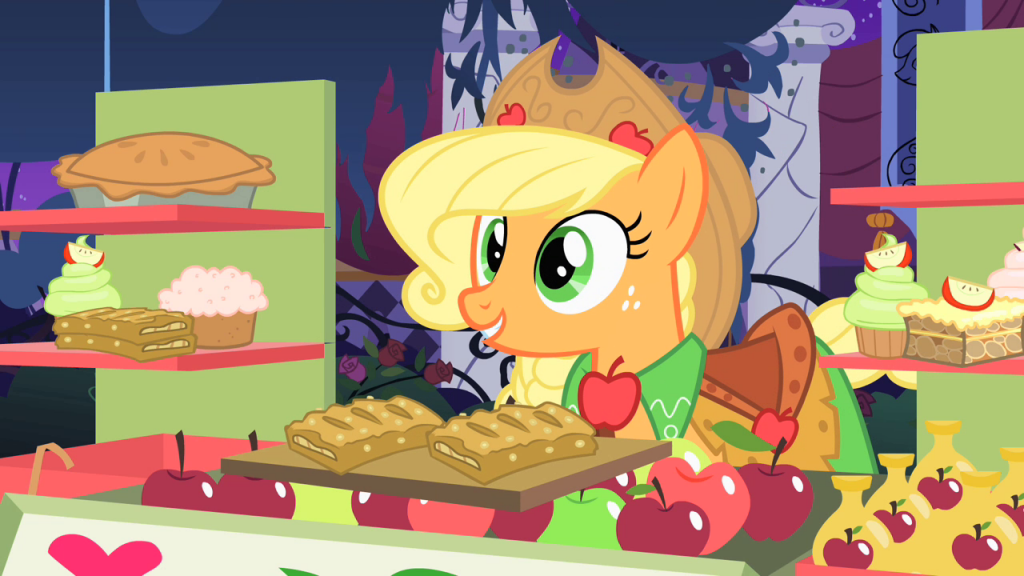
Applejack, by contrast, is a stellar everyday friend. In “Applebuck Season,” she describes herself as the “loyallest of friends and most dependable of ponies,” and her companions in the “Mane Six” clearly agree. Rainbow Dash, Pinkie Pie, and Fluttershy all sing her praises as she devotes her time to helping them with flying tricks, baking, and a bunny census. What makes this more impressive is her willingness to help out even when she has worked herself to exhaustion on her farm.

Applejack’s humility makes even the most extraordinary deeds just a matter of course. When, in “Applebuck Season,” she receives an award for saving the town from a cattle stampede, she brushes it off by stating that she likes helping the pony folks. Later, in “Spike at Your Service,” she saves Spike from a pack of timberwolves and informs that “that’s what friends do.” She seems almost incapable of seeing her actions for the feats that they are, because, according to her standard of friendship, that’s simply what you do.

Applejack’s high personal standards differ in some key ways from those of Twilight Sparkle. Twilight works to impress her powerful mentor, but her harshest critic is herself. She is driven to meet impossible standards that she has set for herself, and she is usually the one who imagines the terrible punishments that she will receive for failing to meet them. More often than not, in Twilight’s mind, “Princess Celestia” is not the actual Alicorn, but the name that Twilight gives to her self-implemented standards. Even when ostensibly trying to meet others’ expectations, Twilight is striving to meet her own.

While she is similarly driven to succeed, Applejack is motivated by other people. “Applebuck Season” begins with her assuring her injured brother, Big Macintosh, that she can harvest the entire apple crop herself. Making a nearly impossible task more difficult, she decides to fulfill her promises of helping her friends, leaving herself no time to sleep. Twilight, intimately familiar with the signs of a pony who’s working herself too hard, eventually makes Applejack see that she should put aside her pride and allow her friends to help her. Her obsessive need to be the most dependable of ponies causes her to be a hindrance rather than a help. It also makes it seem as though Applejack is resigned to being the one who works harder in her relationships; she is proud of being dependable, and part of this is not depending on others.

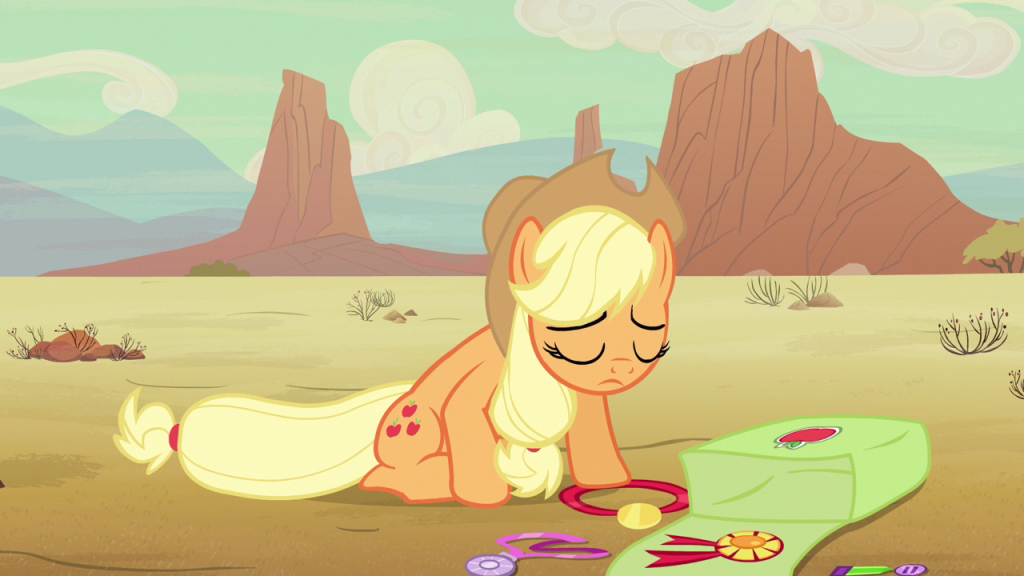
Another example of Applejack’s need for approval occurs in “The Last Roundup.” The ten-time rodeo champion of Ponyville, Applejack sets out for the Canterlot rodeo to win some blue ribbons and prize money she’s already promised to the town to fix the town hall roof. When, at the end of the competition, she doesn’t come home, her friends set out to find her. She is hiding out at a cherry orchard, unable to face the townsfolk after failing to secure the promised money and winning only second, third, and fourth place ribbons. She tells her friends that she “couldn’t come home a failure,” disappointing all the people that she had hoped to make proud. Again, the other ponies remind her that she can rely on them to support her, and that she is allowed to be less than perfect.

Of course, this doesn’t prevent her from struggling with the same problem in the third season, when she volunteers to organize the Apple Family Reunion. However, these are special circumstances, because there is nothing more important to Applejack than her family. This is made abundantly clear throughout the series, but most obviously when she calls her friends her family when they help her to keep Sweet Apple Acres from the clutches of the Flim Flam brothers. Applejack is devoted to her family and to the family business, shown on many occasions to be a fantastic sister and granddaughter.

It should come as no surprise, then, that when she gets the opportunity to put together a family reunion, she sets out to make it the most memorable reunion of all time. Unfortunately, she gets too caught up in proving herself and focuses the event on productivity instead of personal connections. When it becomes clear that the event is on track to be a complete failure, she manages to salvage the day after she is reminded that a family reunion should be intimate, not epic.

Because it is intended for young girls, one of my favourite aspects of the show comes from the way it uses its lesson-based format. When one of the ponies learns a lesson, they write to Princess Celestia not to tell her how they messed up, but to share with her the story of their personal growth. The overall message is not “making this mistake makes you a bad person, so don’t do it”; instead, it’s “you’re pretty awesome, but here’s how to be even more awesome in the future.” It’s inherently positive, and it builds girls up without breaking them down first.

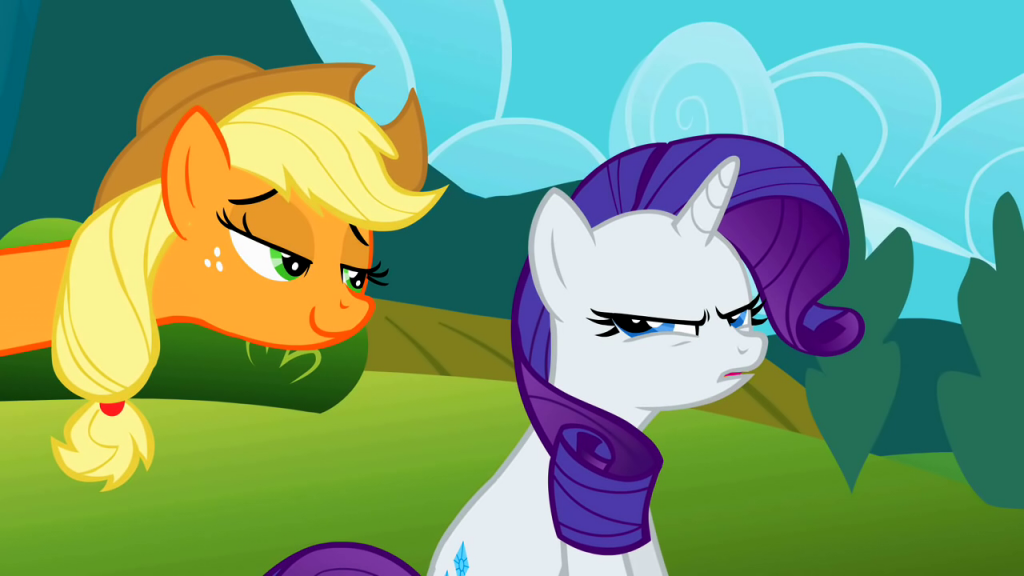
Therefore, because Applejack is such a great friend, her character can withstand a few lessons about the don’ts of friendship. The best example occurs in “Look Before You Sleep,” in which Applejack and Rarity end up at an impromptu slumber party at Twilight’s house. Over the course of the episode, they engage in a long argument that basically boils down to function versus form, as the practical Applejack tries to get things done and the finicky Rarity tries to keep everything, including herself, beautiful. When Applejack accidentally fells a tree into Twilight’s treehouse, she has to swallow her pride and ask for Rarity’s help to fix it. Forced to work together, they realize that they were both being foolish, and they become less critical of what they viewed as the other’s failings.

It’s a testament to the show’s unexpected depth that Applejack’s hostility toward Rarity has its origins in Applejack’s own backstory. When she was younger, Applejack decided to leave Sweet Apple Acres and become a city pony in Manehattan. There, she was groomed to look and sound like she belonged, even as she found that she didn’t. Upon returning home, she received her Cutie Mark, and learned that running the orchard was her destiny. Although her issues with Rarity stem, on first glance, from their very different personalities, it is also possible that the problems on Applejack’s side come from the memory of trying to be something she isn’t. For a pony whose identity is based on honesty, the reminder of her false self would be tough to face and even tougher to befriend.

Still, Applejack manages, because she knew, long before Twilight Sparkle arrived in Ponyville, the importance of interpersonal relationships and (I can’t believe I’m saying this) the magic of friendship.

Verdict: Actual strong female character

Jumat, 03 Mei 2013

Twilight Sparkle

MyLittleVisuals
 
Once upon a time, in the magical land of Canada, there were two regal sisters who watched My Little Pony: Friendship is Magic together. One day, while watching the antics of one Twilight Sparkle, who was having panic attacks over the prospect of not getting her weekly assignment in on time, the younger sister turned to the older and said, “Wow, she’s you.”

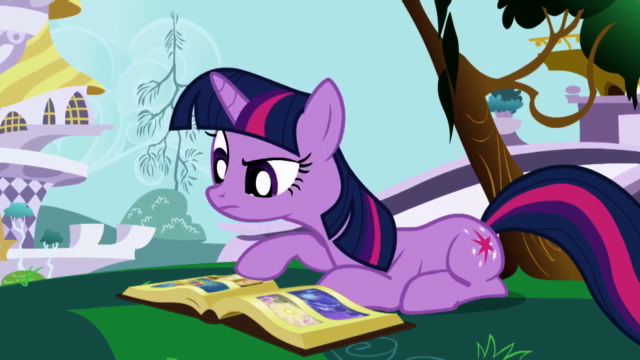
It’s not easy to admit that you over-identify with a purple cartoon unicorn, but when the character in question is Twilight Sparkle, it does get a little easier. Twilight is the main character of Lauren Faust’s somewhat new, very much improved remake of the classic My Little Pony television show. In this version, Twilight is introduced as the student of Princess Celestia, a sort of living god who nevertheless takes time to train young unicorns in the art of magic. The first time we meet her, Twilight is reading about the history of Equestria; the next time we see her, she is literally running away from the idea of socializing with her fellow students in order to do research on her break. Certain that her research indicates an impending danger to all of Equestria, she alerts Princess Celestia, who basically tells her to lay off the studying and go outside.

In this case, “outside” means the town of Ponyville, where Twilight will be ensuring that the Summer Sun Celebration goes off without a hitch. During preparations, she encounters five ponies who want to become her friend; for the most part, she seems to consider friendship as desirable as the flu. Still, when it comes time to defeat Nightmare Moon using the Elements of Harmony, Twilight finds that their friendship is literally magical. Working together, they save Equestria from eternal night and restore Nightmare Moon to her former self, Princess Luna. By the end of the episode, Twilight has come to treasure her new friends and gladly accepts Celestia’s mission to stay on in Ponyville and learn the lessons of friendship.

I will readily admit that any description of the show’s general premise is unlikely to entice adults to watch it. (Also less than appealing are the antics of the infamous Bronies, but I digress...) You would think that there would be a limited audience for a show that basically boils down to “talking horses solve problems using the magic of friendship and Sondheim-inspired musical numbers.” What makes the show, for me, is its focus on positive relationships between female characters with diverse personalities. While shows that only feature one or two female characters often end up painting all girls and women with the same broad strokes, MLP:FiM can address issues both universal and specific to one of a wide range of personality types.

One of these is the antisocial bookworm, represented by Twilight Sparkle. Some critics have claimed that Twilight’s arc is anti-intellectual, placing higher value on social skills than knowledge. In fact, the show handles this issue quite deftly, as evidenced by its emphasis on the “lessons” that Twilight and her friends must learn; Twilight must increase her knowledge, becoming “people-smart” in addition to “book-smart”. The two kinds of intelligence are complementary, and both are necessary to obtain. Twilight also maintains her studious nature, regularly reading and working into the night. On many occasions, research plays a major part in solving problems and the other ponies quite regularly look to Twilight for guidance simply because she knows so much.

It’s an empowering message, especially when considered in combination with a lesson that Twilight learns in the first season. When the arrogant Trixie rolls into Ponyville, proclaiming herself the greatest magician in the world, the other ponies bristle at her boasting. Twilight hesitates to challenge this assertion, fearing that the townspeople will find her similarly grating. After she manages to save the town using her powers, however, her friends assure her that she should be proud of her abilities. Being proud isn’t a problem, but being a braggadocio is. Women and girls are often encouraged to be overly modest, so it’s nice to see a show telling girls that it’s okay to let people know you’re awesome.

The flip side of knowing you’re awesome is living up to that awesomeness, and this is a problem with which Twilight struggles on numerous occasions. The two most interesting examples occur in “It’s About Time” and “Lesson Zero”, which deal with Twilight’s attempts to meet the impossible standards she sets for herself.

“It’s About Time” begins with Twilight having a meltdown over a problem of planning, namely that she forgot to allot time for making next month’s schedule in the current one. Already convinced that her oversight will mess up her entire year, she is completely thrown by the appearance of her future self, rocking a dystopian style complete with eyepatch. Twilight’s insatiable curiosity drives her to ask her future self all about how she got there, leaving no time for the why. Twilight is left to try to prevent some unknown disaster, and she spends days working on the problem. Eventually, she comes to the conclusion that “doing things didn’t work, not doing things didn’t work, and [she] couldn’t predict the future either. So [she] only had one other choice: monitor everything.” When no disaster occurs, Twilight realizes that her future (now present) self was trying to tell her not to worry.

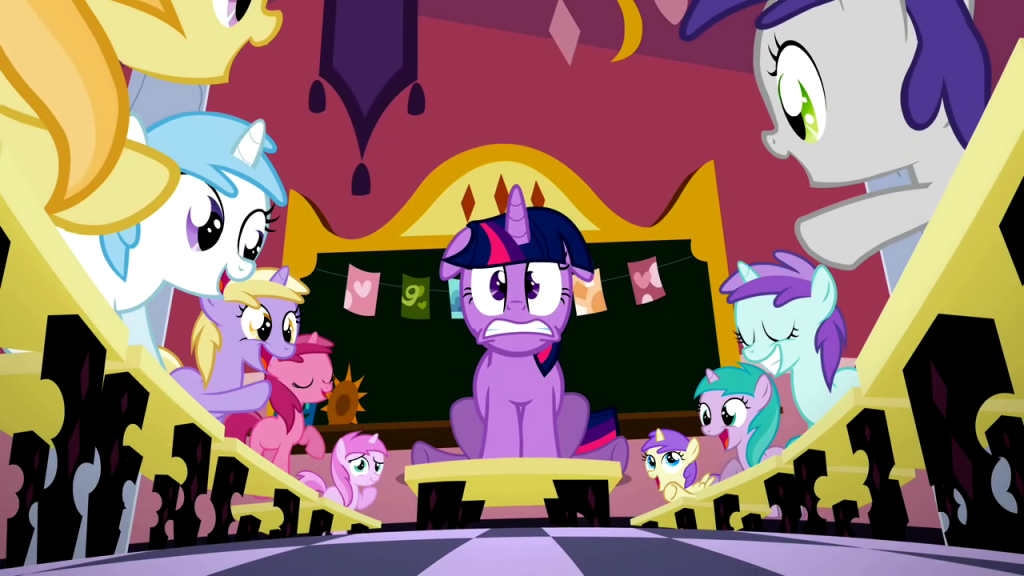
“Lesson Zero” tells a similar story, as Twilight, who adds tasks to checklists like “triple check the checklist to make sure we didn’t miss anything when we double-checked the checklist,” realizes that she has failed to learn her weekly lesson of friendship. Frantic to report back to Celestia in time, she eventually creates a problem for herself to fix. She quickly loses control of the situation, and Celestia arrives in all her deus ex machina glory to set things right. The lesson for this episode is a two-for-one: Twilight needs to learn not to sweat the small stuff, and her friends have to understand that what they see as small stuff is actually of major concern to Twilight. Her worst fear is failure, and the high expectations she has for herself mean that failure of any kind can be crushing.

What I find interesting about Twilight Sparkle is that the only person who can successfully defeat her is herself. A lunar goddess wants to shroud the world in eternal night? No problem. The living incarnation of chaos terrorizes Equestria and distorts her friends almost beyond recognition? She can handle that. An ancient evil that imprisoned an empire for centuries seeks to spread hatred and fear across the land? Let’s do this thing. But the moment she’s faced with the prospect of a missed assignment, she becomes the only villain she can’t vanquish.

It is only when Twilight learns to accept failure that we begin to see where her character arc is going. Celestia gives her the task of saving the Crystal Empire, with the condition that she must do it on her own. With time running out, a trapped Twilight entrusts Spike with the task, knowing that, by doing so, she will fail the test. Luckily, the lesson of the week turns out to be self-sacrifice for the greater good, so she actually passes by failing. In this episode, we get our first indication that there is more behind Twilight’s journey than the education of a single unicorn; here, we get the first whisperings of destiny.

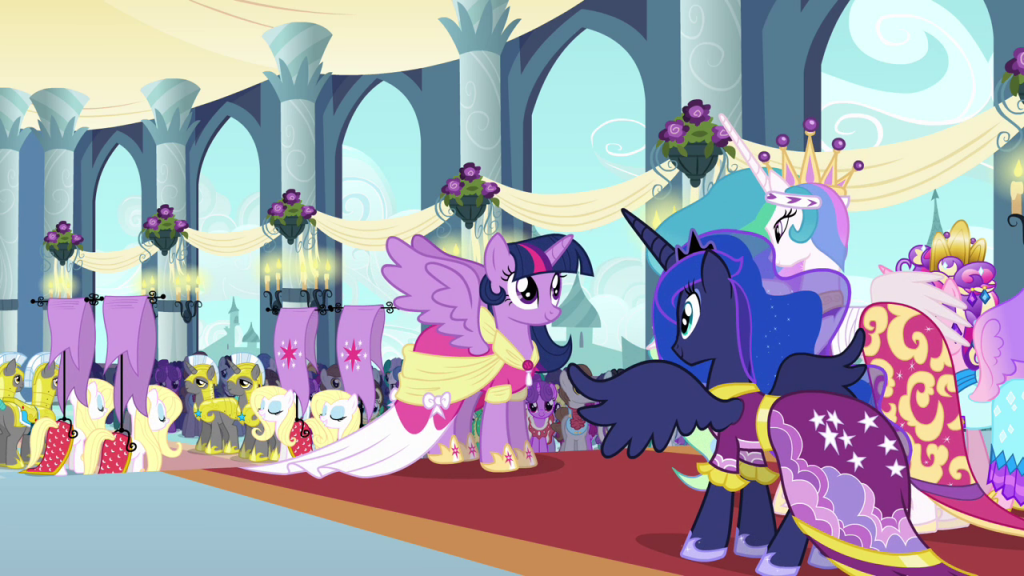
In the final episode of the third season, this destiny is fulfilled. The journey that began with a teacher’s insistence that her student should go outside and smell the roses becomes the story of Twilight Sparkle’s apotheosis. In using the power of friendship to finish a spell that eluded the great Starswirl the Bearded, Twilight proves herself worthy of becoming an Alicorn, a creature that combines the traits of unicorns, pegasi, and earth ponies. She also, notably, gains the title of “princess”.

We’ve talked a lot about princesses on this blog, and I have to say that I prefer the My Little Pony conceptualization of princesses to most other versions. Disney princesses are usually pretty excellent people, but they don’t become royalty because of their positive qualities. Instead, they gain their crowns either through birth or marriage, though I suppose an argument could be made that Mulan earned her “Disney princess” title through sheer badassery. By contrast, My Little Pony makes its princesses earn their crowns. Celestia explicitly states that Twilight has demonstrated the charity, compassion, devotion, integrity, optimism, and leadership of a true princess. Her immense magical ability, in combination with the power of the friendships she’s formed, allows her to create new magic, and this seems to be a prerequisite for achieving princess status. Even after securing the title, Twilight must live up to it. The citizens of Equestria are now Twilight’s students, and she will serve as an inspiration to them, and to all of the geeky, introverted, anxiety-ridden perfectionists in the audience.

Verdict: Actual strong female character