|
| All screencaps: Piandao.org |
(Note: Azula is a famously contentious character. What follows is merely one of a myriad of possible interpretations of her arc. Also, it is long. Very long. Like, hundred-year-long war long.)
One year ago, we kicked off this blog with an analysis of the first three Disney Princesses. These royal ladies sang their days away while doing their chores and dreaming of the princes who would one day save them. They were polite, kind, and compassionate, and every person and animal they met immediately loved them. In fact, anyone who didn’t fall head over heels for these women could be summarily dismissed as a villain, and the narrative deemed their deaths not only justified, but necessary. They were practically perfect in every way, and the person we’ll be talking about this week could not be any less like them if she were actually a 400 foot tall purple platypus bear with pink horns and silver wings.
Princess Azula of the Fire Nation is not like any princess that has come before. She’s not the headstrong tomboy who yearns to escape a life of rules in order to seek adventure in the great wide somewhere. She’s certainly not the paragon of war-time femininity who gets everything she’s ever wanted simply by wishing for it and adhering to societal expectations. She is a lethal force of nature, a brilliant military mind, a first-class firebender, a broken child, and one of the most compelling villains I’ve ever seen.
Origins
It seems only right that we begin with the root of all of Azula’s evil: her childhood. One of the strengths of Avatar: The Last Airbender is its ability to establish history, both cultural and personal. The characters are products of their environment and their past experiences, and we see firsthand through vibrant world-building and a number of flashbacks how both of these things affect them. In Azula’s case, many of her character traits can be traced back to her home life as we see it in “Zuko Alone.”
One of the focuses of this episode is the increasingly antagonistic relationship between Azula and Zuko. They function as foils for Sokka and Katara; they are the same age and, in both sibling dynamics, the younger sister has a dominant role. Katara’s role is maternal; while she and Sokka engage in their fair share of squabbles, he considers her his rock. He derives strength from her strength, and he offers his support when she needs it, regardless of whether or not he agrees with her. They depend on each other.
By contrast, Azula and Zuko spend most of their formative years in competition with each other. From an early age, Azula was able to manipulate the people around her, and she is particularly skilled at getting to Zuko. She exploits his close bond with their mother in order to humiliate him, and she infantilizes him by referring to him by the nickname “Zuzu.” When she tells him that he’s wasting his time failing to hone his mediocre knife fighting skills, he responds, “Put an apple on your head and we’ll find out how good I am!” Their rivalry is fierce and, as we see in this flashback, becoming increasingly violent. The mutual support that Sokka and Katara offer each other is contrasted with Azula and Zuko’s constant need to one-up each other.
A prodigy dedicated to perfection, Azula wins most of their battles. However, Zuko is the clear victor in the struggle for their mother’s affection, even if Azula pretends she doesn’t want it. Ursa regularly expresses her love for Zuko, supporting him even in his failures. Ultimately, she demonstrates the extent of this love by killing the Fire Lord and accepting banishment in order to save Zuko’s life. To her son, she is the ideal mother, sacrificing herself to protect him. Her treatment of Azula is markedly different. This is at least partially because Azula is the kind of kid who ponders aloud the number of people her father would have to kill to succeed his own father as Fire Lord. Ursa reacts to these comments by asking what is wrong with her. While Zuko is “darling,” Azula is “that child.”
To one person, however, she is “my dear,” and therein lies the problem. Her father, Ozai, raised Azula to be his heir, and he uses her to gain the approval of his father, Azulon. He has her demonstrate both her extensive knowledge of military campaigns and her advanced firebending ability, calling her “a true prodigy.” The problem is that Ozai is a sincerely terrible person. He is willing to have Zuko killed to appease his father, and he jumps at the opportunity to become Fire Lord when Ursa kills Azulon. In addition to this, he uses Azula to gain favour for himself, nurturing both her natural talents and her tendency toward cruelty to make her into his perfect heir. Even her name marks her as Ozai’s weapon in the fight for his father’s favour. While Zuko has the more obvious abuse narrative, Azula is just as thoroughly messed up by Ozai, if not more so.

Zuko also has the benefit of Iroh’s love. During the flashbacks, Iroh is laying siege to Ba Sing Se, and he sends gifts for his niece and nephew from the Earth Kingdom. To Zuko, he gives a pearl dagger from a general who surrendered to the invading Fire Nation forces; it is inscribed with the words, “Never give up without a fight.” It’s a perfect gift, tailored to Zuko’s personality in a way that demonstrates Iroh’s profound understanding of him. The gift that Iroh sends for Azula is “a new friend:” a doll who “wears the latest fashion for Earth Kingdom girls.” Azula burns it. Based on everything we know about Azula, even by this point in the series, Iroh could not have picked a less suitable gift if he’d tried. He gives Zuko a present that speaks to him as an individual; he gives Azula a present that acknowledges that she’s a girl. And all girls like dolls, right?
While Ursa is an ideal maternal figure, Iroh is basically the moral centre of the show. He spends years helping Zuko become a decent person, supporting his nephew through a difficult, painful identity crisis. Yet he spends no time at all trying to understand Azula. Zuko enjoys the support of two people who allow him to fail and love him regardless of his abilities. Azula gets validation from a power-hungry monster while these same two people appear to put very little effort into understanding her. They want her to conform to certain societal standards of femininity and decency, but Ozai encourages her to embrace her difference.
This is not to say that the show ever “woobifies” Azula. She is a callous person who revels in the power she exercises over others. She sees most people as a means to an end, and she has no problem using them as she sees fit. Even as a child, she lies as easily as breathing, gleefully ponders her uncle’s death, and endangers her friends for her own amusement. She is thoroughly awful, and that’s what makes her so great. Rise
As Zuko explains before we know anything else about Azula, his father used to say that she was “born lucky,” while Zuko was “lucky to be born.” While I agree with what Zuko goes on to say -- that he has fought for everything he has, and that his struggle has made him strong -- I would argue that Azula is more than simply “lucky.” True, she does have immense privilege and natural ability, but there is significant evidence of her hard work. No one becomes that good at bending without working at it, and even a genius has to pay attention during her studies to pick up that much information about the military campaigns of a nation that thrives on war. She plays an active role in the making of her own terrifying self.
The first time we properly meet Azula, she is on a mission to bring Zuko and Iroh back to the Fire Nation. The captain of the ship on which she is travelling tells her that the tides won’t allow for them to bring the ship in. She responds by asking if the tides command the ship. When the captain answers in the negative, she asks, “If I were to have you thrown overboard, would the tides think twice about smashing you against the rocky shore? … Maybe you should worry less about the tides, who’ve already made up their mind about killing you, and worry more about me, who’s still mulling it over.” From the start, she is someone not to be messed with.
This becomes even clearer when, in her next scene, she performs the incredibly difficult task of bending lightning. Her advisors, Lo and Li, observe that her effort was “almost perfect,” to which Azula responds, “Almost isn’t good enough.” Then she continues to practice. Rather than making her lazy, being lucky and gifted has driven her to strive for perfection. If she’s not the best, she’s not good enough; failure is simultaneously a looming threat and an alien concept.

One of the more compelling aspects of Avatar: The Last Airbender is the fact that, while the Avatar himself is a boy, the best benders of the other three elements are girls. Katara masters waterbending in a matter of months, Toph incorporates earthbending into the way she experiences the world, and Azula’s blue flame burns hotter than that of any other firebender in the series. In addition to their mastery of their respective elements, every one of these girls is a master of a special, advanced form: blood, metal, and lightning bending, respectively. Aang’s divine powers make him almost omnipotent, but even he might have a hard time beating any of these three in a one-on-one situation.
As the second season progresses, Azula shifts her focus from Zuko and Iroh to a much bigger prize: the Avatar. This is the prize that Zuko failed to bring home, and either killing or capturing the Avatar would prove her superiority. So would a mid-season fight that pits Azula against Zuko and Aang at the same time, and culminates in a showdown between herself and Team Avatar plus Zuko and Iroh. Against a group that includes four master benders, Azula still manages to come out on top, exploiting a moment of distraction to cover her escape.
Because completing one nearly impossible task is not enough to keep Azula busy, she decides to add the conquest of an unconquerable city to her agenda. After tussling with the Kyoshi Warriors while tracking Appa, Azula, Mai, and Ty Lee use their uniforms to enter the city of Ba Sing Se. There they are welcomed as allies ready to help the city in its hour of need, as a massive cover-up has just been exposed. The Dai Li, an organization of elite earthbenders established by Avatar Kyoshi to protect the Earth Kingdom’s culture, has become corrupt; they brainwash citizens and keep the entire population -- including the Earth King -- ignorant of the war that is being fought outside their gates. They operate under the command of the king’s advisor and puppetmaster, Long Feng.
Azula correctly deduces that anyone who controls the Dai Li controls Ba Sing Se and, with it, the entire Earth Kingdom, and she begins to craft a plan to seize control for herself. To do this, she uses her opponent’s expectations against him. She has Mai and Ty Lee discuss their true identities out in the open to make Long Feng think he has the upper hand. He confronts Azula with this information, and she pretends to be caught out. She makes him a deal: she will win him the Earth King’s trust, and he will get her the Avatar. Once she has access to the Dai Li, she begins to work to change their allegiance. As one Dai Li agent states in his report to Long Feng, she’s “more than cooperating. She’s really taken charge. She’s terrifying and inspirational at the same time. It’s… hard to explain.” Even with this indication of Azula’s plan, Long Feng thinks that he will easily get the better of her.

When it comes time to show their cards, however, Azula has the winning hand. Long Feng double-crosses her, but finds his betrayal lacking follow-through when the Dai Li fail to follow his order to arrest the Fire Nation princess. Azula informs him that they’re waiting to see who will win before they pick sides. She’s confident that they will choose to side with her; he has clawed his way to the top, but she was born with the divine right to rule. It’s an argument based on pure hubris, but the monumental force of Azula’s self-confidence sells it. She knows that Long Feng will bow down to her, and he does. He concedes defeat, telling her that she’s “beaten [him] at [his] own game.” Her reply: “Don’t flatter yourself. You were never even a player.”
One of the things that sets Azula apart from other women villains is her presentation. Whereas other evil ladies use their feminine wiles to seduce men into doing their dirty work for them, Azula uses her cunning, the force of her personality, and her own firepower. This is reflected in her visual depiction. Many, many shots of Azula have the camera focusing on her face. We see the minute changes in her expression, and they allow us to see her mind working. It’s likely not a coincidence that Ozai is often portrayed in the same way, as when he gives a slight smile of approval at Azula’s firebending display in the flashbacks. Whereas the vast majority of women villains in mainstream media use their sexual appeal as their principal weapon, with the camera obsessing over their objectified bodies, Azula is often all eyes and face. She almost confronts the viewer, and she fills the screen with her presence.
In the midst of enacting the coup, Azula also takes some time out of her busy schedule to kill the Avatar and bring her brother back into the fold. The latter she does through the judicious application of keywords; Zuko’s obsession with regaining his honour leaves him open to suggestion. In her showdown with Long Feng, Azula had to make him believe in her strength, but in her conversion of Zuko, she has to exploit his weaknesses. She offers him redemption, honour, and their Father’s love, and she tops all this off with the suggestion that she needs his help to bring her plan to fruition. Again, she uses the power of words to get what she wants.

Although the Avatar doesn’t stay dead, killing him while he is in the Avatar State is an impressive achievement. While everyone looks on in awe, Azula sees an opportunity to bring Aang down, and she takes it. Had Katara not healed him, Aang’s death would have ensured an end to the Avatar cycle of regeneration, leaving the Fire Nation’s conquest of the world largely unhindered.
At the end of the second season, Azula is essentially unstoppable. She has accomplished the task she originally set out to complete by imprisoning Iroh and bringing Zuko home. She has conquered, with two other girls, some costumes, an iron will, and no loss of life, a city that her nation’s armies spent a century just trying to enter. Finally, she has every reason to believe that she has eliminated the only threat to her father’s plan to take over the world. And she has done all of this at the age of fourteen.
Fall
In “The Boiling Rock,” Azula proclaims herself a “people person.” The events of that episode, and of most of the rest of the third season, thoroughly disabuse her of that notion.
As with Mai and Ty Lee, “The Beach” is a pivotal part of Azula’s characterization. In fact, Lo and Li’s assurances that Ember Island “gives everyone a clean slate,” “has a special way of smoothing even the most ragged edges,” and “reveals the true you” seem to be meant for Azula in particular. In their initial foray out onto the island, Azula has only been physically stripped down, trading her armour for beach clothing. During this scene, she acts as she always has, destroying children’s sand castles and ordering her friends around. What’s changed is the setting; on a beach in a bikini top, Azula is not the conqueror of Ba Sing Se. Instead, she’s a teenager who enjoys ruining vacationers’ days.

This becomes abundantly clear when she gathers her friends to play a game of kuai ball, which is basically volleyball where kicking the ball is allowed. Azula encourages her teammates to exploit one of their opponents’ injuries, and the game ends in a decisive victory for Team Fire Nation Royalty. Azula, basking in the glory of winning a game against a few random teenagers, proclaims, “We defeated you for all time! You will never rise from the ashes of your shame and humiliation!” In that moment, it becomes obvious that she has no idea how to interact with her peers like a normal person.
When a boy, Chan, invites them to a party at his house, Azula realizes that he doesn’t know who they are. She decides not to enlighten him, instead assuring him that they will try to act normal among all the important Fire Nation youths. She later explains that she wanted to know what it would be like to see how they would be treated if people didn’t know who they were. It’s interesting that Azula is the one behind this plan; while the other three act somewhat differently, Azula seems to consider the party an opportunity to see who else she could be.
It turns out that the “true” Azula is basically a socially awkward dork. She takes the saying “partying from dusk ‘til dawn” literally. She compliments Chan’s “sharp” outfit by saying that he “could puncture the hull of an Empire Class Fire Nation battleship, leaving thousands to drown at sea… because it’s so sharp.” Watching her is a bit like watching a robot learn to be human; it can try all it wants, but it’s just not programmed that way.

Enter Ty Lee. All of Azula’s relationships are dysfunctional, and her friendship with Ty Lee is no exception. Still, even with a history of using fear to control her best friends, Azula does seem genuinely to like Ty Lee on some level. The best evidence for this claim occurs in this exchange. When Ty Lee begins to cry after Azula calls her a tease, Azula immediately seeks to comfort her and gives her the sole apology she delivers all series. More importantly, Azula reveals one of her own weaknesses to Ty Lee; as an exploiter of weakness, Azula must know that she is giving Ty Lee ammunition that can be used against her. Still, she admits that she has no luck with boys, and Ty Lee tells her basically to act vapid and laugh at everything the boy says. This works frighteningly well until Azula reveals her actual true self, complete with plans for world domination with Chan at her side. It becomes clear that her upbringing as a megalomaniacal overlord has somewhat impeded the development of her social skills. The fantasy of being a normal girl, even temporarily, is dashed.
“The Beach” brings us another revelation about Azula’s self-perception. Having dismissed her friends’ confrontation of their respective traumas as “wonderful performances,” Azula allows herself a brief moment of seemingly authentic introspection. She claims that she doesn’t care that Ursa liked Zuko more than her, but she follows this up with the observation that “[her] own mother thought [she] was a monster… She was right, of course, but it still hurt.” Although Azula plays this revelation off, the fact that she later hallucinates her mother suggests that she is more profoundly affected than she would have her friends believe. It also makes one wonder whether realizing that her mother saw her as a monster helped Azula to become one.
“The Boiling Rock” marks the beginning of the end for Azula. After Mai saves Zuko and the group of escapees, Azula reveals her surprise at Mai’s betrayal. Mai explains her choice: “I guess you just don’t know people as well as you think you do. You miscalculated. I love Zuko more than I fear you.” Azula responds, “No, you miscalculated! You should have feared me more!” After Ty Lee paralyzes her, she orders them to be put somewhere where she’ll “never have to see their faces again.” The rage she displays during this exchange is the most emotion we’ve seen from her up to this point. Her friends’ betrayal shakes her to her very core.
Even if you support the idea that Azula only thought of Mai and Ty Lee as pawns (or perhaps bishops) in her long game, there are still several reasons for the profound effect their betrayal has on her. First, there is the fact that Mai frames it as a miscalculation, which means that it is Azula’s mistake. For a person whose worth has always hinged on being perfect, such a massive oversight would be catastrophic. Even worse, at the end of the second season, Azula used a similar betrayal to gain control of the Dai Li. She observed that “it’s terrible when you can’t trust the people who are closest to you.” Even then, Mai and Ty Lee shared a look behind her back. It is this egregious error that leads to Azula’s obsessive need to snuff out disloyalty in “Sozin’s Comet.”

Azula’s fall largely takes place over the show’s four-part finale. In a flashback, we learn that she put forth the suggestion to burn the Earth Kingdom to the ground. When it comes time to follow through with this plan, she is certain that she will be working alongside her father. However, at the last moment, he tells her that he will be leading the fleet while she remains home. She is understandably angry, and she exclaims that Ozai can’t treat her like this; “You can’t treat me like Zuko!” Ozai offers her the title of Fire Lord as compensation. A moment later, he declares himself the Phoenix King, the supreme ruler of the world, leaving Azula with an empty title.
This is the second major betrayal that leads to Azula’s fall. At the moment when she is to receive her well-earned reward, Ozai not only refuses payment, but acts as if she never deserved it in the first place. He has no intention of sharing the glory, despite the fact that she did all the work to get it. Azula, who has always been confident that her father values her, suddenly learns that his love was a lie. The fact that she compares her treatment with Zuko’s speaks volumes; she sees herself becoming a failure in her father’s eyes, and she resists his dismissal. Still, it may be the last indignity that stings most. Azula receives her reward as heir apparent, but that coveted title has been rendered meaningless. Even more humiliating is the display that follows: banners emblazoned with the Phoenix King insignia pop up around the arena as Ozai claims his new title. This was all planned in advance, likely at the meeting that took place when she and Zuko were sent away to Ember Island. At the same time as she was trying to overcome Ozai’s influence to interact with her peers in a healthy fashion, he was arranging for her downfall in the area where she excelled. Another miscalculation is added to the tally.
Having been betrayed by three of her closest allies, Azula sets to work banishing all potential traitors. Unfortunately, in her paranoid state, she finds a reason to suspect almost everyone in her employ of treachery. She sends all of her bodyguards away, even as she falls further into the grip of a nervous breakdown or a psychotic break. When no more external threats remain, she turns on herself.
Although, at this point, her defeat is still to come, I consider this scene the end of Azula. Left alone in her room, she attempts to put her hair up into her customary top-knot. When she fails, she tells her hair that it’s time to “face your doom” and cuts off the two locks that frame her face.
Hair and identity are intimately linked in the world of Avatar: The Last Airbender. When he seeks to hide the fact that he is the Avatar in the third season, the usually bald Aang grows out his hair. Zuko and Iroh cut their hair at the beginning of the second season to mark their severance from the Fire Nation and to allow for them to disguise themselves. In this case, both men try -- and almost succeed -- to make new lives for themselves in their fabricated identities. When Azula, Mai, and Ty Lee present themselves to the Earth King as Kyoshi Warriors, we know who they actually are from their distinctive hairstyles.
Azula’s hair functions on a fairly obvious semiotic level in these final episodes. After Ozai’s betrayal, we can see Azula’s breakdown in the replacement of her usually perfect top-knot with loose, unstyled hair. When Azula cuts those two locks, she removes her most recognizable physical feature. In the world of cartoons, where most characters wear the same outfit for the show’s entire run, such a dramatic visual change is a big deal, and in this case it seems to represent a loss of identity. Everything that Azula thought she was has been compromised. In addition to this, the framing of the cut as an attack makes it the G-rated version of a violent act of self-mutilation. This echoes the way in which her paranoia causes Azula essentially to defeat herself.
The hair-cutting is significant for another reason, as it marks Azula’s break from reality. Looking in the mirror during this moment of splitting the self, Azula sees a hallucination of her mother. Ursa tells Azula that she didn’t want to miss her coronation, but Azula can’t accept her pride: “I know what you really think of me. You think I’m a monster.” Their conversation turns to Azula’s tendency to use fear to control people, and Azula argues that she had no other choice: “Trust is for fools. Fear is the only reliable way. Even you fear me.” Ursa denies this, telling Azula that she loves her, but Azula responds by throwing a hairbrush into the mirror and shattering it.

This exchange, like many a mirror-focused scene before it, is fraught with symbolism. As Azula seeks to destroy herself, her mind creates an image of her mother, like a subconscious attempt to protect the self. This Ursa doesn’t see her daughter as a monster; instead, she views her as a misguided child. She offers the love that Azula claimed not to need, and it is this that Azula rejects. This may be because Azula doesn’t believe that Ursa loved her, or because she realizes that this is just a figment of her imagination offering her empty promises, just as her father did. It may be because Azula has been operating in the realm of fear for so long that she wouldn’t know how to accept this love, even if it were real. On another level, this mirror-mother appears to be a representation of Azula’s sense of self-preservation and, in destroying her, Azula signals her inability to value herself now that she has failed in her own eyes.
After this, Azula’s defeat is just a matter of course. The last member of her family turns against her, claiming her title. The most powerful waterbender in the world pulls off an ingenious maneuver and shackles her to a grate. The proud, perfect Fire Nation princess is reduced to a sobbing mess, breathing fire in a tragic display of madness. This is the last we see of her.
Azula’s arc is powerful and tragic and brilliant, but that doesn’t mean it’s free of dubious implications. It perpetuates the correlation between evil and mental illness that pervades Western media. Iroh, the moral centre, tells Zuko that “she’s crazy and she needs to go down,” which suggests that it is Azula’s mental illness -- arguably not even present before her breakdown -- that needs to be punished.
In addition, while a perceptive viewer will trace Azula’s breakdown to the betrayal of the people she trusted most, the show also ties her downfall to her rise to power. Her obsessive behaviour focuses on assassination attempts. When Lo and Li express their concern for her wellbeing, Azula says, “My father asked you to come here and talk to me, didn’t he? He thinks I can’t handle the responsibility of being Fire Lord, but I will be the greatest leader in Fire Nation history.” One could easily read Azula’s storyline in these final episodes as a cautionary tale about what happens when women gain political power, as Azula crumbling under the pressure of her title before she has even officially assumed it. It’s difficult to ignore the fact that Azula would have been the only female ruler of a country; the Earth Kingdom has King Kuei, the Water Tribes have Chiefs Hakoda and Arnook, and the Fire Nation has a long line of male Fire Lords, including Zuko. While they have their own problems, only she is shown to have broken down. In a series full of powerful women, it’s disheartening to see that none of them can bend their way through that particular glass ceiling.

Finally, there is the matter of Azula’s future. While other characters’ final scenes show them reunited with their families and friends or paired off with their love interests, the last we see of Azula is a shackled, broken kid. The last we see of Ozai is a shackled, broken man. The difference is that Ozai is given the chance for redemption. When Zuko visits him in his cell, he tells his father that his banishment put him on the right path, and he suggests that Ozai’s time in prison might do the same for him. A similar assurance spoken to Azula is noticeably absent.
One of the major themes of the series is redemption. Aang makes up for abandoning the world in its time of need by saving it a hundred years later. Zuko undergoes a long and painful journey of character development that ends with him joining the people he once hunted and helping them to win the war. Offering redemption to Ozai is, in principle, what the show’s about. However, by denying Azula the same option, it sets a troubling double standard. The man is afforded the possibility of redemption while the girl is denied it but, more importantly, the abuser is offered the opportunity to make good while his victim is left to cope with the consequences of his abuse.
What makes this even worse is that it is Azula, not Ozai, whose position at the end of the series mirrors Zuko’s at the beginning. She has had the ground swept out from under her feet by their father, and she too bears the scars of his betrayal, if less visibly than Zuko does. As Zuko’s sister, Azula is the descendent of both Good and Evil, as the show embodies in Avatar Roku and Fire Lord Sozin. If Zuko can learn to embrace the good parts of himself, why can’t Azula at least have the chance to try? Finally, the third season makes Azula a significantly more sympathetic character than Ozai, suggesting that the audience would care more about her potential for redemption. If anyone deserves to be a phoenix, it’s the girl who burned the brightest.
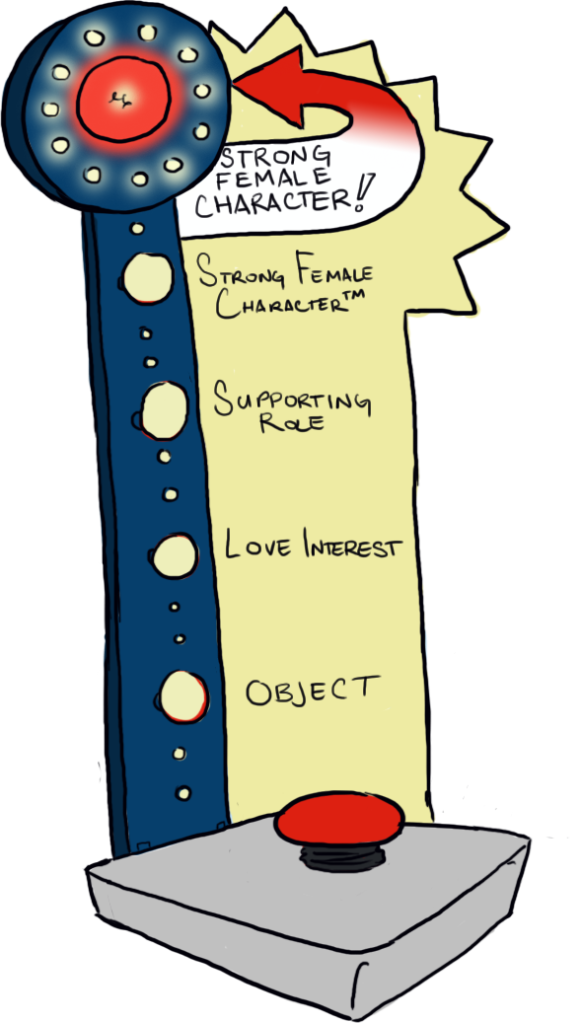
Verdict: Actual strong female character